
Welcome to the A1 Motorcycle Theory lesson on Throttle Management and Power Delivery. This crucial topic within the 'Vehicle Controls and Riding Techniques' unit will teach you how precise throttle control impacts your motorcycle's stability and grip. Mastering this skill is vital for navigating Dutch roads safely and successfully passing your CBR theory exam.

Mastering throttle control is a fundamental skill for any motorcycle rider, especially those preparing for the Dutch A1 Motorcycle Theory exam. This skill directly influences the motorcycle's stability, traction, and overall safety. Effective throttle management allows a rider to smoothly adjust speed, maintain balance, and navigate challenging road conditions, ensuring a predictable and controlled ride.
For Dutch A1 riders, understanding throttle management is crucial not only for passing the CBR licence exam but also for safe and responsible participation in traffic. Motorcycles up to 125 cc and 11 kW, while smaller, still require precise control to manage power delivery, especially given the varied road conditions in the Netherlands. Correct throttle usage prevents abrupt weight shifts, reduces the risk of skidding, and enhances the rider's ability to react safely to unforeseen circumstances, aligning with Dutch traffic regulations (RVV 1990) that mandate smooth and controlled vehicle operation.
Throttle management refers to the rider’s continuous and subtle manipulation of the throttle grip to modulate the engine’s power output. This control directly impacts the engine’s torque, which is then delivered to the rear wheel. The goal is to achieve a balance between the desired speed, available traction, and the motorcycle's stability, ensuring the propulsive force never exceeds the tyre's grip limit. This continuous adjustment is key to maintaining control in all riding situations, from gentle cruising to demanding cornering.
Understanding the underlying principles of throttle control is essential for safe and efficient motorcycle riding. These principles govern how the motorcycle responds to rider input and interacts with the road surface.
Smooth roll-on is the gradual increase of throttle opening, progressively increasing engine torque without abrupt changes. This technique is vital for stable acceleration, particularly when exiting a corner or accelerating from a stop. It prevents sudden weight transfer to the rear, which could reduce front tyre grip or cause an unwanted wheelie, compromising stability.
Conversely, smooth roll-off involves a gradual reduction of throttle opening. This controlled decrease in torque allows for progressive deceleration, preventing abrupt engine braking that could lead to rear-wheel slip or destabilise the motorcycle, especially when entering a corner or on slippery surfaces. Both techniques are crucial for maintaining continuous control and predictable handling.
The throttle-torque relationship describes the direct, proportional link between the throttle valve's position and the engine torque produced. When you twist the throttle, you open a valve that allows more air and fuel into the engine, resulting in greater combustion and thus more torque. This torque is then transmitted through the drivetrain (gears and chain/shaft) to the rear wheel, generating power delivery or propulsive force. A predictable relationship allows the rider to anticipate the motorcycle's response to their inputs, making speed and acceleration control intuitive.
Traction management is the critical practice of ensuring that the torque delivered to the rear wheel never exceeds the available frictional grip between the tyre and the road surface. This "traction limit" is represented by the traction circle, which illustrates the maximum combination of longitudinal (acceleration/braking) and lateral (cornering) forces a tyre can withstand before slipping. Factors like road surface, tyre condition, and lean angle significantly reduce this available traction. Riders must constantly adjust throttle input to stay within this limit, especially on wet or uneven surfaces, to prevent rear-wheel spin.
Engine response lag refers to the slight, but critical, time delay between when the rider actuates the throttle and when the full, corresponding increase in torque is delivered to the rear wheel. This lag is due to mechanical factors such as drivetrain inertia and combustion dynamics. Riders must account for this delay by anticipating their torque needs slightly ahead of time, particularly when preparing for an overtake or powering out of a corner. Failing to do so can lead to either an over- or under-acceleration, potentially compromising safety.
Closed-throttle deceleration, often referred to as engine braking, is the process of reducing speed by completely closing the throttle while the motorcycle remains in gear. In this state, the engine’s internal friction and compression resistance act as a braking force, slowing the rear wheel. This technique provides a controlled and stable reduction in speed, particularly useful when entering corners or descending hills, as it minimises the need for aggressive use of the wheel brakes and helps maintain tyre grip. On very low-traction surfaces, engine braking should be combined with light rear-brake application to prevent rear-wheel lock-up.
The lean angle of the motorcycle, the angle at which it tilts into a turn, significantly impacts the available traction for power delivery. As a motorcycle leans into a corner, more of the tyre’s available grip is used to generate lateral forces (for turning). This reduces the portion of the traction circle available for longitudinal forces (acceleration or braking). Therefore, the more a motorcycle is leaned, the less torque can be safely applied to the rear wheel without exceeding the tyre's grip and causing a slide. Riders must adjust their throttle input proportionally to their lean angle, decreasing power delivery as lean angle increases and gradually increasing it as the bike straightens up.
Building on the core principles, several key concepts further refine a rider's ability to manage power safely and effectively.
Precise throttle control is the cornerstone of motorcycle stability. By making small, incremental adjustments to the throttle, riders can avoid abrupt weight transfers that destabilise the motorcycle. For instance, a sudden throttle opening can lift the front wheel, while an abrupt closure can cause excessive engine braking and rear-wheel hop. Maintaining smooth, consistent throttle input helps keep the motorcycle balanced and predictable, reducing the rider’s cognitive load and allowing for better focus on road conditions and other traffic.
Optimising power delivery means ensuring the engine's torque is transmitted efficiently and appropriately to the rear wheel for the current riding conditions. This involves selecting the correct gear to keep the engine within its optimal RPM range, where peak power delivery or linear power delivery occurs. For smaller A1 motorcycles, smooth and consistent power output across the RPM range is often more important than peak power bursts. Misjudging power delivery can lead to either sluggish acceleration or an uncontrollable surge, both of which can be dangerous.
Advanced traction management involves dynamic adjustments based on real-time observations of the road surface, tyre grip, and motorcycle dynamics. This includes distinguishing between static traction (when the tyre is not slipping) and dynamic traction (the reduced grip during controlled slip). Riders learn to sense the limits of their tyres and adjust throttle accordingly, especially during complex maneuvers like cornering on varied surfaces or accelerating over painted road markings. This often requires subtle throttle corrections that are barely perceptible but critical for maintaining control.
Anticipating engine lag is a critical skill for smooth and safe riding. Because power delivery is not instantaneous, riders must learn to initiate throttle inputs slightly before the desired effect is needed. For example, when preparing to accelerate out of a corner, a rider might begin to gently roll on the throttle just before reaching the apex, allowing the engine lag to resolve by the time they need full power for a smooth exit. This anticipatory approach prevents either sudden lurches or a lack of power when it's most needed.
Engine braking offers a powerful, yet often underutilised, method for controlled deceleration. When combined with appropriate gear selection, engine braking can reduce speed smoothly without over-relying on the friction brakes. This technique is particularly valuable in long descents, preventing brake fade, or when setting up for a corner, where it helps stabilise the motorcycle by keeping load on the front wheel while reducing speed. However, on extremely slippery surfaces like ice, sole reliance on engine braking can cause the rear wheel to lock up, necessitating a combination with light, modulated rear-brake input.
When a motorcycle is leaning into a turn, the amount of available tyre grip for acceleration or braking is significantly reduced. Therefore, throttle input must be carefully modulated to avoid exceeding the tyre's traction limits. As the lean angle increases, the throttle should be rolled off or held steady at a minimal maintenance throttle. As the bike begins to straighten out of the corner, the rider can progressively roll on the throttle, gradually increasing power as more of the traction circle becomes available for longitudinal forces. This careful modulation prevents rear-wheel slip and maintains the motorcycle's stability throughout the turn.
Dutch traffic legislation, particularly the Reglement Verkeersregels en Verkeerstekens (RVV 1990), places clear obligations on drivers, including motorcyclists, regarding vehicle operation. These rules indirectly but fundamentally govern how throttle must be managed to ensure safety and prevent hazards.
Article 4 of the RVV 1990 is a cornerstone of safe riding in the Netherlands. It mandates that all road users, including motorcyclists, operate their vehicles smoothly and predictably. This directly applies to throttle management, prohibiting sudden throttle inputs that could cause the motorcycle to lurch, unexpectedly change speed, or lose traction. Such abrupt actions can surprise other road users, especially cyclists and pedestrians, and increase the risk of accidents. Maintaining a smooth throttle flow is not just good practice; it is a legal requirement designed to enhance road safety.
On wet or loose surfaces, the legal obligation for smooth operation becomes even more critical. Abrupt throttle actions are far more likely to cause loss of grip in these conditions.
Article 5 of the RVV 1990 stipulates that drivers must never exceed the maximum posted speed limit. Throttle management is the primary means by which a motorcyclist controls their speed. This means continuously adjusting throttle input to ensure the motorcycle remains within legal speed limits, adapting to changes in road conditions, traffic density, and visibility. Applying excessive throttle to breach speed limits, even for a short duration, is a direct violation and increases the risk of serious accidents due to reduced reaction time and increased stopping distances.
Article 7 specifically addresses safe cornering, requiring riders to adapt their speed and throttle usage to the specific characteristics of a curve. This means reducing throttle and speed before entering a bend, maintaining a steady, minimal throttle through the apex, and then smoothly rolling on the throttle as the motorcycle exits the curve and straightens up. Failure to adapt throttle input to the curve's radius, road surface conditions (e.g., wet leaves, gravel), or visibility can lead to loss of traction and control. This rule directly ties into the principles of lean angle influence on power delivery and traction management.
While engine braking is a valuable tool for deceleration, its use is implicitly regulated under the general duty of care outlined in Article 4 of the RVV 1990. Engine braking is permissible and often encouraged, provided it does not cause loss of control or endanger other road users. This implies that sudden, harsh engine braking that could destabilise the motorcycle or surprise following traffic, particularly on low-traction surfaces, would be considered irresponsible and potentially illegal under the broader "dangerous operation" clause. Riders must ensure that any deceleration, whether using engine braking or friction brakes, is smooth and controlled.
Understanding common errors in throttle management is as important as learning the correct techniques. These mistakes can lead to dangerous situations and legal repercussions.
One of the most perilous mistakes is applying sudden or excessive throttle while cornering, especially on wet or low-traction surfaces. This snap-open throttle can instantly exceed the tyre's reduced traction limit, causing the rear wheel to lose grip and slide out. The consequence is often a low-side crash, which can result in serious injury or even fatality. On dry surfaces, excessive throttle in a corner can still destabilise the bike or cause a high-side if the tyre regains traction abruptly.
Maintaining a high throttle in stop-and-go traffic leads to jerky acceleration and deceleration, making it difficult to maintain a safe following distance and potentially surprising other road users. In an emergency, using throttle to "pump" brakes (rapidly modulating between throttle and brake) is highly dangerous. It causes instability, reduces braking efficiency, and can lead to a crash. During overtaking maneuvers, a full throttle input on a narrow road with oncoming traffic, or exceeding the speed limit, can reduce reaction time and increase the risk of a head-on collision.
When riding with a passenger or carrying heavy cargo, the motorcycle's centre of gravity shifts, and its overall mass increases significantly. Using normal, unadjusted throttle inputs in these situations can be dangerous. An abrupt throttle roll-on with a heavily loaded bike can cause the front wheel to lift unexpectedly, leading to a wheelie and loss of stability. Similarly, sharp throttle roll-off can cause the passenger to be thrown forward, or cargo to shift, destabilising the bike. Riders must adjust their throttle inputs to be even smoother and more gradual to account for the increased inertia and altered weight distribution.
Effective throttle management is highly dynamic, requiring constant adaptation to various external and internal factors.
Applying theoretical knowledge to practical situations is vital for safe riding. Here are common scenarios illustrating correct and incorrect throttle management.
Scenario: A 30 km/h 90-degree right-hand turn on a dry city street with light traffic. Correct Behaviour: The rider gently rolls off the throttle before the corner's apex, reducing speed to approximately 20 km/h. They maintain a steady, minimal throttle through the turn, leaning appropriately, and then smoothly roll on the throttle as the motorcycle straightens up to exit, staying well within the tyre’s traction circle. Incorrect Behaviour: The rider maintains full throttle into the corner or snaps the throttle open mid-turn, causing the rear wheel to slip and resulting in a low-speed slide and potential collision.
Scenario: A wet asphalt, 50 km/h left-hand curve on a rural road with a moderate radius. Correct Behaviour: The rider anticipates the wet conditions, closes the throttle earlier than in dry conditions, and enters the corner at a reduced speed (e.g., 35 km/h). They maintain minimal throttle through the lean, then very gradually roll on the throttle only once the bike is nearly upright, applying low torque to match the reduced friction on the wet surface. Incorrect Behaviour: The rider opens the throttle too quickly after the apex, exceeding the reduced traction of the wet road, leading to a sudden and dangerous rear-wheel slide.
Scenario: A straight, lightly iced road, travelling at 60 km/h, approaching a stop sign. Correct Behaviour: The rider closes the throttle completely, engaging engine braking. They also gently apply the rear brake (if not equipped with ABS, or with care if ABS is present), monitoring for any sign of rear-wheel slip. Downshifting to a lower gear can assist engine braking, ensuring a controlled and gradual reduction in speed. Incorrect Behaviour: The rider relies solely on aggressive engine braking or applies the rear brake too forcefully, causing the rear wheel to lock due to the extremely low friction on the ice, leading to an uncontrolled skid and potential fall.
Scenario: A motorcycle carrying a passenger and luggage, travelling at 45 km/h in stop-and-go city traffic. Correct Behaviour: When accelerating from a stop, the rider releases the clutch very gradually, simultaneously adding throttle slowly and smoothly. This allows the extra mass to settle, preventing sudden forward thrust or an unexpected wheelie, which could destabilise the heavily loaded motorcycle. Incorrect Behaviour: The rider snaps the throttle open after clutch release, causing the front wheel to lift off the ground due to the increased weight transfer, leading to a loss of stability and potential loss of control.
Scenario: A dry motorway, travelling at 80 km/h, with a clear lane to overtake a slower vehicle over a distance of 100 metres. Correct Behaviour: The rider checks mirrors and signals, then gently and progressively rolls on the throttle, smoothly increasing speed to safely pass the vehicle. They stay within the legal speed limit and maintain a smooth acceleration curve, ensuring predictable speed changes for surrounding traffic. Incorrect Behaviour: The rider snaps open the throttle aggressively, resulting in abrupt acceleration that could exceed the speed limit, creating a sudden speed differential that surprises following traffic, or potentially making an unsafe pass.
Throttle management is not merely a mechanical action but an interplay of fundamental physics, human perception, and cognitive processing.
The laws of physics dictate that acceleration, braking, and turning forces cause weight transfer on a motorcycle.
Human reaction time, typically around 0.8 seconds for a combined perception-reaction process, plays a significant role in safe riding. Anticipatory throttle management is key to mitigating this delay. By predicting upcoming situations (e.g., a bend, an obstruction, a change in traffic flow) and initiating smooth throttle changes slightly in advance, riders reduce the need for sudden, emergency responses. This proactive approach lowers cognitive load, improves decision-making, and enhances overall safety.
Statistical data from motorcycle accidents often highlights the role of traction loss, particularly in wet conditions or during cornering. For example, in the Netherlands, rear-wheel slides are a contributing factor in a significant percentage of motorcycle accidents on wet roads. This underscores the importance of smooth throttle usage as a primary mitigation strategy. Rider training programs have shown that riders who consistently maintain gradual throttle changes (e.g., under 10% change per second) experience fewer traction loss events, demonstrating the direct correlation between smooth input and improved safety.
Throttle management is a dynamic skill that improves with practice and a deeper understanding of motorcycle dynamics. It is intrinsically linked to other crucial riding techniques.
Lesson content overview
Explore all units and lessons included in this driving theory course.
Explore search topics learners often look for when studying Throttle Management and Power Delivery. These topics reflect common questions about road rules, driving situations, safety guidance, and lesson level theory preparation for learners in the Netherlands.
Browse additional driving theory lessons that cover connected traffic rules, road signs, and common driving situations related to this topic. Improve your understanding of how different rules interact across everyday traffic scenarios.
Explore advanced techniques for precise throttle control, focusing on maintaining stability and traction during complex maneuvers. Learn how to manage power delivery in challenging conditions and understand the physics behind smooth riding for Dutch A1 motorcycle theory.

This lesson focuses on the fine art of throttle control ('vermogenbeheer'), which is critical for managing the power of a Category A motorcycle and maintaining chassis stability. It explains how smooth, progressive throttle application stabilizes the suspension and maximizes rear-wheel traction, particularly when exiting a corner. The concept of 'maintenance throttle' through a turn and the use of engine braking for speed regulation are also covered in detail.

This lesson provides a comprehensive guide to safe and effective deceleration on a motorcycle. You will learn the principles of controlled braking, including the progressive application of both the front and rear brakes to maximize stopping power while maintaining stability. The content also explains the role of engine braking in managing speed and how the Anti-lock Braking System (ABS) helps prevent wheel lock-up during hard braking.

This lesson focuses on the specific skills needed to maintain balance and control while riding at very low speeds, such as when filtering between lanes of slow-moving or stationary traffic. It details the coordinated use of the clutch friction zone, gentle throttle, and light application of the rear brake to achieve maximum stability. Proper upright posture and keeping your head up to scan for hazards are also emphasized as key components of safe filtering.

This lesson focuses on managing the unique acceleration characteristics of a 35 kW A2 motorcycle. You will learn about the relationship between engine power, torque, and acceleration, and how to apply throttle smoothly to maintain traction and stability. The content provides techniques for effective gear selection to ensure you have responsive power when needed for overtaking, while also preventing jerky or uncontrolled acceleration.

Controlling a two-wheeled vehicle at very low speeds is a challenging but essential skill. This lesson focuses on the delicate interplay between the clutch, throttle, and rear brake to maintain balance and control without putting your feet down. You will learn the techniques for a smooth take-off from a standstill and how to come to a gentle, controlled stop, which are fundamental skills for navigating city traffic and junctions safely.

This lesson addresses the specific challenge of cornering when road grip is compromised. It teaches riders how to identify potential low-traction surfaces like wet manhole covers, painted lines, gravel, or oil patches. The content focuses on techniques to mitigate risk, such as reducing speed, minimizing lean angle, and applying all control inputs—braking, steering, and throttle—with exceptional smoothness to avoid overwhelming the available grip.

This lesson provides theoretical knowledge on how to manage a loss of traction, covering both rear-wheel and the more critical front-wheel skids. It explains the typical causes, such as harsh braking or acceleration, and the correct, often counter-intuitive, recovery inputs. The importance of looking in the desired direction of travel to avoid target fixation and using smooth, measured controls to help the tires regain grip is strongly emphasized.

Riding on two wheels requires special care on surfaces with reduced grip. This lesson teaches you how to handle challenging conditions like rain, ice, wet leaves, or tram tracks. Key principles include reducing speed significantly, making all control inputs (braking, accelerating, steering) much more smoothly and gradually, and increasing your following distance to allow for much longer stopping distances. Recognizing potentially slippery areas is a critical part of proactive hazard perception.

This lesson teaches the technique of progressive braking, which involves applying the brakes smoothly and gradually rather than abruptly. This method allows the motorcycle's weight to transfer forward in a controlled manner, compressing the front suspension and increasing the size of the front tire's contact patch. This, in turn, maximizes available grip and allows for harder, safer braking without unsettling the chassis or locking a wheel.
This lesson explains the function of the clutch and gearbox in managing the motorcycle's power and speed. It details the correct techniques for upshifting and downshifting, including the concept of rev-matching for smoother transitions. The principles of engine braking are also covered, illustrating how releasing the throttle in gear provides controlled deceleration, which is a key skill for managing speed and reducing brake wear.
Understand how Dutch traffic laws, specifically RVV 1990, apply to throttle management. This lesson clarifies legal requirements for smooth acceleration, deceleration, and safe cornering, ensuring compliance for your A1 motorcycle license.
This lesson focuses on the fine art of throttle control ('vermogenbeheer'), which is critical for managing the power of a Category A motorcycle and maintaining chassis stability. It explains how smooth, progressive throttle application stabilizes the suspension and maximizes rear-wheel traction, particularly when exiting a corner. The concept of 'maintenance throttle' through a turn and the use of engine braking for speed regulation are also covered in detail.
This lesson focuses on managing the unique acceleration characteristics of a 35 kW A2 motorcycle. You will learn about the relationship between engine power, torque, and acceleration, and how to apply throttle smoothly to maintain traction and stability. The content provides techniques for effective gear selection to ensure you have responsive power when needed for overtaking, while also preventing jerky or uncontrolled acceleration.
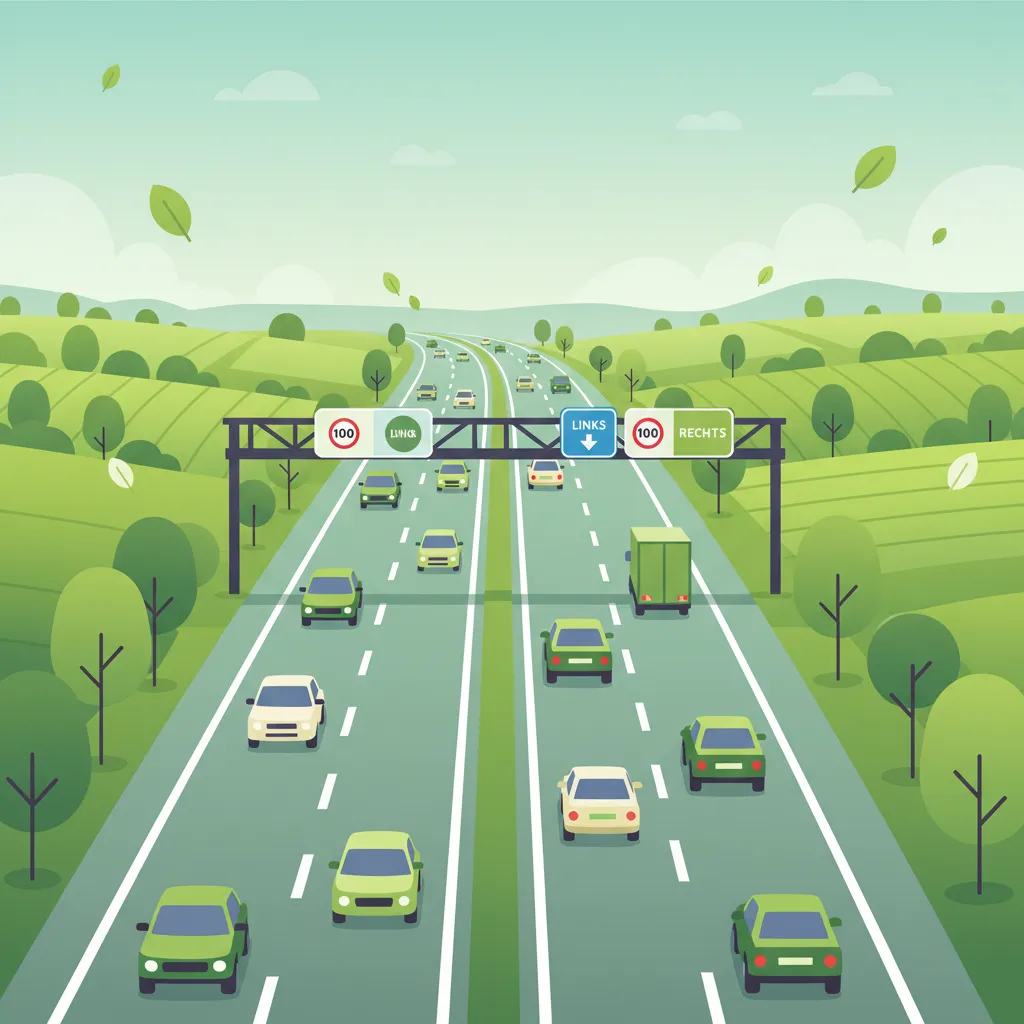
This lesson covers the specific articles of the Dutch Road Traffic Act that apply to motorways, with a primary focus on the strict rule of keeping to the rightmost available lane unless overtaking. It explains the legal and safety reasons for only passing on the left and discusses the correct positioning within a lane for maximum visibility and safety. The content also addresses the nuances of lane usage during heavy congestion, ensuring riders comply with the law and contribute to smooth traffic flow.

This lesson explains how to respond to variable speed limits shown on overhead electronic signs, which are used to manage traffic flow in real-time. You will learn why these limits are adjusted for factors like congestion, accidents, or bad weather, and the legal requirement to obey them. The content focuses on the importance of anticipatory riding, scanning far ahead for these signs to allow for smooth and safe speed adjustments.

This lesson covers the universal Dutch road rules with a specific focus on their application to light motorcycles. It details the various speed limits for different road types, from urban areas to motorways, and explains the correct procedures for overtaking and lane positioning. The legal aspects of lane filtering in congestion are also examined, alongside mandatory equipment use like daytime running lights, to ensure riders can integrate safely and legally into traffic flow.
This lesson focuses on the specific skills required for managing speed on high-speed highways (autosnelwegen). You will learn the correct technique for accelerating on the on-ramp to smoothly merge with traffic flow. The content covers how to choose an appropriate cruising speed, maintain a safe following distance, and manage the aerodynamic effects of wind and turbulence from larger vehicles at high speeds.
This lesson clarifies the legal status and accepted code of conduct for filtering ('gedogen') between lanes of slow or stationary traffic in the Netherlands. It explains the conditions under which it is generally tolerated, such as maintaining a small speed differential. The content focuses heavily on the associated risks, including drivers changing lanes without looking and opening doors, and emphasizes the need for extreme caution and slow speed.

This lesson reinforces the fundamental rule of Dutch highway driving: use the rightmost lane available and use the lanes to the left only for overtaking. You will learn the complete, safe overtaking procedure: check mirrors, signal, perform a shoulder check for the blind spot, smoothly move over, accelerate past the vehicle, and then return to the right lane when safe.
This lesson details the systematic process for safely overtaking on a multi-lane motorway, leveraging the acceleration capabilities of a Category A motorcycle. It covers the 'mirror, signal, maneuver' sequence, with a strong emphasis on the critical shoulder check to clear the blind spot before moving out. The content also discusses how to judge closing speeds, ensure adequate space before returning to the lane, and how to handle situations involving multiple lanes and slower-moving heavy vehicles.
Riding on two wheels requires special care on surfaces with reduced grip. This lesson teaches you how to handle challenging conditions like rain, ice, wet leaves, or tram tracks. Key principles include reducing speed significantly, making all control inputs (braking, accelerating, steering) much more smoothly and gradually, and increasing your following distance to allow for much longer stopping distances. Recognizing potentially slippery areas is a critical part of proactive hazard perception.
Find clear answers to common questions learners have about Throttle Management and Power Delivery. Learn how the lesson is structured, which driving theory objectives it supports, and how it fits into the overall learning path of units and curriculum progression in the Netherlands. These explanations help you understand key concepts, lesson flow, and exam focused study goals.
Smooth throttle control is vital for maintaining stability and traction, especially on a light motorcycle. Abrupt changes can cause the rear wheel to slip or the bike to become unsettled, which is particularly dangerous on Dutch roads, particularly in wet weather or during cornering, and is a common area for CBR theory exam questions.
When braking or entering a corner, releasing the throttle too quickly can cause the rear wheel to slow down suddenly, potentially leading to a skid. Conversely, rolling on the throttle too aggressively mid-corner can destabilize the bike and lead to a loss of traction. Proper throttle management ensures a stable transition through these phases.
Learners often underestimate the impact of throttle actions on the bike's balance. They might choose answers that suggest aggressive throttle use in situations requiring finesse, or fail to recognise scenarios where engine braking or gentle throttle application is crucial for safety and stability, leading to incorrect answers in CBR exam simulations.
Engine braking occurs when you close the throttle or downshift, causing the engine's compression to slow the rear wheel. This is a form of deceleration that can be used alongside or instead of the brakes. Mastering its smooth application, by feathering the throttle or using the clutch, is key to controlled slowing, especially when approaching corners.
While the principles are the same, the impact of throttle inputs is often more pronounced on lighter A1 motorcycles due to their lower weight and potentially less sophisticated suspension. This means precise throttle control is even more critical for maintaining stability and avoiding unintended reactions from the bike, a nuance tested in the CBR exam.