Logo
Dutch Driving Theory Courses

Lesson 1 of the Safety Equipment and Vehicle Checks unit

Dutch A1 Motorcycle Theory: Mandatory Protective Gear and Legal Standards

This lesson focuses on essential safety gear for A1 motorcycle riders in the Netherlands. We'll cover the legal requirements for helmets and strongly advise on other protective equipment to ensure your safety on the road and prepare you for the CBR theory exam.

protective gearmotorcycle safetyhelmet standardsECE 22.06legal requirements
Dutch A1 Motorcycle Theory: Mandatory Protective Gear and Legal Standards
Dutch A1 Motorcycle Theory

Mandatory Protective Gear and Legal Standards for A1 Motorcyclists in the Netherlands

Riding a motorcycle offers unparalleled freedom, but it also carries inherent risks. In the Netherlands, as with many countries, specific laws and regulations are in place to ensure rider safety, particularly concerning personal protective equipment (PPE). This lesson provides a comprehensive overview of the mandatory and recommended gear for Category A1 motorcyclists, emphasizing the legal requirements, safety standards, and practical implications for safe riding. Understanding and adhering to these standards is not only crucial for passing your CBR licence exam but, more importantly, for protecting yourself on the road.

The Critical Role of Motorcycle Protective Gear

Personal Protective Equipment (PPE) for motorcyclists serves as your primary defense in the event of an accident. It is designed to mitigate injury severity by absorbing impact energy, resisting abrasion, and providing structural support to vulnerable body parts. Beyond accident protection, proper gear also enhances comfort, improves control by maintaining grip and warmth, and makes you more visible to other road users. The choice and condition of your gear directly influence your safety, influencing factors from minor scrapes to life-altering injuries.

The Dutch A1 Motorcycle Theory course places a strong emphasis on understanding these requirements, as they are fundamental to responsible motorcycling. Failing to comply with mandatory gear regulations can lead to fines, penalty points, and even impact insurance claims, let alone the devastating personal cost of avoidable injuries.

Mandatory Motorcycle Helmet Standards in the Netherlands: ECE 22.05 and ECE 22.06

The most critical piece of protective equipment, and the only one explicitly mandated by Dutch law for all motorcyclists, is the helmet. According to the Reglement Verkeersregels en Verkeersinstrumenten (RVV 1990) – Article 21, every motorcyclist on public roads in the Netherlands must wear an approved protective helmet. This regulation applies equally to Category A1 riders.

Understanding ECE Certification: ECE 22.05 and ECE 22.06

The legal standard for motorcycle helmets in the Netherlands, and across the European Union, is set by the ECE (Economic Commission for Europe) regulations. Specifically, helmets must conform to either the ECE 22.05 or the newer ECE 22.06 standard.

Definition

ECE 22.05 / ECE 22.06

European standards defining comprehensive performance criteria for motorcycle helmets, including impact absorption, penetration resistance, field of vision, and retention system effectiveness.

The ECE 22.05 standard was introduced in 2002 and served as the benchmark for decades. However, with advancements in helmet technology and a deeper understanding of crash dynamics, the ECE 22.06 standard was introduced in 2022. This newer standard is more rigorous, requiring tests for rotational forces, multiple impact points (not just specific zones), and a wider range of impact speeds. While ECE 22.05 helmets are still legal to use, all newly manufactured helmets sold in the EU must comply with ECE 22.06. When purchasing a new helmet, always look for the ECE 22.06 certification.

The presence of an ECE certification label inside the helmet is paramount. This label, typically sewn into the lining, includes the "E" mark followed by a number indicating the country where the helmet was certified (e.g., E1 for Germany, E4 for the Netherlands), the regulation number (22.05 or 22.06), and a series of numbers identifying the specific helmet type and production batch. Without this official marking, a helmet is not legally approved for use on Dutch roads.

Key Components of an Approved Motorcycle Helmet

Regardless of its specific type, an approved helmet consists of several critical layers working together to protect your head:

  1. Outer Shell: This hard, rigid layer (often made from polycarbonate, fiberglass, or carbon fiber composites) is designed to distribute impact forces over a larger area and resist penetration by sharp objects.
  2. Impact-Absorbing Liner: Made from expanded polystyrene (EPS) foam, this layer is crucial for absorbing kinetic energy during an impact. It deforms to slow down the head's deceleration, significantly reducing the forces transmitted to the brain.
  3. Comfort Padding: Soft, removable, and often washable padding that lines the interior, ensuring a snug and comfortable fit. It also helps manage moisture.
  4. Retention System (Chin Strap): This system, typically a double D-ring or a quick-release buckle, keeps the helmet securely on your head during a crash. It must always be fastened tightly.
  5. Visor/Face Shield: Provides eye protection from wind, debris, insects, and UV radiation. Visors must be clear at night and not excessively tinted.

Types of Motorcycle Helmets and Their Protection Levels

Different riding styles and preferences lead to various helmet designs, each offering distinct levels of protection and features.

Full-Face Helmets

These helmets offer the highest level of protection, covering the entire head and face, including the chin. They are robust, aerodynamic, and provide excellent noise reduction and weather protection. They are highly recommended for all types of riding, especially at higher speeds or in challenging conditions.

Modular (Flip-Up) Helmets

Modular helmets combine the protection of a full-face helmet with the convenience of an open-face design. The chin bar and visor can be flipped up, allowing the rider to talk, drink, or get more ventilation without removing the entire helmet. While offering significant protection, the hinge mechanism can sometimes be a point of weakness in extreme impacts compared to a solid full-face shell. Riders should always ride with the chin bar in the closed and locked position.

Open-Face (3/4) Helmets

Open-face helmets cover the top, back, and sides of the head but leave the face exposed. While they offer good ventilation and a wide field of vision, they provide no protection for the chin or jaw, which are highly vulnerable in a crash. If using an open-face helmet, certified eye protection (goggles or a visor) is essential. These are generally only suitable for low-speed urban riding.

Off-Road / Motocross Helmets

Designed for dirt riding, these helmets typically have an elongated chin bar for increased airflow and a peak to block sun glare and roost. They are often worn with separate goggles. While they meet ECE 22.05/22.06 standards, their design is optimized for off-road impacts and lower speeds, and they may be less aerodynamic or comfortable for sustained road use.

Proper Helmet Fit and Maintenance: Essential for Safety

A helmet can only offer its intended protection if it fits correctly and is in good condition.

  1. Correct Fit: A helmet should fit snugly all around your head, without being uncomfortably tight or causing pressure points. It should not move freely when you shake your head or try to rotate it. The padding should compress slightly around your cheeks. If the helmet is too loose, it can shift during an impact, compromising protection or even coming off.
  2. Chin Strap: Always fasten the chin strap securely. It should be tight enough that you cannot pull the helmet off your head when attempting to roll it forward or backward, but not so tight that it chokes you. A loose chin strap is as dangerous as not wearing a helmet at all, as the helmet can be ejected in a crash.
  3. Regular Inspection: Before each ride, inspect your helmet for visible damage. Look for cracks in the outer shell, deep scratches, fraying on the chin strap, or degradation of the EPS liner.
  4. Replacement After Impact: Even after a seemingly minor drop or low-speed accident, a helmet's structural integrity can be compromised. The energy-absorbing liner is designed to deform once, and subsequent impacts might not be absorbed effectively. Always replace a helmet that has sustained an impact.
  5. Cleanliness: Keep your visor clean for clear vision and maintain the interior padding according to manufacturer instructions.

While only the helmet is legally mandatory in the Netherlands, wearing additional protective gear is highly recommended and dramatically reduces the risk and severity of injuries. The Centraal Bureau Rijvaardigheidsbewijzen (CBR), the Dutch authority for driving licences, also expects candidates to wear suitable protective clothing during the practical exam, even if it's not strictly legally enforced by police on the road.

Protective Jackets: Abrasion and Impact Resistance

A motorcycle jacket is designed to protect your torso and arms from abrasion, impact, and the elements.

Definition

Abrasion Resistance

The ability of a material to withstand scraping, rubbing, or tearing upon contact with rough surfaces, preventing road rash.

  1. Abrasion Resistance: Jackets are typically made from durable materials such as specialized textiles (e.g., Cordura, Kevlar-reinforced fabrics) or thick leather. Leather offers excellent natural abrasion resistance, while modern textiles provide a good balance of protection, comfort, and weatherproofing.
  2. Impact Protection: Many motorcycle jackets incorporate CE-certified armor in critical areas like the shoulders, elbows, and back. This armor, meeting standards like EN 1621-1 (limbs) or EN 1621-2 (back), is designed to absorb and distribute impact energy, preventing fractures and deep tissue injuries.
  3. Weather Protection: Jackets often feature waterproof membranes and thermal liners to keep riders comfortable in various weather conditions, enhancing concentration and control.

Motorcycle Gloves: Grip, Protection, and Dexterity

Motorcycle gloves are essential for protecting your hands, which are often the first point of contact with the ground in a fall.

  1. Abrasion Resistance: Gloves are made from leather or reinforced textiles, providing a protective layer against road rash.
  2. Impact Protection: Many gloves include knuckle protectors (often carbon fiber or hard plastic) and palm sliders to reduce injury in a slide or impact.
  3. Grip and Control: Gloves enhance grip on the handlebars and controls, especially in wet or cold conditions, preventing hands from slipping due to sweat or rain.
  4. Weather Protection: Insulated and waterproof gloves keep hands warm and dry, maintaining dexterity and reducing fatigue.

Warning

Fingerless gloves offer minimal protection and are strongly discouraged for motorcycle riding. In a fall, your fingers and palms are highly vulnerable to severe injury.

Motorcycle Boots: Ankle, Foot, and Leg Protection

Sturdy, high-cut boots are vital for protecting your feet and ankles, which can be easily crushed or fractured in an accident.

  1. Ankle and Foot Protection: Motorcycle-specific boots typically feature reinforced ankle support, toe sliders, and stiff soles to prevent twisting, crushing, and penetration injuries. They also protect from hot engine parts and road debris.
  2. Height and Reinforcement: Boots should extend above the ankle, providing crucial support. Shoes with soft soles or high heels are inappropriate and often prohibited during the CBR practical exam.
  3. Grip: The soles of motorcycle boots are designed to provide excellent grip on footpegs and the road surface, even in wet conditions.

Eye Protection: Clear Vision and Shielding

While your helmet's visor provides eye protection, specific considerations are important.

  1. Visor Clarity: Your visor must always be clean and free of scratches to ensure unimpaired vision.
  2. Tinting: Tinted visors are excellent for daytime riding to reduce glare, but they are illegal and dangerous for night riding as they severely reduce visibility. Always carry a clear visor for evening or low-light conditions, or opt for a helmet with an integrated sun shield.
  3. Anti-Fog: In cold or humid weather, visors can fog up. Anti-fog coatings or Pinlock inserts are highly recommended to maintain clear vision.

High-Visibility Clothing: Being Seen on the Road

Visibility is paramount for motorcyclists, as they are smaller and less conspicuous than cars.

Definition

High-Visibility Clothing

Garments incorporating fluorescent colors (like yellow or orange) and reflective materials that enhance a rider's conspicuity, especially in low light, dawn/dusk, or adverse weather conditions.

  1. Conspicuity: High-visibility jackets, vests, or helmet elements make you more noticeable to other road users, significantly reducing the risk of collisions, especially in low-light conditions, fog, or heavy rain.
  2. Reflective Elements: Retro-reflective strips on your gear reflect light back to its source (e.g., car headlights), making you stand out in the dark. While not nationally mandatory for A1 riders, some local municipal bylaws may advise or even require high-visibility clothing in specific conditions.

Tip

Consider wearing a bright, high-contrast helmet and jacket to maximize your daytime visibility. For nighttime riding, reflective elements are key.

Adherence to legal requirements for protective gear is non-negotiable for motorcyclists in the Netherlands. The primary legal source is the RVV 1990, with additional guidance from the CBR and EU regulations.

RVV 1990 – Article 21: The Helmet Law

Article 21 of the RVV 1990 explicitly details the rules regarding helmet use:

  • Article 21 (1): "Anyone who drives a motorbike must wear a protective helmet that conforms to the ECE 22.05 (or later) standard." This establishes the mandatory nature and certification requirement.
  • Article 21 (2): "The helmet must be correctly fastened with the chin strap." A helmet not properly secured offers no protection and is a violation.
  • Article 21 (3): "A helmet that is visibly damaged, cracked, or has an aged liner must not be used." This clause prohibits the use of compromised helmets, acknowledging that damage negates their protective capacity.

CBR Practical Exam Requirements

During the CBR practical exam for your A1 motorcycle licence, strict rules apply to protective gear:

  • Candidates must present and wear a CE-marked helmet (ECE 22.05/22.06) that is in good condition and correctly fastened.
  • While not strictly mandatory by law for everyday riding, the CBR expects candidates to wear appropriate protective clothing for the exam, typically including an abrasion-resistant jacket, gloves, and sturdy boots that cover the ankles. This demonstrates a commitment to safe riding practices. Failure to comply with these exam requirements will result in immediate disqualification.

EU Regulation No 89/686/EEC (Personal Protective Equipment)

This overarching EU regulation mandates that all PPE sold within the European Union, including motorcycle helmets, must bear the CE Mark. This mark signifies that the product complies with relevant health and safety standards. While this regulation primarily affects manufacturers and retailers, it indirectly ensures that riders have access to properly tested and certified equipment. Using a helmet without a CE mark is illegal as it cannot be verified as meeting safety standards.

Local Bylaws on Visibility

While not widespread national legislation, some Dutch municipalities may have specific bylaws regarding the use of high-visibility clothing or reflective accessories in reduced visibility conditions (e.g., at night, in fog, or heavy rain). Always be aware of local regulations if you frequently ride in specific urban areas.

Consequences of Non-Compliance

  • Fines and Penalty Points: Violating RVV 1990 Article 21 can result in significant monetary fines and may incur penalty points on your driving licence, which could lead to licence suspension if accumulated.
  • Increased Injury Risk: The most severe consequence is the increased risk of severe injury or fatality in an accident. Helmets alone have been shown to reduce fatal head injuries by a substantial margin.
  • Insurance Implications: In the event of an accident, your insurance claim might be affected if it can be proven that your injuries were exacerbated by a lack of proper, legally compliant protective gear.
  • Exam Failure: As mentioned, failure to wear appropriate gear during the CBR practical exam will result in an immediate fail.

Understanding Helmet Safety: Physics of Impact and Injury Prevention

The design and mandatory certification of motorcycle helmets are rooted in scientific principles of physics and biomechanics.

How Helmets Protect Your Brain

When your head hits a surface, the impact involves a rapid deceleration. Without a helmet, the brain sloshes inside the skull, leading to concussions, contusions, and potentially fatal injuries. A helmet works by:

  • Energy Dissipation: The rigid outer shell spreads the impact force over a wider area. The soft, crushable EPS liner then absorbs the majority of the impact energy by deforming. This dramatically reduces the peak acceleration forces transmitted to the brain. Studies indicate helmets can reduce peak linear acceleration from over 200g (without a helmet) to less than 25g, significantly lowering the risk of severe brain injury.
  • Penetration Resistance: The outer shell prevents sharp objects from piercing the skull.
  • Rotational Force Reduction: Newer ECE 22.06 standards specifically test for rotational forces, which can cause severe brain injuries even without a direct linear impact. Helmets are designed to minimize these twisting forces.

Abrasion Mechanics and Skin Protection

Road rash, or skin abrasions, can be incredibly painful and lead to infections or permanent scarring. Protective clothing works by:

  • Sacrificial Layer: The tough outer materials (leather, Cordura) are designed to slide and tear before your skin does. They dissipate kinetic energy through friction and material deformation, literally sacrificing themselves to protect you.
  • Impact Absorption: Integrated armor in jackets and pants further protects bones and joints from direct impacts.

Visibility Theory and Collision Avoidance

Visibility is not just about seeing but also about being seen.

  • Detection Distance: In daylight, the human eye detects objects more easily when there's high contrast. Fluorescent colors (yellow, orange) used in high-visibility clothing stand out in daylight against most backgrounds.
  • Nighttime Detection: At night, reflective materials work by retro-reflection, meaning they bounce light directly back to its source. This makes a rider wearing reflective gear highly visible to drivers with headlights, effectively doubling the detection distance compared to dark clothing. This extra detection time can be crucial for a driver to react and avoid a collision.

Data Insights on Gear Effectiveness

Numerous road safety reports, including those from the Netherlands, consistently demonstrate the effectiveness of protective gear. For example, studies often correlate helmet usage with a significant reduction (e.g., 58%) in fatal head injuries for motorcyclists. While not always mandated, the use of abrasion-resistant clothing, gloves, and boots is linked to substantial reductions in the severity of other injuries, such as fractures, lacerations, and burns.

Practical Scenarios and Conditional Considerations for Gear Choice

The ideal protective gear can vary depending on riding conditions, emphasizing the importance of adapting your choices for maximum safety.

Scenario 1: Night Riding in an Urban Area

  • Condition: Low light, multiple light sources, busy traffic, often lower speeds.
  • Gear Recommendation: Full-face helmet with a clear visor (never tinted at night), high-visibility jacket with ample reflective strips, and reflective elements on gloves and boots.
  • Reasoning: Clear vision is paramount. Reflective gear makes you stand out against the urban backdrop, helping other drivers spot you amidst distractions.

Scenario 2: Highway Riding at Higher Speeds (e.g., 80 km/h)

  • Condition: Higher speeds, potential for more severe impacts, longer slide distances.
  • Gear Recommendation: Full-face or modular helmet (chin bar down) with ECE 22.06 certification. Robust leather or high-quality textile jacket with CE-certified armor (Level 2 where possible). Full-gauntlet leather gloves with knuckle protection and CE-rated motorcycle boots.
  • Reasoning: Higher speeds mean greater kinetic energy in a crash, demanding maximum impact absorption and abrasion resistance. A full-face helmet provides aerodynamic stability and superior protection.

Scenario 3: Riding in Heavy Rain or Fog

  • Condition: Reduced visibility for both rider and other road users, slippery surfaces, potential for hypothermia.
  • Gear Recommendation: Waterproof and insulated jacket and gloves to maintain body temperature and grip. Helmet with an anti-fog visor (e.g., Pinlock insert). High-visibility outerwear (e.g., reflective rain suit) to maximize conspicuity.
  • Reasoning: Maintaining warmth and dexterity is crucial for control. Enhanced visibility is critical when detection distances are severely reduced.

Scenario 4: Post-Accident Gear Inspection

  • Condition: Rider involved in a low-speed crash, helmet may have superficial damage, other gear might be scuffed.
  • Recommendation: Always replace a helmet after any impact, even if damage is not immediately obvious. Inspect all other gear (jacket, gloves, boots) for compromised integrity (tears, broken stitching, shattered armor).
  • Reasoning: Helmets are designed for a single major impact. Other gear might have hidden damage that reduces its protective capacity in a subsequent incident. This is a mandatory legal requirement under RVV 1990 Article 21 (3) for helmets.

Scenario 5: Riding with a Pre-Existing Medical Condition

  • Condition: Rider has limited neck mobility or requires special accommodations.
  • Recommendation: Seek medical advice on helmet types. Some helmets offer adjustable padding or have a larger internal volume. Neck braces (non-mandatory) can be considered for specific conditions.
  • Reasoning: Gear must protect effectively while also accommodating rider comfort and any medical needs without causing further risk.

Scenario 6: Track Days vs. Road Use

  • Condition: Participating in an official track day event.
  • Recommendation: Track day organizers often have stricter gear requirements than road law. Helmets may need to meet additional certifications beyond ECE (e.g., Snell, FIM homologation). Full leather suits, back protectors, and race-specific boots/gloves are usually mandatory.
  • Reasoning: Track environments involve much higher speeds and impact forces, necessitating more robust protective gear. Always check organizer rules before attending.

Essential Vocabulary for Motorcycle Protective Gear

ECE 22.05 / 22.06
European standards for motorcycle helmets covering impact absorption, penetration resistance, field of vision, and retention system performance.
CE Mark
A conformity marking indicating compliance with EU health, safety, and environmental protection standards, required on all PPE sold in the EU.
RVV 1990 Article 21
The specific article in Dutch traffic law that mandates the use of approved, correctly fastened, and undamaged protective helmets for motorcyclists.
Full-face helmet
A helmet covering the entire head and face, including the chin bar, offering the highest level of protection.
Modular helmet
A helmet with a hinged chin bar that can be flipped up, combining full-face protection with convenience.
Abrasion resistance
The ability of a material (e.g., leather, textile) to withstand scraping and rubbing without tearing, protecting skin from road rash.
Impact attenuation
The reduction of peak forces transmitted to the body during a crash, primarily achieved by energy-absorbing liners in helmets and armor.
Retention system
The chin strap and buckle mechanism that securely fastens a helmet to the rider's head.
High-visibility clothing
Garments incorporating fluorescent colors and reflective elements designed to enhance a rider's conspicuity, especially in low light or adverse weather.
CBR
Centraal Bureau Rijvaardigheidsbewijzen, the Dutch authority responsible for driving licence theory and practical exams.
CE-certified armor
Protective inserts (e.g., for shoulders, elbows, back) meeting European standards like EN 1621-1 or EN 1621-2, designed to absorb impact energy.
Penalty points
Points added to a driver’s licence record for traffic violations in the Netherlands, which can lead to licence suspension.
Visor tint
The level of darkness or shading in a helmet visor. Highly tinted visors are illegal and unsafe for night riding.
Road rash
Severe skin abrasions caused by sliding across a rough road surface during a motorcycle accident.
EPS Liner
Expanded Polystyrene foam, the crucial energy-absorbing layer inside a helmet designed to deform and dissipate impact energy.

Conclusion: Prioritizing Safety Through Proper Protective Gear

Understanding and adhering to the legal standards for motorcycle protective gear, especially the mandatory ECE-certified helmet, is fundamental to safe motorcycling in the Netherlands. While only the helmet is legally required, embracing the use of high-quality, abrasion-resistant jackets, gloves, and boots is a proactive choice that significantly enhances your safety on the road.

Always ensure your gear is the correct size, properly maintained, and replaced after any significant impact. By prioritizing appropriate protective equipment, A1 motorcyclists not only comply with Dutch traffic laws and CBR exam requirements but also drastically reduce their risk of severe injury, ensuring a safer and more enjoyable riding experience.

Learn more with these articles

Check out these practice sets


Search topics related to Mandatory Protective Gear and Legal Standards

Explore search topics learners often look for when studying Mandatory Protective Gear and Legal Standards. These topics reflect common questions about road rules, driving situations, safety guidance, and lesson level theory preparation for learners in the Netherlands.

mandatory motorcycle helmet netherlandsA1 motorcycle gear rules cbrECE 22.06 helmet requirements nlwhat protective gear is required for motorcycles in the netherlandsdriving theory test motorcycle safety gearbest motorcycle jacket for safety nlimportance of motorcycle gloves theory examapproved motorcycle helmets for A1 license

Related driving theory lessons for Mandatory Protective Gear and Legal Standards

Browse additional driving theory lessons that cover connected traffic rules, road signs, and common driving situations related to this topic. Improve your understanding of how different rules interact across everyday traffic scenarios.

Legal Standards for Motorcycle Protective Gear in the Netherlands

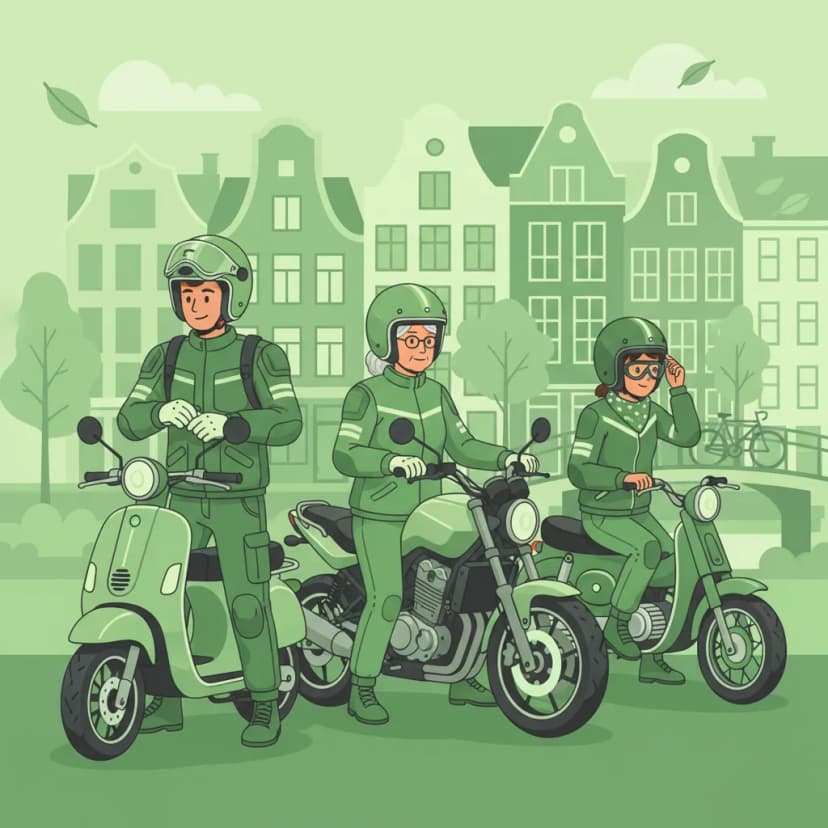
Understand the Dutch legal requirements for motorcycle protective gear, focusing on mandatory helmet standards like ECE 22.05 and 22.06. Learn about RVV 1990 Article 21 and CBR exam expectations for rider safety equipment.
legal requirementsprotective gearhelmet standardsECE 22.06Dutch traffic lawmotorcycle safety
Helmet and Protective Gear Regulations lesson image

Helmet and Protective Gear Regulations

This lesson details the statutory helmet regulations applicable to all Category AM vehicles. It clearly defines the mandatory helmet use for bromfiets and speed pedelec riders and the specific rules for snorfiets riders, including the required ECE safety certification for all approved helmets. The content also provides information on recommended protective gear, such as gloves and sturdy footwear, explaining how proper equipment enhances rider safety and is a key part of responsible riding culture in the Netherlands.

Dutch Driving Theory AMLegal Foundations & Vehicle Types
View lesson
Required Documentation (rijbewijs, verzekeringsbewijs, kenteken) lesson image

Required Documentation (rijbewijs, verzekeringsbewijs, kenteken)

This lesson provides a definitive list of the documents a motorcyclist must carry at all times when riding in the Netherlands. It specifies the requirement for a valid driving license ('rijbewijs') for the correct category, the vehicle registration card ('kentekenbewijs'), and proof of valid third-party liability insurance ('verzekeringsbewijs'). The content clarifies that failure to produce these documents during a police check can result in significant fines and legal complications.
Dutch Motorcycle Theory AVehicle Inspection, Maintenance, and Documentation
View lesson
Signal Devices and Lighting Requirements for A2 Motorcycles lesson image

Signal Devices and Lighting Requirements for A2 Motorcycles

This lesson covers the mandatory lighting and signaling equipment for A2 motorcycles under Dutch law, ensuring you remain visible and communicate your intentions correctly. You will learn the rules for using headlights, taillights, turn signals, and brake lights in various conditions, including daytime and adverse weather. The content also addresses the importance of maintaining this equipment and using hand signals as a valid secondary method of communication in traffic.

Dutch Motorcycle Theory (A2)Road Signs and Motorcycle-Specific Indicators
View lesson
Rider Obligations and Liability lesson image

Rider Obligations and Liability

This lesson examines the statutory duties imposed on motorcyclists, with a strong emphasis on the 'duty of care' (zorgplicht) and the conditions under which legal liability arises after a traffic incident. It clarifies the relationship between personal responsibility, mandatory insurance coverage, and the legal expectation for proactive risk mitigation to prevent accidents. The content also analyzes scenarios to illustrate how liability is typically determined within Dutch traffic jurisprudence, preparing riders for their legal responsibilities.

Dutch Motorcycle Theory AFundamentals of Motorcycle Theory & Dutch Traffic Law
View lesson
Overview of Dutch Traffic Legislation lesson image

Overview of Dutch Traffic Legislation

This lesson provides a detailed overview of the structure of Dutch traffic legislation, focusing on the Road Traffic Act (Wegenverkeerswet 1994) and its relationship with CBR regulations. It explains the hierarchy from national statutes to local ordinances and how these rules govern rider behavior in various traffic situations. Furthermore, the lesson clarifies the mechanisms for enforcement, the types of sanctions for non-compliance, and the legislative goal of ensuring road safety for all participants.

Dutch Motorcycle Theory AFundamentals of Motorcycle Theory & Dutch Traffic Law
View lesson
Correct Use of Helmets, Gloves, and Protective Clothing lesson image

Correct Use of Helmets, Gloves, and Protective Clothing

This lesson goes beyond simply owning safety gear and focuses on its correct use. It explains how to check for a proper helmet fit and the importance of securely fastening the chin strap every time. The content also discusses the features of protective jackets, pants, and gloves, such as abrasion-resistant materials and built-in impact armor, and why a snug fit is crucial for them to function correctly in a crash.

Dutch A1 Motorcycle TheorySafety Equipment and Vehicle Checks
View lesson
General Road Rules for Light Motorcycles lesson image

General Road Rules for Light Motorcycles

This lesson covers the universal Dutch road rules with a specific focus on their application to light motorcycles. It details the various speed limits for different road types, from urban areas to motorways, and explains the correct procedures for overtaking and lane positioning. The legal aspects of lane filtering in congestion are also examined, alongside mandatory equipment use like daytime running lights, to ensure riders can integrate safely and legally into traffic flow.

Dutch A1 Motorcycle TheoryDutch Traffic Laws for A1 Motorcycles
View lesson
Dutch Motorway Law (snelwegwet) and Lane Discipline lesson image

Dutch Motorway Law (snelwegwet) and Lane Discipline

This lesson covers the specific articles of the Dutch Road Traffic Act that apply to motorways, with a primary focus on the strict rule of keeping to the rightmost available lane unless overtaking. It explains the legal and safety reasons for only passing on the left and discusses the correct positioning within a lane for maximum visibility and safety. The content also addresses the nuances of lane usage during heavy congestion, ensuring riders comply with the law and contribute to smooth traffic flow.

Dutch Motorcycle Theory AHighway and Tunnel Riding Strategies
View lesson
Pedestrian Crossings and School Zones lesson image

Pedestrian Crossings and School Zones

This lesson focuses on the legal requirements and safe practices for riding near pedestrian crossings ('zebrapaden') and designated school zones. It details the absolute obligation to yield to pedestrians on or about to use a crossing and the need for significantly reduced speeds and heightened vigilance in areas with children. The content underscores the importance of anticipation and being prepared for unpredictable movements from vulnerable road users to prevent serious incidents.

Dutch Motorcycle Theory APriority Rules and Intersection Navigation
View lesson
Reporting Obligations and Interaction with Police lesson image

Reporting Obligations and Interaction with Police

This lesson details the legal requirements for reporting a traffic accident in the Netherlands, including the circumstances under which you must involve the police. It explains the correct procedure for exchanging personal, vehicle, and insurance information with any other parties involved. The lesson also covers the use of the European Accident Statement form to document the facts of the incident for insurance purposes.

Dutch A1 Motorcycle TheoryAccident Management, Legal Responsibilities & Substance Use
View lesson

Frequently asked questions about Mandatory Protective Gear and Legal Standards

Find clear answers to common questions learners have about Mandatory Protective Gear and Legal Standards. Learn how the lesson is structured, which driving theory objectives it supports, and how it fits into the overall learning path of units and curriculum progression in the Netherlands. These explanations help you understand key concepts, lesson flow, and exam focused study goals.

What is the legal requirement for motorcycle helmets in the Netherlands for an A1 licence?

For the A1 motorcycle licence in the Netherlands, wearing an approved helmet is mandatory. This helmet must meet at least ECE 22.05 or the newer ECE 22.06 standard. Look for the ECE certification label inside the helmet to confirm it complies with these safety regulations.

Are motorcycle jackets, gloves, and boots legally required in the Netherlands for A1 riders?

While the law primarily mandates an approved helmet, wearing protective jackets, gloves, and sturdy boots is strongly recommended for A1 riders. These items significantly reduce the risk and severity of injuries during falls or collisions. The CBR theory exam includes questions on rider safety and best practices.

What is the difference between ECE 22.05 and ECE 22.06 helmet standards?

ECE 22.06 is the latest European safety standard for motorcycle helmets, offering more stringent testing protocols and coverage than the previous ECE 22.05 standard. While ECE 22.05 helmets are still legal to use if manufactured before their phase-out date, ECE 22.06 helmets provide a higher level of tested safety.

Why is protective gear so important if it's not all legally mandatory?

Motorcycles offer very little inherent protection. Protective gear acts as your personal safety system. It's designed to absorb impact, prevent abrasion, and protect vital areas. Even if not strictly mandatory beyond the helmet, wearing full PPE drastically improves your chances of avoiding or minimizing serious injury in an accident, which is a key aspect of safe riding emphasized in theory exams.

Where can I find the ECE approval sticker on a helmet?

The ECE approval sticker is typically found on the chin strap, inside the helmet lining, or sometimes on the rear exterior of the helmet shell. It usually consists of a white or yellow sticker with a capital 'E' inside a circle, followed by a number indicating the approving country, and then the helmet's approval number (e.g., E1 05xxxxxx).

Continue your Dutch driving theory learning journey

Dutch road signsDutch article topicsSearch Dutch road signsDutch driving theory homeDutch road sign categoriesSearch Dutch theory articlesDutch driving theory coursesDutch Driving Theory B courseDutch driving theory articlesDutch driving theory practiceDutch practice set categoriesDutch Driving Theory AM courseDutch Motorcycle Theory A courseDutch A1 Motorcycle Theory courseDutch Motorcycle Theory (A2) courseSearch Dutch driving theory practiceTowing, Trailers, and Loads unit in Dutch Driving Theory BRoadway Access & Navigation unit in Dutch Driving Theory AMVehicle Positioning and Lane Use unit in Dutch Driving Theory BHuman Factors & Risk Management unit in Dutch Driving Theory AMInfrastructure and Special Roads unit in Dutch Driving Theory BLegal Foundations & Vehicle Types unit in Dutch Driving Theory AMLegal Responsibilities & Incident Procedures unit in Dutch Driving Theory AMHighway (Autosnelweg) Rules for Motorcycles unit in Dutch Motorcycle Theory (A2)Record-Keeping and Service Intervals lesson in Safety Equipment and Vehicle ChecksAdvanced Riding Techniques and High-Speed Control unit in Dutch Motorcycle Theory AMandatory Protective Gear and Legal Standards lesson in Safety Equipment and Vehicle ChecksAccident Management, Legal Responsibilities & Substance Use unit in Dutch A1 Motorcycle TheoryMaintenance Basics for Engine, Chain, and Brakes lesson in Safety Equipment and Vehicle ChecksPre-Ride Inspection Checklist (Lights, Tires, Fluids) lesson in Safety Equipment and Vehicle ChecksCorrect Use of Helmets, Gloves, and Protective Clothing lesson in Safety Equipment and Vehicle Checks