
This lesson provides a systematic guide to safe motorcycle cornering, a crucial skill for the Dutch A1 CBR theory exam. You'll learn the 'slow in, fast out' principle, covering proper entry, identifying the apex, and smooth throttle application for stable exits. Mastering these techniques will enhance your control and safety through bends, building on your understanding of lean angles.

Navigating corners safely and efficiently is a fundamental skill for any motorcyclist, especially for those operating an A1 motorcycle within the Dutch road network. This lesson provides a comprehensive guide to proper corner entry and exit techniques, focusing on stability, traction, and control. By understanding and applying these systematic procedures, riders can significantly reduce the risks associated with cornering, which is statistically one of the most accident-prone manoeuvres.
The principles discussed here are crucial for maintaining control and safety, building upon foundational knowledge such as the physics of lean angles and centrifugal forces, efficient braking, and strategic road positioning. Mastering these techniques will not only prepare you for the Dutch A1 Motorcycle Theory exam but also establish a robust foundation for confident and safe riding in real-world traffic conditions.
The cornerstone of effective and safe cornering on a motorcycle is the "slow-in, fast-out" principle. This concept dictates that all necessary speed reduction, including braking and downshifting, must be completed before the motorcycle begins to lean into the corner. Once the bike is leaned over and committed to the turn, the rider should progressively apply throttle from the apex onwards, accelerating smoothly out of the bend.
This methodical approach is vital for several reasons. Primarily, it ensures that the tyres have maximum available grip for the demanding lateral forces of cornering, rather than splitting grip between braking and turning. It also minimises the time spent at high lateral loads, where the bike is most susceptible to losing traction. Adhering to this principle is not merely a riding tip; it directly aligns with Dutch traffic law, specifically RVV 1990, article 24, which mandates drivers to adjust their speed to prevailing road, traffic, and weather conditions, particularly when approaching a bend.
Effective line selection is about choosing the safest and most efficient path through a corner. It involves identifying three key points: the turn-in point, the apex, and the exit point. Strategic line selection maximises the usable turning radius, reduces the required lean angle, and importantly, enhances the rider's sightline through the bend.
The turn-in point is the precise location on the approach to a corner where the rider initiates steering input, causing the motorcycle to begin its lean. This point is crucial because it marks the end of your braking phase and the beginning of your turning phase. An early turn-in might be suitable for very tight urban bends, while a later turn-in is often preferred for more gentle, sweeping curves to maximise visibility and radius. It is imperative that all deceleration is completed before reaching this point. Braking while already leaning significantly compromises front-wheel grip, increasing the risk of a loss of control.
The apex is the geometric centre of the corner, the point where the motorcycle comes closest to the inside edge of the curve. Hitting the correct apex is critical for maximising the effective turning radius. There are different types of apices:
The exit point is where the motorcycle straightens up and accelerates out of the corner, aiming towards the outer edge of the lane as it transitions back to a straight line. A well-executed exit is a direct result of proper entry and apex management, allowing for smooth acceleration and maintaining a stable trajectory.
The most common and generally safest line selection for a corner is the outside-inside-outside (O-I-O) approach. You start wide on the approach (near the outer edge of your lane), move towards the inside (the apex) at the centre of the turn, and then exit wide again, towards the outer edge of your lane as you straighten up. This line effectively "straightens out" the curve, creating the largest possible radius and thus requiring less lean angle and less centripetal force at a given speed. This maximises safety and comfort, particularly on two-lane roads where you must remain within your designated lane.
Crucial to the "slow-in, fast-out" philosophy is the precise management of speed and gears before entering a corner. This preparation ensures that the motorcycle is stable, in the correct gear for power, and has maximum tyre grip available for turning.
The braking point is the location on the approach to a corner where you begin to apply the brakes. Determining the correct braking point depends on several factors: your current speed, the corner's sharpness (radius), the road surface condition, and your motorcycle's braking capability.
Downshifting involves selecting a lower gear before entering a corner. This is done to keep the engine within its optimal power band, ensuring that sufficient torque is available for a smooth and controlled acceleration out of the bend.
Once past the apex, as the motorcycle begins to straighten up and prepare for exit, the rider should progressively increase engine power. Smooth throttle application is key to maintaining rear-wheel traction and stabilising the motorcycle.
A sudden, aggressive increase in throttle can easily exceed the rear tyre's grip limit, especially on damp or low-grip surfaces. This can lead to rear-wheel spin, which may result in a "low-side" crash (where the bike slides out from under you) or, more dangerously, a "high-side" crash (where the rear tyre regains traction suddenly, violently flipping the rider off the bike). By applying the throttle gradually, the rider ensures a steady transfer of power to the rear wheel, maintaining tyre-road contact and preventing any abrupt movements that could compromise stability. This aspect of riding, while not explicitly covered by a direct legal rule, falls under the umbrella of "reasonable and prudent driving" as required by RVV 1990, article 4.
Your eyes are your most important tools when cornering. Effective visual strategy, including tri-point visibility and continuous road scanning, allows you to anticipate hazards, plan your line, and make timely adjustments.
Before and during a turn, a rider should mentally establish three sequential visual reference points: the entry point, the apex, and the exit point.
This dynamic scanning technique prevents "tunnel vision," where a rider focuses only on the road directly ahead, missing crucial information about the rest of the turn or beyond. By continuously looking where you want to go, your body and motorcycle will naturally follow, allowing for smoother and more accurate execution of the corner. This approach supports the "see-and-avoid" principle embedded in RVV 1990, article 3, which requires drivers to maintain a clear view of the road ahead.
In the Netherlands, specific traffic laws and general principles of safe driving govern how motorcyclists should navigate corners. Adhering to these regulations is not only a legal obligation but also essential for preventing accidents.
Drivers must adjust their speed to all prevailing circumstances, including road conditions, traffic, and visibility, especially when approaching bends, intersections, or areas with vulnerable road users.
This article is directly applicable to cornering. It legally obliges motorcyclists to reduce their speed sufficiently before entering a bend to ensure they can navigate it safely and within the limits of their motorcycle's traction. Failing to adapt speed to a curve is a common cause of accidents and can lead to penalties.
Vehicles must stay within their designated lane and may only cross lane markings when it is safe and legally permitted, such as during a safe overtaking manoeuvre.
When cornering on multi-lane roads or roads with oncoming traffic, it is mandatory to stay within your lane. Drifting into an adjacent lane or the lane of oncoming traffic to "cut the corner" is a dangerous violation and a direct breach of this article. Proper line selection within your lane (e.g., outside-inside-outside) should never involve encroaching on other lanes.
Drivers must behave in traffic in a manner that is reasonable and prudent, taking into account all circumstances and avoiding any behaviour that could endanger other road users or oneself.
This overarching principle covers aspects of riding that aren't explicitly detailed in other articles, such as smooth throttle application, controlled braking, and general awareness. Aggressive or uncontrolled cornering, even if not directly breaking a speed limit, could be deemed unreasonable and imprudent if it creates a hazardous situation.
Drivers must maintain a clear view of the road ahead and are prohibited from driving where they cannot see potential hazards or obstructions.
This article underpins the importance of tri-point visibility and continuous road scanning. A rider must ensure they can see far enough through and beyond a corner to react to unexpected obstacles like parked vehicles, debris, or pedestrians. Blindly entering a curve without assessing the exit falls foul of this rule.
Understanding proper technique is only half the battle; recognising and avoiding common mistakes is equally vital for motorcycle safety. Many motorcycle accidents in corners stem from a failure to execute one or more steps correctly.
Why it's wrong: Applying brakes, especially the front brake, while the motorcycle is already leaned over shifts weight to the front wheel. This reduces the available grip for steering and maintaining the lean angle, as the tyre's traction limit is being shared between braking and turning. Consequence: Increased risk of front-wheel loss of traction, leading to a "low-side" crash. This is also a potential breach of RVV 1990 art. 24 for inadequate speed adaptation. Correct behaviour: Complete all necessary braking before initiating the lean at the turn-in point.
Why it's wrong: Downshifting while leaned over can cause an abrupt change in engine torque, potentially leading to the rear wheel locking up or skidding, especially if the clutch is released quickly. Consequence: Rear-wheel slip, loss of stability, and an increased risk of a crash. This can be considered negligent riding. Correct behaviour: Downshift to the appropriate gear while the motorcycle is upright and in a straight line, before initiating the turn-in. Match engine revs for smooth engagement.
Why it's wrong: Entering the apex too soon effectively shortens the turning radius of the curve. This requires a sharper steering input and a greater lean angle to stay on the road, increasing the lateral G-forces on the tyres. Consequence: Higher required lean angle, making it easier to exceed tyre grip limits, especially if conditions change or an unexpected obstacle appears. Correct behaviour: Aim for the geometric or a slightly delayed apex to maximise the turning radius and provide a better view of the corner exit.
Why it's wrong: Applying too much throttle too suddenly after the apex can overwhelm the rear tyre's traction, particularly on wet or low-grip surfaces. Consequence: Rear-wheel loss of traction, leading to a dangerous "high-side" crash or a less severe "low-side." This could be cited under RVV 1990 art. 4 (unreasonable and imprudent driving). Correct behaviour: Apply throttle progressively and smoothly after the apex, monitoring for any signs of rear-wheel slip.
Why it's wrong: If the entry speed is too high for the curve's radius and conditions, the required centripetal force to maintain the turn will exceed the tyres' available grip. Consequence: Loss of control, resulting in a low-side or high-side crash, or running wide off the road. This is a direct violation of RVV 1990 art. 24. Correct behaviour: Always reduce speed to the appropriate maximum before the turn-in point, considering all factors.
Why it's wrong: Drifting into an adjacent lane or the lane of oncoming traffic while cornering is extremely dangerous and illegal. It significantly reduces your safety margin and can lead to head-on collisions. Consequence: Collision with other vehicles; direct breach of RVV 1990 art. 7. Correct behaviour: Stay strictly within your designated lane throughout the entire corner.
Why it's wrong: Focusing only on the immediate road ahead or the front wheel means you won't see hazards developing further into the curve or on the exit. Consequence: Late detection of obstacles (e.g., debris, parked cars, pedestrians) requiring abrupt braking or steering, which can cause a crash. This violates RVV 1990 art. 3. Correct behaviour: Establish tri-point visibility before the corner and continuously scan ahead through the turn and towards the exit.
Motorcycle cornering techniques are not static; they must be dynamically adapted to various environmental, road, and vehicle conditions.
When riding on wet or damp roads, the coefficient of friction (μ) between your tyres and the road surface is significantly reduced. This demands a substantial adjustment to your cornering technique.
Reduced visibility during nighttime or due to sun glare requires heightened awareness.
The environment of the road itself dictates variations in technique.
Riding with a passenger or heavy luggage alters the motorcycle's centre of gravity and overall dynamics.
The presence of other road users, especially vulnerable ones, requires immediate adjustments.
Understanding the underlying science of cornering enhances a rider's ability to anticipate and react safely.
For a motorcycle to successfully navigate a curve, an inward-directed force called centripetal force is required. This force, generated by the lean angle and tyre-road friction, keeps the bike on its curved path. The formula for centripetal force is , where is mass, is speed, and is the turning radius.
Human factors play a significant role in safe cornering. The average perception-reaction time for motorcyclists is typically around 2 to 2.5 seconds. At a speed of 50 km/h, a motorcycle travels approximately 28 metres during this interval. This emphasizes why early visual scanning and early braking are paramount. Anticipating the corner and any potential hazards well in advance provides the necessary time to perceive, decide, and act safely. "Tunnel vision," where a rider fixates on one point, can severely impair this process.
Applying the brakes causes load transfer, shifting weight from the rear wheel to the front. While necessary for effective braking, doing this while leaned over reduces the weight on the rear tyre, making it prone to slip during acceleration, and simultaneously overloads the front tyre, reducing its ability to grip for steering. Completing all braking before the turn-in point minimizes this effect, preserving the front wheel's grip for steering and allowing the rear wheel to maintain traction for smooth acceleration out of the turn. This balanced approach is crucial for overall motorcycle stability.
Mastering cornering is a systematic process that combines anticipation, precise control, and adaptive riding. By consistently applying these steps, A1 motorcycle riders can navigate bends safely and confidently within the Dutch road system.
Recognise the Corner: Before anything else, identify the corner's characteristics – its radius, any speed limits, and the prevailing road surface conditions.
Establish Tri-Point Visibility: Actively look far ahead to identify your entry point, then scan towards the apex, and finally look through to the exit point of the corner.
Select the Optimal Line: Plan your trajectory, typically following an outside-inside-outside (O-I-O) line within your lane to maximise the turning radius and visibility.
Determine Braking Point: Identify where you need to begin braking to achieve the desired entry speed well before the turn-in point.
Complete All Braking: Finish all deceleration while the motorcycle is upright and in a straight line, before initiating the lean into the turn.
Downshift to Appropriate Gear: Select the correct lower gear while still straight and upright, ensuring the engine is in its power band for a smooth exit. Rev-match if necessary.
Enter the Corner at Calculated Speed: Initiate your lean smoothly at the turn-in point, maintaining the appropriate entry speed for the conditions.
Clip the Geometric or Slightly Delayed Apex: Aim for the centre or slightly later point of the inside of the curve to maximise your turning radius and improve exit visibility.
Apply Throttle Progressively: After passing the apex, gradually increase throttle to maintain rear-wheel traction and stabilise the motorcycle as it straightens up.
Exit the Corner: Allow the motorcycle to naturally widen its line towards the outer edge of your lane as you exit the curve and accelerate back to your desired speed.
Adapt Your Technique: Always adjust your approach based on external factors such as weather (rain, ice), lighting (night, glare), road type (urban, rural), vehicle load, and the presence of other road users.
Maintain Legal Compliance: Ensure all actions adhere to Dutch traffic regulations, including RVV 1990 articles 3 (visibility), 4 (prudent driving), 7 (lane discipline), and 24 (speed adaptation).
Continuously Scan: Keep your eyes moving, constantly assessing the road ahead for new hazards and ready to adjust your speed or line as needed.
By internalising and practicing each of these steps, you will develop the skill and intuition required to safely and confidently navigate any corner on your A1 motorcycle.
Lesson content overview
Explore all units and lessons included in this driving theory course.
Explore search topics learners often look for when studying Proper Corner Entry and Exit Techniques. These topics reflect common questions about road rules, driving situations, safety guidance, and lesson level theory preparation for learners in the Netherlands.
Browse additional driving theory lessons that cover connected traffic rules, road signs, and common driving situations related to this topic. Improve your understanding of how different rules interact across everyday traffic scenarios.
Understand the fundamental physics behind motorcycle cornering, including centripetal force, grip limits, and load transfer. Learn how speed, lean angle, and road conditions affect stability and control in bends for Dutch theory.

This lesson provides a foundational understanding of the physics that govern motorcycle cornering. It explains how leaning the motorcycle shifts its center of gravity, creating a centripetal force that counteracts the outward centrifugal force of the turn. Learners will explore the relationship between speed, turn radius, and the required lean angle, as well as the critical role of tire traction in this dynamic balance.

This lesson explains the critical role of the rider's body in controlling the motorcycle's dynamics, especially during cornering. It details how shifting body weight alters the combined center of gravity, allowing for greater cornering speed at a given lean angle or a safer lean angle for a given speed. Techniques for correct posture, footpeg weighting, and active body positioning are covered to enhance stability, maximize grip, and provide more precise control.

This lesson demystifies the concept of counter-steering, the primary method for steering a motorcycle at speed. It explains how a small push on the handlebar initiates a lean, allowing the bike to turn effectively. The lesson also details how a rider's body position and weight shifting are used in conjunction with steering inputs to control the motorcycle's center of gravity, ensuring stability and precision while cornering.

This lesson focuses on how you must adapt your riding style when the motorcycle is heavily loaded. You will learn that your braking distances will be significantly longer, requiring you to increase your following distance and begin braking earlier. The content also explains that acceleration will be slower, and cornering will require smoother, more deliberate inputs to avoid upsetting the motorcycle's altered balance.

This lesson explains how you, the rider, are an active part of the motorcycle's dynamics. You will learn how shifting your body weight into the turn can reduce the required lean angle of the motorcycle itself, increasing the margin of safety and grip. The content covers correct posture, the importance of looking through the turn with your head up, and how to stay relaxed on the controls to allow the bike to work effectively.

This lesson focuses on the critical relationship between speed, braking, and throttle control in cornering. You will learn the golden rule: complete your braking while the motorcycle is still upright, before initiating your lean. The content then explains how to use a neutral or slightly positive 'maintenance throttle' to keep the suspension settled mid-corner, followed by smoothly rolling on the throttle as you exit the turn to aid stability.

This lesson addresses the specific challenge of cornering when road grip is compromised. It teaches riders how to identify potential low-traction surfaces like wet manhole covers, painted lines, gravel, or oil patches. The content focuses on techniques to mitigate risk, such as reducing speed, minimizing lean angle, and applying all control inputs—braking, steering, and throttle—with exceptional smoothness to avoid overwhelming the available grip.

This lesson demystifies the concept of counter-steering, the primary method for controlling a motorcycle at any speed above a walking pace. It explains the physics behind why pressing on the inside handlebar initiates a lean and turn in that direction. Mastering this non-intuitive but essential skill is fundamental for fluid cornering, precise line control, and the ability to execute rapid, life-saving swerves to avoid unexpected obstacles.

This lesson examines how adding weight, such as a pillion passenger or luggage, and changes in aerodynamics affect a motorcycle's performance and stability at speed. It explains the impact on acceleration, braking distances, and cornering ability due to a higher center of gravity and increased mass. Riders will learn how to adjust their speed and control inputs to safely manage the altered handling characteristics, especially when riding in windy conditions or at high motorway speeds.

This lesson explores the psychological factors that underpin safe riding, focusing on the concept of cognitive load—the amount of mental effort required to process information. It explains how fatigue, stress, and distractions can overload a rider's capacity to process information, leading to a loss of situational awareness and poor decisions. The content provides strategies for managing mental resources, maintaining focus, and ensuring that the rider's brain is always ahead of the motorcycle.
Identify and learn to avoid critical errors in motorcycle cornering such as braking while leaned, improper downshifting, and incorrect speed. Master safe techniques to prevent accidents in Dutch theory.
This lesson focuses on the critical relationship between speed, braking, and throttle control in cornering. You will learn the golden rule: complete your braking while the motorcycle is still upright, before initiating your lean. The content then explains how to use a neutral or slightly positive 'maintenance throttle' to keep the suspension settled mid-corner, followed by smoothly rolling on the throttle as you exit the turn to aid stability.
This lesson explains the critical role of the rider's body in controlling the motorcycle's dynamics, especially during cornering. It details how shifting body weight alters the combined center of gravity, allowing for greater cornering speed at a given lean angle or a safer lean angle for a given speed. Techniques for correct posture, footpeg weighting, and active body positioning are covered to enhance stability, maximize grip, and provide more precise control.
This lesson explains how you, the rider, are an active part of the motorcycle's dynamics. You will learn how shifting your body weight into the turn can reduce the required lean angle of the motorcycle itself, increasing the margin of safety and grip. The content covers correct posture, the importance of looking through the turn with your head up, and how to stay relaxed on the controls to allow the bike to work effectively.
This lesson provides a foundational understanding of the physics that govern motorcycle cornering. It explains how leaning the motorcycle shifts its center of gravity, creating a centripetal force that counteracts the outward centrifugal force of the turn. Learners will explore the relationship between speed, turn radius, and the required lean angle, as well as the critical role of tire traction in this dynamic balance.
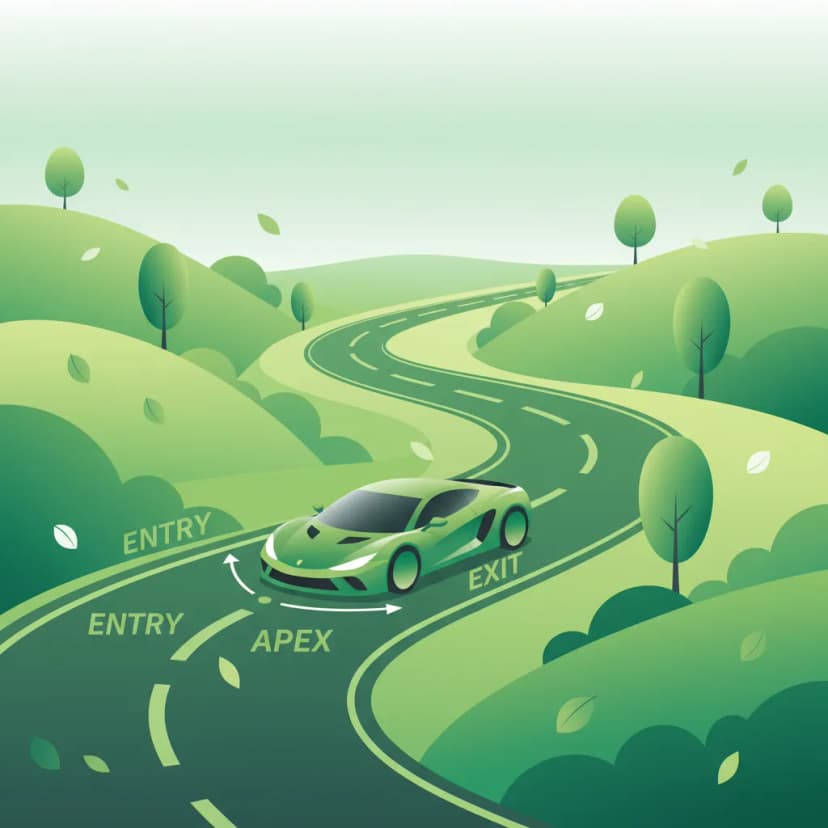
This lesson teaches a systematic approach to cornering by breaking it down into three distinct phases: entry, apex, and exit. It explains how to choose the correct road position and entry speed, identify the safest apex (not always the geometric one), and apply the throttle smoothly on exit to maximize stability and safety. This 'slow in, fast out' methodology provides a structured, repeatable process for navigating any corner with confidence and control.

Proper cornering technique is vital for safety and stability on a two-wheeler. This lesson explains the physics of turning, including the concepts of lean angle and counter-steering. You will learn the importance of adjusting your speed before the turn, looking where you want to go, and maintaining a smooth throttle through the corner. These techniques help you maximize grip and maintain control, ensuring you can navigate bends safely.
This lesson demystifies the concept of counter-steering, the primary method for controlling a motorcycle at any speed above a walking pace. It explains the physics behind why pressing on the inside handlebar initiates a lean and turn in that direction. Mastering this non-intuitive but essential skill is fundamental for fluid cornering, precise line control, and the ability to execute rapid, life-saving swerves to avoid unexpected obstacles.
This lesson demystifies the concept of counter-steering, the primary method for steering a motorcycle at speed. It explains how a small push on the handlebar initiates a lean, allowing the bike to turn effectively. The lesson also details how a rider's body position and weight shifting are used in conjunction with steering inputs to control the motorcycle's center of gravity, ensuring stability and precision while cornering.

This lesson explains the principle of counter-steering, the primary method for steering a motorcycle at speeds above a walking pace. You will learn that to turn right, you must momentarily press forward on the right handlebar, and to turn left, you press the left one. The content demystifies the physics behind this technique, explaining how it uses gyroscopic forces to initiate a lean, which is what actually makes the motorcycle turn.
This lesson addresses the specific challenge of cornering when road grip is compromised. It teaches riders how to identify potential low-traction surfaces like wet manhole covers, painted lines, gravel, or oil patches. The content focuses on techniques to mitigate risk, such as reducing speed, minimizing lean angle, and applying all control inputs—braking, steering, and throttle—with exceptional smoothness to avoid overwhelming the available grip.
Find clear answers to common questions learners have about Proper Corner Entry and Exit Techniques. Learn how the lesson is structured, which driving theory objectives it supports, and how it fits into the overall learning path of units and curriculum progression in the Netherlands. These explanations help you understand key concepts, lesson flow, and exam focused study goals.
This principle ensures you complete all braking and downshifting before entering the turn, allowing you to focus purely on steering and acceleration through the corner. It minimizes the risk of losing traction or unsettling the bike mid-bend, which is crucial for safety and exam success, especially on potentially unfamiliar Dutch roads.
The ideal line often means starting wide, moving towards the apex (the innermost point of the curve), and then widening out again on the exit. This maximizes your sight distance through the turn and allows for a smoother, more controlled trajectory, which is vital for anticipating hazards and maintaining stability.
The apex is the point where you get closest to the inside of the curve. Identifying the correct apex helps you use the maximum available road width for the turn, allowing for a shallower lean angle and enabling earlier, smoother throttle application on the exit, leading to greater stability and control for A1 motorcycle riders.
Ideally, all significant braking should be completed before entering the corner. Braking while leaned over can reduce tire grip and potentially cause the motorcycle to stand up, widening your turn or even causing a fall. In an emergency, gentle, progressive braking with caution is possible, but it's generally advised to avoid it if possible for safe A1 motorcycle handling.
Smooth, progressive throttle application on the exit of a corner helps transfer weight to the rear wheel, increasing traction and stabilizing the motorcycle. Abrupt acceleration can cause the rear wheel to lose grip, while maintaining a constant, gentle throttle helps the bike track smoothly out of the bend, which is important for safe A1 motorcycle riding in the Netherlands.