
Welcome to the 'Fundamentals of Counter-Steering' lesson, a key part of your Dutch Category A2 motorcycle theory preparation. This lesson demystifies the essential technique of counter-steering, explaining how to initiate turns and control your motorcycle at speed. Mastering this is crucial for safe cornering and exam success.

For motorcycle riders, especially those preparing for their Dutch Category A2 license, understanding how a motorcycle turns at speed is fundamental to safe and confident riding. Unlike bicycles or very slow-moving motorcycles, where steering involves directly turning the handlebars in the direction you want to go, higher speeds introduce a different, yet essential, technique: counter-steering. This lesson will demystify counter-steering, explaining its mechanics, the physics behind it, and its crucial role in navigating Dutch roads safely and efficiently.
Counter-steering is the primary method used to steer a motorcycle at speeds above approximately 15 km/h. It's a deliberate, momentary input on the handlebars that might initially feel counter-intuitive. To turn the motorcycle to the right, you momentarily push the right handlebar forward (or pull the left handlebar). Conversely, to initiate a left turn, you push the left handlebar forward (or pull the right). This brief, opposite input causes the motorcycle to lean into the desired turn, which is what ultimately makes it corner.
This technique is not merely an advanced trick; it's the most effective and safest way to control your motorcycle's trajectory at typical riding speeds. Without proper counter-steering, a rider would struggle to achieve the necessary lean angle for a stable turn, especially when needing to make quick adjustments or navigate sharper bends. It allows for precise control, stability, and responsiveness, all critical for passing your CBR theory exam and riding safely on Dutch roads.
While experienced riders often perform counter-steering almost unconsciously, it's important to differentiate between its forms:
The practical meaning is that if you want to turn right, you briefly push the right handlebar forward. This creates a tiny, almost instant steer to the left, which then causes the bike to lean right due to gyroscopic forces. Once the desired lean is achieved, you typically relax the pressure, allowing the bike to maintain its lean and follow the curve. Holding the pressure throughout the turn is a common misconception and can lead to instability.
To truly understand counter-steering, we must delve into the fascinating physics that govern a motorcycle's stability and turning. The rotating wheels, acting like gyroscopes, are key to this process.
The phenomenon at the heart of counter-steering is gyroscopic precession. A gyroscope is a spinning object that resists changes to its axis of rotation. When a force is applied to a spinning wheel, it doesn't immediately move in the direction of that force. Instead, it reacts by moving perpendicular to the applied force.
On a motorcycle, when you push the right handlebar forward, you are applying a torque to the front wheel, causing it to briefly steer slightly to the left. Because the front wheel is spinning at speed, gyroscopic precession causes it to resist this leftward steer by generating a perpendicular force. This force pushes the top of the motorcycle to the right, initiating a lean to the right—the direction you actually want to turn.
The faster the front wheel spins (i.e., the faster you are riding), the greater the gyroscopic effect, and thus, the more responsive the motorcycle is to counter-steering inputs. This is why counter-steering is ineffective at very low speeds where gyroscopic forces are minimal, and direct handlebar steering is used instead.
Once initiated by counter-steering, the motorcycle leans into the turn. The lean angle is the critical factor that allows the motorcycle to successfully navigate a curve.
When a motorcycle turns, centrifugal force (the apparent outward force) tries to push it upright and out of the curve. To counteract this, the rider and bike must lean into the turn. This lean generates a component of the tire's grip that provides the necessary centripetal force (inward force) to keep the bike on its curved path. The correct lean angle is determined by your speed and the radius of the curve. A higher speed or tighter curve requires a greater lean angle.
The traction circle represents the total available grip a tire has. It describes the maximum combination of braking, acceleration, and cornering forces that a tire can generate before losing traction. As you lean a motorcycle into a turn, a significant portion of the tire's grip is used to generate lateral (sideways) force. This reduces the amount of grip available for braking or acceleration. Exceeding the limits of the traction circle, either by leaning too far, braking too hard, or accelerating too aggressively, will cause the tire to slip and potentially lead to a loss of control.
For example, at 50 km/h, a curve with a radius of 30 meters demands approximately a 15-degree lean. Exceeding 20 degrees in such conditions, especially on less-than-ideal surfaces, could cause tire slip. Maintaining the ideal lean angle ensures sufficient tire contact patch and grip, keeping you stable and safe through the corner.
Beyond gyroscopic forces, the inherent design of a motorcycle's front end, known as its steering geometry, significantly influences how it handles and responds to counter-steering. Key geometric parameters include rake, trail, and head-angle.
Sport bikes, designed for agility and quick changes of direction, typically have steeper rake angles and shorter trail measurements, making them very responsive to counter-steering. Cruiser-style motorcycles, built for stable highway cruising, often feature shallower rake angles and longer trail, requiring more deliberate counter-steering inputs to initiate a lean. While steering geometry contributes to the bike's natural stability and self-centering tendency, it does not replace the need for active counter-steering; it merely modulates the effort required from the rider.
Executing counter-steering effectively requires a coordinated effort between your hands, body, throttle, and brakes.
The fundamental practical action of counter-steering is a brief, firm push on the handlebar on the side corresponding to your desired turn.
A common misunderstanding among novice riders is the belief that you "pull the left handlebar to go left." This is incorrect. Pulling the left handlebar would effectively push the right handlebar forward, causing the bike to lean to the right. Always remember: push the handlebar on the side you wish to turn.
While counter-steering initiates the lean, your body positioning plays a crucial role in refining and fine-tuning that lean, reducing the effort needed, and enhancing stability.
By shifting your torso and hips towards the inside of the turn, you move the combined center of gravity of the rider and bike. This allows the motorcycle to achieve a desired lean angle with less actual motorcycle lean, meaning the bike itself doesn't have to lean as far. This can be particularly advantageous in slippery conditions or when you're pushing the limits of available traction. Techniques include:
For instance, on a 30 km/h right-hand curve, a rider shifting their torso to the right might reduce the bike's required lean from 10 degrees to about 7 degrees. Proper body positioning enhances grip, reduces fatigue, and allows for more precise control throughout the corner.
The interaction between throttle, braking, and counter-steering is vital for smooth, stable, and safe cornering.
Engine torque, transmitted to the rear wheel, significantly influences a motorcycle's stability and handling during a lean.
In a 60 km/h right bend, for example, a smooth increase of 10% throttle after initiating counter-steer can help keep the rear wheel planted and stable.
Braking significantly alters weight distribution on a motorcycle, which in turn affects the effectiveness of counter-steering and overall cornering stability.
For instance, a rider applying 10% front brake while counter-steering into a 45 km/h curve can improve front-wheel stability and feel. This technique is often taught in advanced riding courses but is a crucial concept for understanding vehicle dynamics.
The correct application of counter-steering is not just a matter of riding skill; it is implicitly required by Dutch traffic laws concerning safe vehicle operation. These regulations ensure that riders maintain control and do not endanger others.
The Reglement verkeersregels en verkeerstekens 1990 (RVV 1990), Article 3.1, states a fundamental principle:
Article 3.2 of the RVV 1990 reinforces safe vehicle operation, particularly concerning braking and speed:
While not explicitly mentioning counter-steering, the Dutch Highway Code (Wegcode), in sections like §13, outlines general rules for turning:
Misunderstanding or misapplying counter-steering can lead to dangerous situations. Recognizing these common errors is crucial for safe riding.
Effective counter-steering isn't a static technique; it requires adaptation to various environmental and vehicle conditions.
Mastering counter-steering is a foundational skill that opens the door to more advanced riding techniques crucial for your CBR Theory Course and beyond.
This lesson on counter-steering provides the physical and theoretical basis for these future topics, ensuring you build a robust foundation for your complete CBR Theory Course for the Dutch Motorcycle License (Category A2).
Lesson content overview
Explore all units and lessons included in this driving theory course.
Explore search topics learners often look for when studying Fundamentals of Counter-Steering. These topics reflect common questions about road rules, driving situations, safety guidance, and lesson level theory preparation for learners in the Netherlands.
Browse additional driving theory lessons that cover connected traffic rules, road signs, and common driving situations related to this topic. Improve your understanding of how different rules interact across everyday traffic scenarios.
Explore advanced techniques for motorcycle cornering, building on counter-steering. Understand how body positioning, throttle control, and braking influences lean angle and stability. Essential for safe riding and Dutch theory exam preparation.
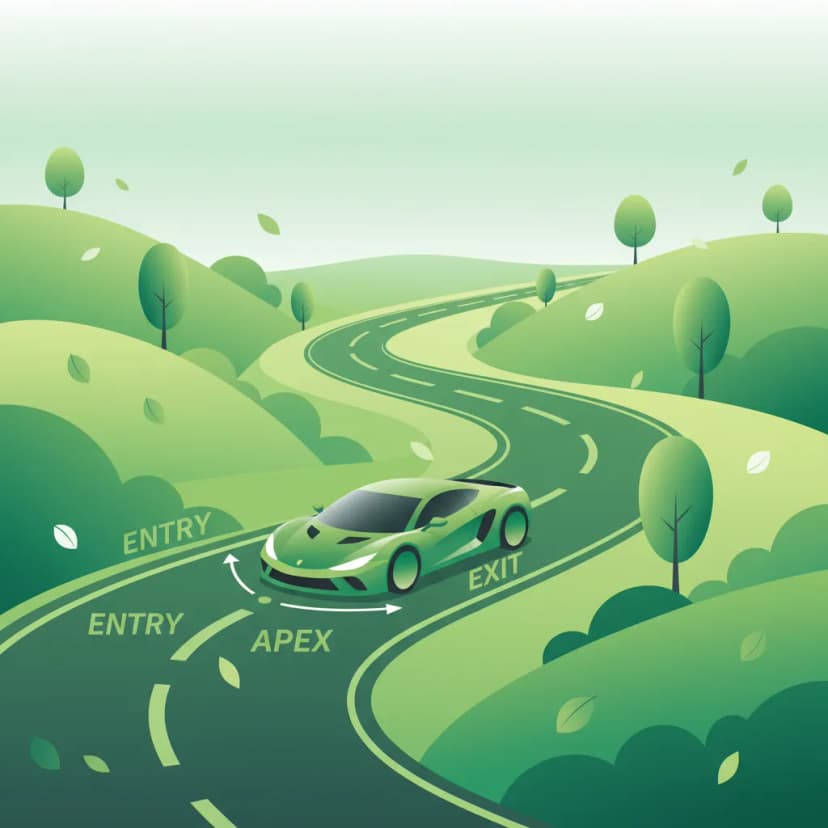
This lesson teaches a systematic approach to cornering by breaking it down into three distinct phases: entry, apex, and exit. It explains how to choose the correct road position and entry speed, identify the safest apex (not always the geometric one), and apply the throttle smoothly on exit to maximize stability and safety. This 'slow in, fast out' methodology provides a structured, repeatable process for navigating any corner with confidence and control.

This lesson details the correct, systematic procedure for safely navigating a corner. It teaches the 'slow in, fast out' principle, where all necessary braking and downshifting is completed before entering the turn. The content covers how to choose the correct line, identify the apex, and use smooth throttle application on the exit to maintain stability and traction, ensuring a safe and controlled passage through the bend.

This lesson addresses the specific challenge of cornering when road grip is compromised. It teaches riders how to identify potential low-traction surfaces like wet manhole covers, painted lines, gravel, or oil patches. The content focuses on techniques to mitigate risk, such as reducing speed, minimizing lean angle, and applying all control inputs—braking, steering, and throttle—with exceptional smoothness to avoid overwhelming the available grip.

This lesson explains how you, the rider, are an active part of the motorcycle's dynamics. You will learn how shifting your body weight into the turn can reduce the required lean angle of the motorcycle itself, increasing the margin of safety and grip. The content covers correct posture, the importance of looking through the turn with your head up, and how to stay relaxed on the controls to allow the bike to work effectively.

This lesson explains the critical role of the rider's body in controlling the motorcycle's dynamics, especially during cornering. It details how shifting body weight alters the combined center of gravity, allowing for greater cornering speed at a given lean angle or a safer lean angle for a given speed. Techniques for correct posture, footpeg weighting, and active body positioning are covered to enhance stability, maximize grip, and provide more precise control.

This lesson provides critical instruction on managing blind spots ('dode hoek') to prevent collisions, particularly during lane changes. It covers the correct setup and use of mirrors, but stresses their limitations and the absolute necessity of the 'lifesaver' shoulder check before any lateral movement. Furthermore, it teaches riders how to be aware of the large blind spots around cars and especially trucks, and how to position themselves on the road to remain visible to other drivers at all times.

This lesson explains how to apply the principle of counter-steering decisively in an emergency situation to perform a rapid swerve. It covers the importance of looking where you want to go, avoiding 'target fixation' on the obstacle, and executing a firm push on the appropriate handlebar to initiate a quick lean and change of direction. This skill is a critical component of collision avoidance for any motorcyclist.

This lesson focuses on the critical relationship between speed, braking, and throttle control in cornering. You will learn the golden rule: complete your braking while the motorcycle is still upright, before initiating your lean. The content then explains how to use a neutral or slightly positive 'maintenance throttle' to keep the suspension settled mid-corner, followed by smoothly rolling on the throttle as you exit the turn to aid stability.

This lesson prepares you for real-world cornering challenges where conditions are not always perfect. You will learn how to identify clues that a corner may be tightening (a decreasing radius) and how to adjust your line accordingly. The content covers strategies for dealing with unexpected hazards like gravel or wet patches mid-corner and emphasizes the importance of always riding in a way that leaves you an escape route or a margin for error.

This lesson demystifies the concept of counter-steering, the primary method for steering a motorcycle at speed. It explains how a small push on the handlebar initiates a lean, allowing the bike to turn effectively. The lesson also details how a rider's body position and weight shifting are used in conjunction with steering inputs to control the motorcycle's center of gravity, ensuring stability and precision while cornering.
Learn to identify and avoid frequent errors in counter-steering application. Understand the physics and practical consequences of incorrect inputs for safer motorcycle handling and improved understanding of Dutch traffic rules.

This lesson demystifies the concept of counter-steering, the primary method for controlling a motorcycle at any speed above a walking pace. It explains the physics behind why pressing on the inside handlebar initiates a lean and turn in that direction. Mastering this non-intuitive but essential skill is fundamental for fluid cornering, precise line control, and the ability to execute rapid, life-saving swerves to avoid unexpected obstacles.
This lesson demystifies the concept of counter-steering, the primary method for steering a motorcycle at speed. It explains how a small push on the handlebar initiates a lean, allowing the bike to turn effectively. The lesson also details how a rider's body position and weight shifting are used in conjunction with steering inputs to control the motorcycle's center of gravity, ensuring stability and precision while cornering.
This lesson explains how to apply the principle of counter-steering decisively in an emergency situation to perform a rapid swerve. It covers the importance of looking where you want to go, avoiding 'target fixation' on the obstacle, and executing a firm push on the appropriate handlebar to initiate a quick lean and change of direction. This skill is a critical component of collision avoidance for any motorcyclist.
This lesson explains how you, the rider, are an active part of the motorcycle's dynamics. You will learn how shifting your body weight into the turn can reduce the required lean angle of the motorcycle itself, increasing the margin of safety and grip. The content covers correct posture, the importance of looking through the turn with your head up, and how to stay relaxed on the controls to allow the bike to work effectively.

This lesson teaches the technique for swerving when stopping is not possible. You will learn that a swerve is initiated with a decisive counter-steer: press right to go right, press left to go left. The content emphasizes the importance of separating braking from swerving—ideally, you brake first, then release the brakes to execute the swerve, maintaining maximum available traction for steering.
This lesson explains the critical role of the rider's body in controlling the motorcycle's dynamics, especially during cornering. It details how shifting body weight alters the combined center of gravity, allowing for greater cornering speed at a given lean angle or a safer lean angle for a given speed. Techniques for correct posture, footpeg weighting, and active body positioning are covered to enhance stability, maximize grip, and provide more precise control.
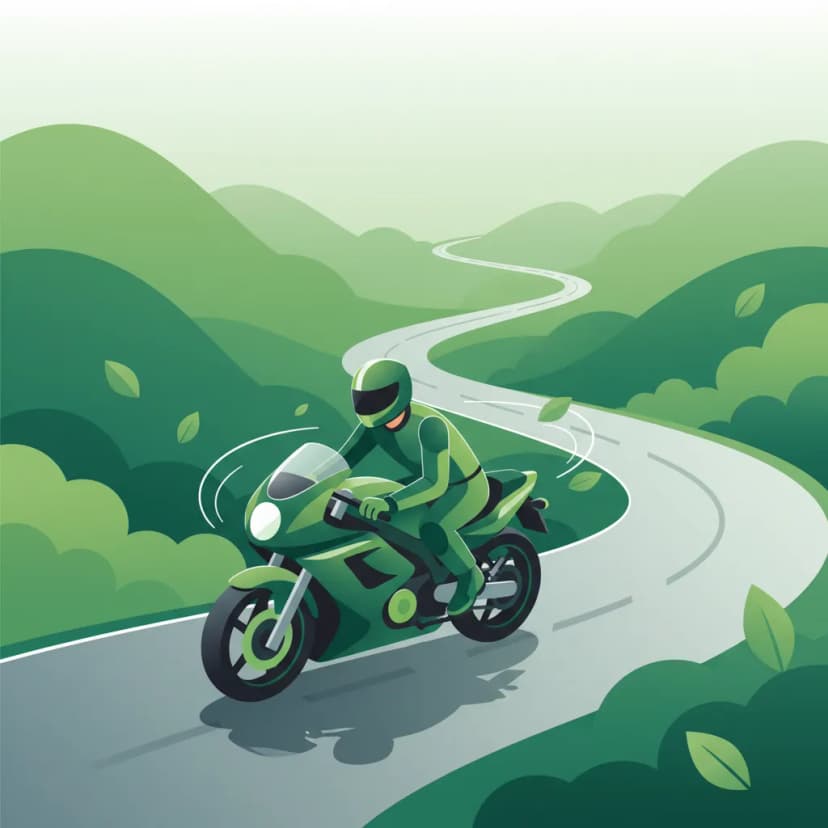
Proper cornering technique is vital for safety and stability on a two-wheeler. This lesson explains the physics of turning, including the concepts of lean angle and counter-steering. You will learn the importance of adjusting your speed before the turn, looking where you want to go, and maintaining a smooth throttle through the corner. These techniques help you maximize grip and maintain control, ensuring you can navigate bends safely.
This lesson focuses on the critical relationship between speed, braking, and throttle control in cornering. You will learn the golden rule: complete your braking while the motorcycle is still upright, before initiating your lean. The content then explains how to use a neutral or slightly positive 'maintenance throttle' to keep the suspension settled mid-corner, followed by smoothly rolling on the throttle as you exit the turn to aid stability.
This lesson teaches a systematic approach to cornering by breaking it down into three distinct phases: entry, apex, and exit. It explains how to choose the correct road position and entry speed, identify the safest apex (not always the geometric one), and apply the throttle smoothly on exit to maximize stability and safety. This 'slow in, fast out' methodology provides a structured, repeatable process for navigating any corner with confidence and control.
This lesson provides critical instruction on managing blind spots ('dode hoek') to prevent collisions, particularly during lane changes. It covers the correct setup and use of mirrors, but stresses their limitations and the absolute necessity of the 'lifesaver' shoulder check before any lateral movement. Furthermore, it teaches riders how to be aware of the large blind spots around cars and especially trucks, and how to position themselves on the road to remain visible to other drivers at all times.
Find clear answers to common questions learners have about Fundamentals of Counter-Steering. Learn how the lesson is structured, which driving theory objectives it supports, and how it fits into the overall learning path of units and curriculum progression in the Netherlands. These explanations help you understand key concepts, lesson flow, and exam focused study goals.
Pushing forward on the handlebar you want to turn towards (e.g., left handlebar for a left turn) momentarily causes the front wheel to turn slightly in that direction. This initiates a lean to the opposite side due to gyroscopic forces and the motorcycle's geometry, which is what actually makes the bike turn. It's a fundamental principle of motorcycle dynamics.
Counter-steering is essential for turning a motorcycle at any speed above a slow walk. At very low speeds, you might use body weight and slight handlebar adjustments, but once you gain momentum, counter-steering becomes the primary and most effective method for initiating and controlling turns.
The concept can seem counter-intuitive at first. However, the physical action is usually gentle. Many riders learn to apply it instinctively with practice. This lesson focuses on the theory, which helps build the mental understanding necessary for developing the physical skill.
The Dutch CBR exam tests your understanding of safe riding principles. Questions may arise about how to control the motorcycle during turns, the physics involved, or how to react safely in different road situations. Understanding counter-steering is key to answering these questions correctly and demonstrating theoretical knowledge of safe motorcycle operation.
While the fundamental principle of counter-steering remains the same across most motorcycles, factors like wheelbase, rake and trail, and weight distribution can influence how sensitive the motorcycle is to handlebar inputs. However, for the purpose of the theory exam and basic understanding, the core principle is universally applicable.