
This lesson focuses on the critical safety strategy of adjusting your following distance for adverse conditions like rain, fog, and strong winds. Understanding how these conditions affect your braking and visibility is essential for safe A2 motorcycle riding and passing the Dutch theory exam. It builds on basic following distance principles and prepares you for more complex hazard perception scenarios.
Motorcycle riding demands constant vigilance and dynamic adaptation, especially when facing challenging road and weather conditions. This lesson, part of your complete CBR theory course for the Dutch Motorcycle License (Category A2), focuses on a critical aspect of rider safety: adjusting your following distance. While the basic two-second rule provides a foundation, adverse conditions drastically alter the dynamics of stopping, requiring riders to extend their safety margins significantly. Understanding how factors like wet roads, reduced visibility, and strong winds affect your stopping capability is fundamental to preventing collisions and maintaining control.
Maintaining an adequate following distance, often referred to as a "space cushion," is not merely a recommendation; it is a vital safety strategy. For motorcyclists, the consequences of insufficient distance can be particularly severe, as motorcycles offer less protection in a collision compared to cars. When conditions are adverse – meaning wet roads, fog, heavy rain, or strong winds – the distance required to perceive a hazard, react, and bring your motorcycle to a complete stop increases dramatically.
A properly adjusted following distance ensures you have enough time to react to unexpected events, allows your braking system (including ABS, if equipped) to operate effectively without exceeding available grip, and provides a buffer zone in case of a skid or loss of control. This proactive approach to spacing directly prevents rear-end collisions, which can be catastrophic for motorcyclists.
Unlike a static rule that applies universally, dynamic following distance is the practice of continuously assessing and modifying the longitudinal gap between your motorcycle and the vehicle ahead. This gap must vary with your speed, the condition of the road surface, overall visibility, and other environmental factors like wind. The primary goal is to guarantee that you always have sufficient time for perception, reaction, and safe braking under the prevailing circumstances.
A static "two-second rule," while a useful baseline in ideal dry and clear conditions, becomes inadequate and even dangerous in adverse situations. As a Category A2 rider, you must cultivate the habit of dynamically adjusting this time-based gap, often extending it to three, four, or even more seconds to maintain safety. This constant assessment and adjustment are what define a responsible and skilled motorcyclist.
Several environmental and physical factors can significantly alter the total distance required to stop your motorcycle. Being aware of these elements and their specific effects is crucial for making informed decisions about your following distance.
The most significant factor influencing braking distance is the friction coefficient (µ) between your tyres and the road surface. This coefficient describes the amount of grip available. On a clean, dry asphalt road, the friction coefficient is relatively high (typically around 0.7-0.9), allowing for effective braking. However, adverse conditions drastically reduce this grip.
Wet Roads: When rain falls, especially after a dry spell, it mixes with oil, dust, and rubber particles on the road, creating a greasy film. This film, along with the water itself, significantly reduces friction. On a wet road, the friction coefficient can drop to approximately 0.35-0.45, roughly half of what it is on dry pavement.
This reduction in grip has a profound impact on your braking distance. Since braking distance is proportional to the square of your speed and inversely proportional to the friction coefficient (dbrake = v² / (2 × μ × g)), halving the friction coefficient effectively doubles your braking distance. For example, if you need 15 metres to stop at 60 km/h on a dry road, you might need around 30 metres or more on a wet surface.
Other Slippery Surfaces: Beyond rain, other conditions can reduce grip:
Never assume your braking distance is consistent. Always assess the road surface ahead and adjust your following distance to account for any potential loss of grip.
Perception-reaction time (PRT) is the interval from when you first perceive a hazard to the moment you initiate an action, such as applying the brakes. Under ideal conditions, a typical PRT is around 1 second for an attentive rider. However, several factors can significantly increase this time:
The impact of an increased PRT on your total stopping distance is significant. At 80 km/h, your motorcycle travels approximately 22 metres per second. If your PRT increases by just one second, you will travel an additional 22 metres before even touching the brakes. This underscores why a larger time-based following gap is essential when visibility is poor, as it directly compensates for the delayed hazard detection. For example, if fog reduces visibility to 30 metres, you might need to increase your following distance to at least 5 seconds, allowing you to stop within the visible range.
Crosswinds are lateral aerodynamic forces that can significantly affect a motorcycle's stability, particularly at higher speeds and on open stretches of road like bridges or motorways. These forces can cause the motorcycle to drift sideways, making it harder to maintain a straight line and control your vehicle.
When your motorcycle is being affected by a crosswind, your attention and physical effort are diverted to maintaining lateral stability. This can compromise your ability to react to hazards ahead or to brake efficiently, as lateral forces can reduce the effective grip available for braking. Therefore, in strong or gusty crosswind conditions, it is prudent to add an extra 0.5 to 1.0 second to your normal following distance. This additional space provides a buffer for unexpected drifts and gives you more time to recover control if a sudden gust occurs.
Your visibility range is the maximum distance ahead at which you can reliably see and identify obstacles under current lighting and weather conditions. This range directly dictates the maximum safe speed and the minimum safe following distance you should maintain.
A fundamental principle of safe riding is that your following distance must at least match your visibility range. You must be able to stop safely within the distance you can see. If you cannot see far enough to stop before a potential hazard appears, you are travelling too fast for the conditions. In dense fog, for example, if your visibility is only 30 metres, your following distance (and speed) must ensure you can stop within that 30-metre limit. Relying on the taillights of the vehicle ahead is dangerous, as they might brake suddenly, or you might fail to see a hazard that their vehicle clears.
In low visibility, it's not just about seeing; it's about being seen. Use your dipped beams, and if equipped, your fog lights. Avoid high beams in fog as they can reduce your own visibility.
While a precise calculation isn't always feasible while riding, time-based following distances provide a practical and easily measurable method for ensuring safety. The baseline is the two-second rule for dry, clear conditions. For adverse conditions, you must extend this baseline. These are minimum recommendations, and you should always err on the side of caution.
| Condition | Minimum Time Gap (seconds) | Reasoning |
|---|---|---|
| Dry, clear daylight | 2.0 – 2.5 | Standard baseline for ideal conditions. |
| Wet (light rain, damp road) | 3.0 – 3.5 | Reduced friction; increased braking distance. |
| Wet (standing water, heavy rain) | 3.5 – 4.0 | Significantly reduced friction (braking distance can double); added safety margin. |
| Heavy rain (with spray) | 4.0 – 5.0 | Reduced visibility combined with lower grip. |
| Fog (< 50 m visibility) | 4.5 – 6.0 | Visibility limits hazard detection; higher PRT. |
| Night (no street lighting) | 3.5 – 4.5 | Higher PRT due to reduced contrast and depth perception. |
| Strong cross-wind (> 15 km/h) | Add 0.5 – 1.0 s | Compensates for lateral instability and recovery time. |
| Mixed (wet + fog) | 5.0 – 7.0 | Compounded effects require a much larger safety margin. |
These recommended time gaps are additive. If you are riding at night in heavy rain, you would add the increments for both conditions to your baseline. For instance, a 2.5-second baseline + 1.5 seconds for heavy rain + 1.0 second for night would suggest a 5.0-second gap as a minimum.
In the Netherlands, specific laws govern driver behaviour, including the requirement to maintain a safe following distance. The core regulation is RVV 1990 article 33, which places a clear legal duty on all road users, including motorcyclists.
"A driver shall keep a distance that allows safe stopping without endangering other road users, taking into account speed, road, weather, and vehicle condition."
This article is fundamental because it makes the adaptation of following distance mandatory based on prevailing conditions. It is not sufficient to simply maintain a generic distance; that distance must be safe for the specific circumstances. Non-compliance with Article 33 can result in a significant fine and potential demerit points. This legal requirement underscores the importance of the dynamic following distance principle discussed throughout this lesson.
For example, a motorcyclist on a wet highway who maintains a 4-second gap at 80 km/h is acting in compliance with RVV 1990 article 33. Conversely, the same rider keeping only a 2-second gap on that wet surface would be in violation of the law because their stopping distance would be insufficient for the conditions.
While RVV 1990 article 33 is the primary regulation for following distance, other laws and guidelines also play a role in ensuring a motorcyclist's ability to stop safely in adverse conditions:
A low-intensity headlamp setting for normal night driving and conditions of reduced visibility (rain, fog, dusk).
A high-intensity headlamp setting intended for open roads with no street lighting and no oncoming traffic. It should never be used in fog or heavy rain, as it scatters light, reducing visibility for both the rider and other road users.
Even experienced riders can sometimes fall into common traps or misunderstandings regarding safe following distance in adverse conditions. Being aware of these errors can help you avoid them.
The required following distance is a dynamic value influenced by a multitude of factors. A skilled motorcyclist continually assesses these factors and adjusts their riding accordingly.
Understanding the underlying principles reinforces the importance of adjusting your following distance.
Let's look at how these principles translate into practical riding decisions for a Category A2 motorcyclist.
Mastering the art of adjusting your following distance in adverse conditions is a hallmark of a responsible and safe motorcyclist. As you progress through your Dutch Category A2 motorcycle license theory, remember these critical principles:
By integrating these principles into your riding habits, you will significantly enhance your safety and confidence on Dutch roads, preparing you effectively for both your theory exam and real-world motorcycle riding.
Lesson content overview
Explore all units and lessons included in this driving theory course.
Explore search topics learners often look for when studying Adjusting Following Distance in Adverse Conditions. These topics reflect common questions about road rules, driving situations, safety guidance, and lesson level theory preparation for learners in the Netherlands.
Browse additional driving theory lessons that cover connected traffic rules, road signs, and common driving situations related to this topic. Improve your understanding of how different rules interact across everyday traffic scenarios.
Understand how to dynamically adjust your following distance in rain, fog, strong winds, and darkness. Learn the physics, legal requirements (RVV 1990 Article 33), and practical time-based gaps needed for A2 motorcycle theory in the Netherlands.
This lesson explains why the standard two-second rule is insufficient in adverse conditions and requires extension. It details how factors like rain, fog, and darkness reduce both visibility and tire grip, thereby significantly increasing total stopping distance. The content provides practical guidelines, such as extending the following gap to four seconds or more in the wet, to ensure the rider always has enough time and space to stop safely, regardless of the conditions.

This lesson focuses on the crucial safety practice of maintaining an adequate following distance to the vehicle ahead. It explains the 'two-second rule' as a minimum baseline and emphasizes the need to increase this gap to three or four seconds in adverse conditions like rain or poor visibility. For a motorcyclist, this 'space cushion' is a critical buffer that provides the necessary time and space to react to sudden hazards or stop safely.

This lesson reinforces the critical relationship between adverse conditions, reduced traction, and massively increased stopping distances. It provides a clear framework for how much riders need to increase their following distance and reduce their overall speed to maintain a safe margin for error. The curriculum teaches riders to constantly reassess their speed based on visual feedback from the road surface and the level of visibility, ensuring they can always stop within the distance they can clearly see.
This lesson provides a detailed guide to riding in wet and low-visibility conditions. You will learn to make all your control inputs—braking, accelerating, and steering—exceptionally smooth to avoid breaking traction on slippery surfaces. The content covers the dangers of painted lines and manhole covers when wet, and the importance of increasing your following distance dramatically to account for longer braking distances.
This lesson addresses the dual challenge of poor visibility: being able to see the road ahead and ensuring other road users can see you. It covers techniques for riding in fog and heavy rain, such as using appropriate lights and reducing speed to match sight distance. The lesson also discusses practical issues like helmet visor fogging and the importance of wearing high-visibility or reflective clothing to enhance conspicuity in low-light conditions.
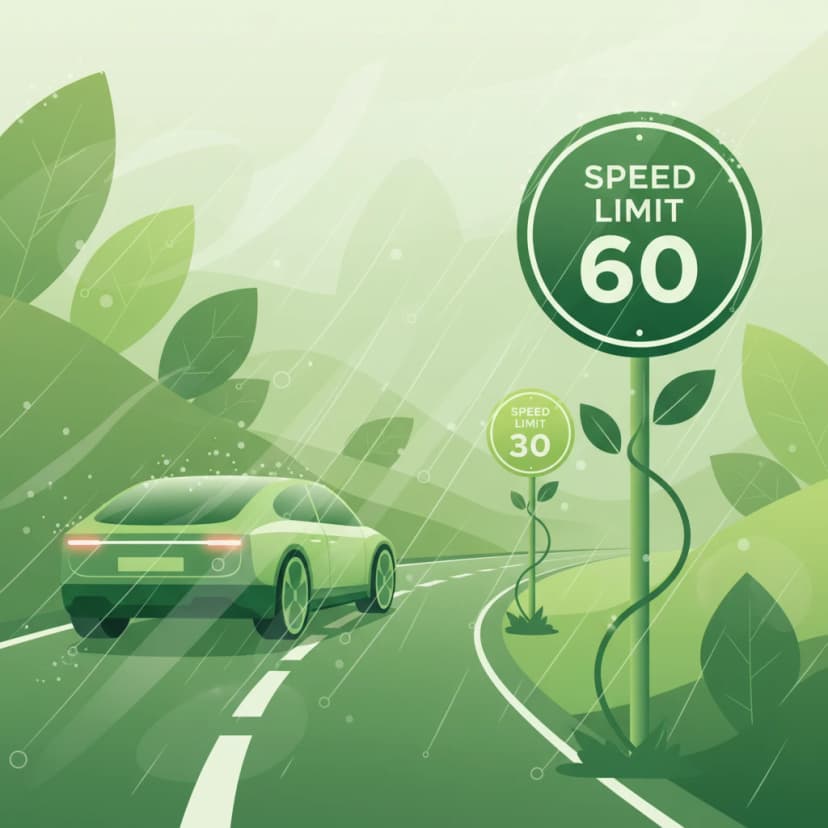
This lesson emphasizes the critical importance of adapting your speed to prevailing conditions, which may require driving slower than the legal limit. You will learn how factors like rain, fog, snow, and darkness significantly increase braking distances and reduce visibility. The curriculum explains the dangers of aquaplaning on wet roads and black ice in winter. The core principle taught is that a safe driver always adjusts their speed to ensure they can stop within the distance they can see to be clear.
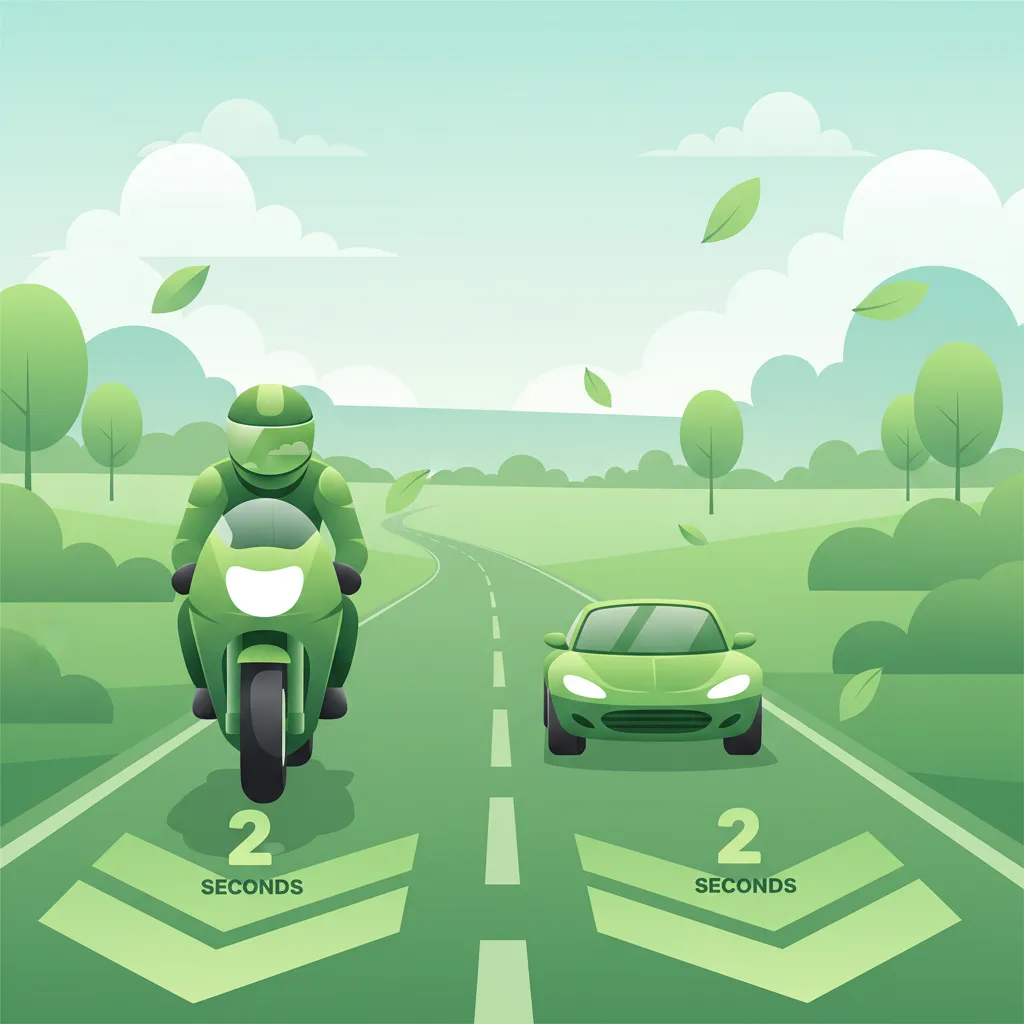
This lesson explains the two-second rule, a simple and effective technique for ensuring you have enough time to react and stop safely. You will learn how to use a fixed object on the roadside to measure the time gap between your motorcycle and the vehicle ahead. The content emphasizes why motorcyclists may need to extend this gap to three or more seconds in poor weather, at high speeds, or in heavy traffic.

This lesson revisits the concept of following distance, emphasizing its heightened importance in the high-speed motorway environment. It explains how increased speeds dramatically lengthen both reaction and braking distances, making a minimum two-to-three-second gap absolutely critical for safety. The content also stresses the importance of maintaining a space cushion to the sides, creating potential escape routes in case of sudden incidents in adjacent lanes.

Riding on two wheels requires special care on surfaces with reduced grip. This lesson teaches you how to handle challenging conditions like rain, ice, wet leaves, or tram tracks. Key principles include reducing speed significantly, making all control inputs (braking, accelerating, steering) much more smoothly and gradually, and increasing your following distance to allow for much longer stopping distances. Recognizing potentially slippery areas is a critical part of proactive hazard perception.

Rain significantly reduces tire grip and rider visibility. This lesson covers the essential adjustments needed for wet-weather riding, including reducing speed, increasing following distance, and applying all controls more smoothly. It explains the danger of hydroplaning (aquaplaning) when tires lose contact with the road over standing water and how to avoid it. You will also learn about the importance of good tire tread depth for channeling water away and maintaining traction.
Explore the science behind total stopping distance for motorcycles. This lesson details how speed, friction, perception-reaction time, and vehicle factors like ABS influence your ability to stop safely, with a focus on Dutch traffic law.
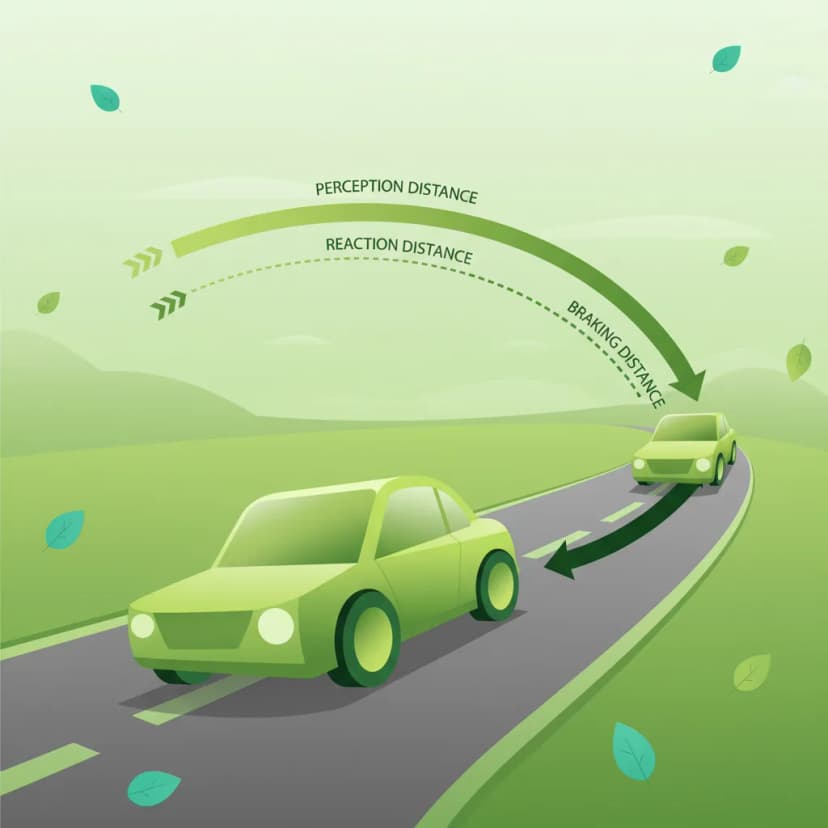
This lesson breaks down the concept of total stopping distance into its two key parts: the distance traveled during your reaction time and the distance the motorcycle travels after the brakes are applied. You will learn the formulas and rules of thumb for estimating these distances at various speeds. The content highlights how factors like rider fatigue, road surface conditions, and tyre quality can significantly increase your overall stopping distance.
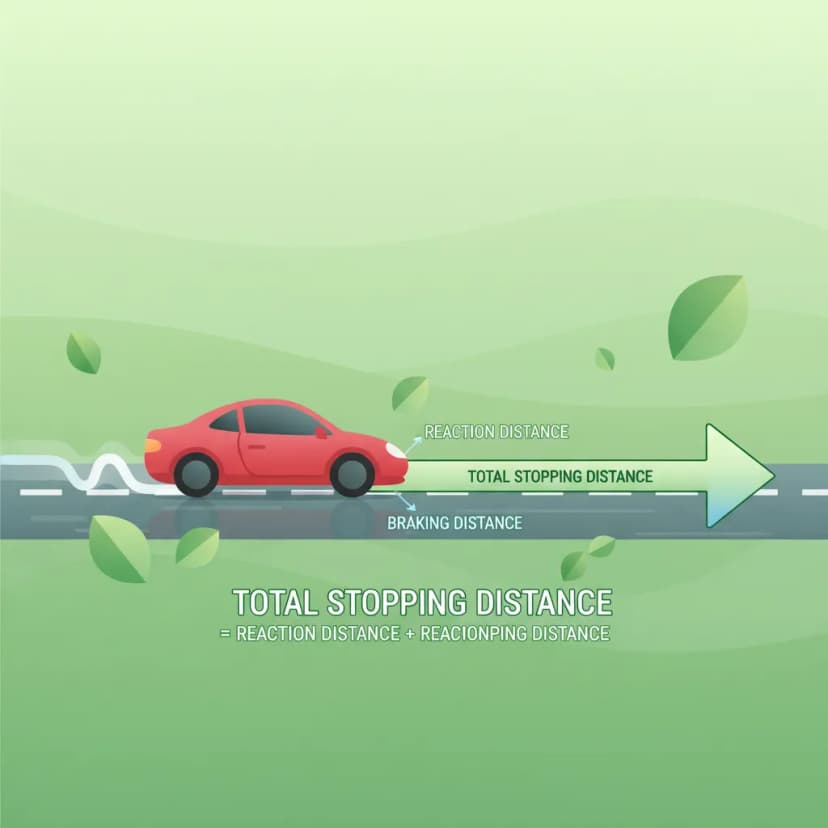
This lesson provides a theoretical understanding of the components that make up the total stopping distance. It explains how to calculate reaction distance (the distance traveled before applying the brakes) and braking distance (the distance traveled while braking). The content highlights how speed exponentially increases stopping distance and how other variables like rider alertness, road grip, and brake condition play a significant role in the final calculation.
This lesson provides a detailed explanation of the two-second rule as a simple yet effective method for maintaining a safe following distance in good conditions. It breaks down the concept of total stopping distance into its two components: reaction distance (the distance traveled before applying the brakes) and braking distance (the distance traveled while braking). Understanding this calculation is fundamental for appreciating the need for a sufficient space cushion to react to sudden events ahead.
This lesson reinforces the critical relationship between adverse conditions, reduced traction, and massively increased stopping distances. It provides a clear framework for how much riders need to increase their following distance and reduce their overall speed to maintain a safe margin for error. The curriculum teaches riders to constantly reassess their speed based on visual feedback from the road surface and the level of visibility, ensuring they can always stop within the distance they can clearly see.
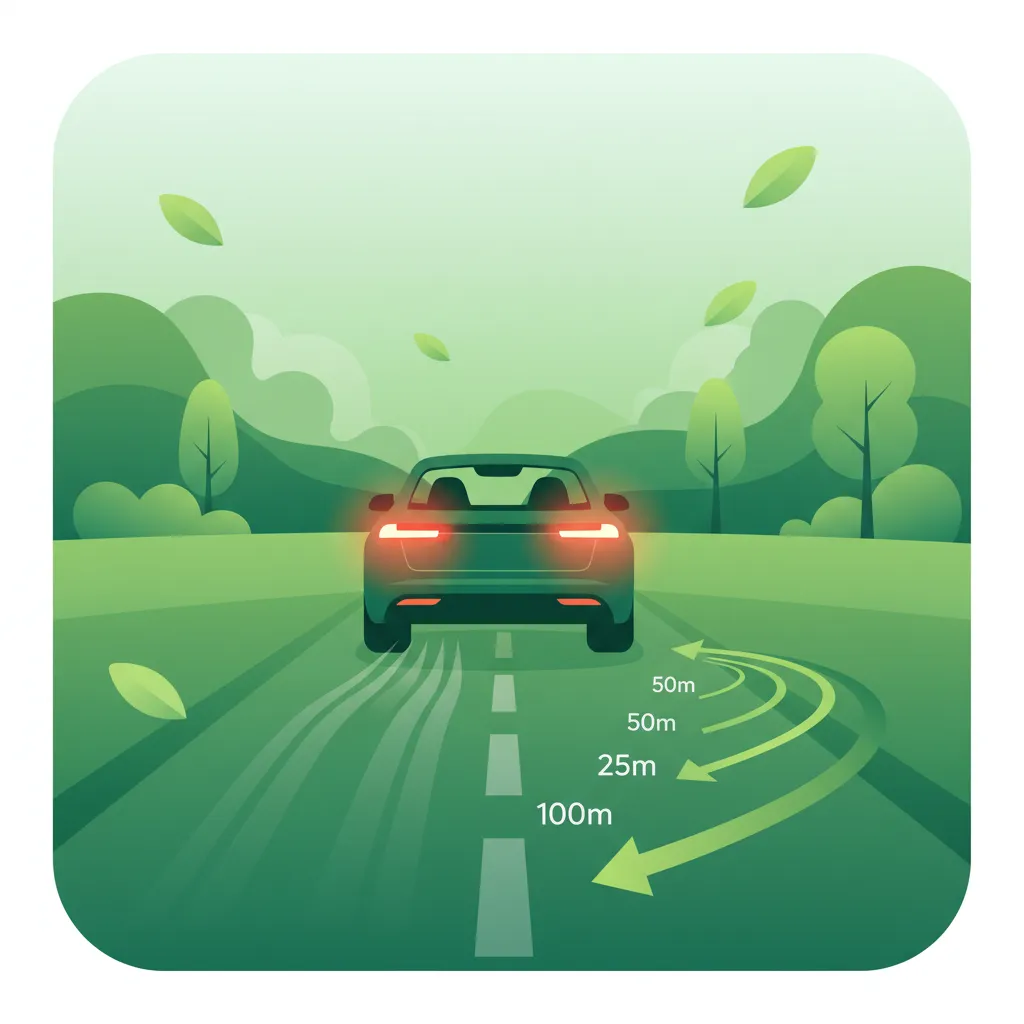
This lesson explains the components of the total stopping distance: the reaction distance (distance traveled before you start braking) and the braking distance (distance traveled while braking). You will learn the general formulas and rules of thumb for estimating these distances at different speeds. Understanding that braking distance increases exponentially with speed is a critical piece of knowledge that reinforces the importance of maintaining safe speeds and following distances.
This lesson explains why the standard two-second rule is insufficient in adverse conditions and requires extension. It details how factors like rain, fog, and darkness reduce both visibility and tire grip, thereby significantly increasing total stopping distance. The content provides practical guidelines, such as extending the following gap to four seconds or more in the wet, to ensure the rider always has enough time and space to stop safely, regardless of the conditions.
This lesson revisits the concept of following distance, emphasizing its heightened importance in the high-speed motorway environment. It explains how increased speeds dramatically lengthen both reaction and braking distances, making a minimum two-to-three-second gap absolutely critical for safety. The content also stresses the importance of maintaining a space cushion to the sides, creating potential escape routes in case of sudden incidents in adjacent lanes.
This lesson focuses on the crucial safety practice of maintaining an adequate following distance to the vehicle ahead. It explains the 'two-second rule' as a minimum baseline and emphasizes the need to increase this gap to three or four seconds in adverse conditions like rain or poor visibility. For a motorcyclist, this 'space cushion' is a critical buffer that provides the necessary time and space to react to sudden hazards or stop safely.
This lesson explains the two-second rule, a simple and effective technique for ensuring you have enough time to react and stop safely. You will learn how to use a fixed object on the roadside to measure the time gap between your motorcycle and the vehicle ahead. The content emphasizes why motorcyclists may need to extend this gap to three or more seconds in poor weather, at high speeds, or in heavy traffic.
This lesson focuses on the unique demands of riding at sustained high speeds on motorways ('snelwegen'). It covers essential topics such as strict lane discipline, safe overtaking procedures, and maintaining a greater following distance to compensate for higher reaction and braking times. The content also addresses the physical and mental challenges, including managing wind blast, increased noise levels, and maintaining heightened situational awareness over long distances to combat fatigue.
Find clear answers to common questions learners have about Adjusting Following Distance in Adverse Conditions. Learn how the lesson is structured, which driving theory objectives it supports, and how it fits into the overall learning path of units and curriculum progression in the Netherlands. These explanations help you understand key concepts, lesson flow, and exam focused study goals.
On a wet road surface, your braking distance can nearly double compared to dry conditions. This is due to reduced friction between your tires and the road. Therefore, for your A2 motorcycle, you must significantly increase your following distance, aiming for at least a four-second gap, or more if the rain is very heavy or there's standing water.
Reduced visibility in fog, heavy rain, or at night means you cannot see hazards as far ahead. To compensate, you need to increase your following distance. This gives you more time to perceive a potential danger (like a stopped vehicle or debris) and react safely, allowing for the increased braking distance required in such conditions.
Strong crosswinds can push your A2 motorcycle sideways, affecting your stability and making it harder to maintain a straight line, especially when overtaking or passing large vehicles. A larger following distance provides a greater margin for error, allowing you to make small steering corrections or brake more smoothly without getting too close to the vehicle in front.
No, the standard two-second rule is designed for good, dry conditions. In adverse weather like rain, fog, or strong winds, you must increase this to at least four seconds. For very poor conditions, even five or six seconds might be appropriate, depending on your speed and the severity of the weather.
Yes, the Dutch CBR theory exam for the A2 motorcycle license includes questions about hazard perception and safe riding practices in various conditions, including adverse weather. Understanding how to adjust your speed and following distance is a key part of this assessment.