
Mastering emergency braking is vital for motorcycle safety and passing your Category A2 theory exam. This lesson covers the critical techniques for stopping in the shortest possible distance, including the vital role of Anti-lock Braking Systems (ABS) in maintaining control during a panic stop. It builds upon your understanding of braking principles from earlier lessons.

Emergency braking is arguably one of the most vital skills for any motorcycle rider. It represents your last line of defense against an imminent collision, demanding precise technique, rapid decision-making, and often, an understanding of advanced vehicle technology. This lesson delves into the intricacies of performing a maximum-force emergency stop on a Category A2 motorcycle, covering everything from optimal body posture and braking technique to the sophisticated function of an Anti-Lock Braking System (ABS). Mastering these concepts is crucial for stopping your motorcycle in the shortest possible distance while maintaining control, ultimately ensuring your safety and the safety of others on the road.
Emergency braking is not merely about applying the brakes hard; it's a controlled maneuver designed to achieve the maximum possible deceleration without losing stability or steerability. Unlike routine braking, it involves pushing the motorcycle's braking system and tyre grip to their absolute limits under intense pressure.
In the unpredictable environment of Dutch roads, unforeseen hazards can appear in an instant: a car suddenly stops ahead, a pedestrian steps into the road, or an animal darts out. In such situations, the ability to execute an effective emergency stop can be the difference between a near miss and a serious accident. Improper technique, such as locking a wheel, can lead to a loss of control, a skid, or even a fall, turning a potential collision into an almost certain one. This is why dedicated practice and a thorough theoretical understanding are indispensable for all Category A2 motorcycle riders.
At its core, braking is a battle against inertia, relying on friction between the tyres and the road surface to slow the vehicle down. The maximum deceleration your motorcycle can achieve is directly limited by this friction, often quantified by the friction coefficient (µ). This coefficient changes dramatically based on the road surface (dry asphalt, wet pavement, gravel, ice) and the condition of your tyres.
The ratio of the maximum frictional force between a tyre and the road surface to the normal force pressing them together. It indicates the available grip.
When you apply the brakes, weight transfers from the rear of the motorcycle to the front. This dynamic load transfer significantly increases the grip available at the front wheel, making the front brake the most powerful braking tool. Exceeding the available friction on either wheel leads to wheel lock-up, a condition where the tyre stops rotating but the motorcycle continues to slide. A locked wheel dramatically reduces the available grip for both braking and steering, leading to a loss of control and increased stopping distance.
While normal braking involves smooth, progressive application of both front and rear brakes to gently reduce speed or come to a gradual halt, emergency braking requires a rapid, decisive, and forceful application. The goal shifts from comfort and gradual deceleration to maximum deceleration in the shortest time. This means quickly building brake pressure to the point just below wheel lock-up, a technique known as threshold braking for motorcycles without ABS, or simply pressing firmly and letting ABS work on equipped bikes.
Executing a successful emergency stop on a motorcycle is a coordinated effort involving precise brake application, optimal body positioning, and maintaining mental composure.
Your body position plays a crucial role in optimizing the effectiveness of an emergency stop. As weight transfers forward during heavy braking, you need to actively shift your own body weight to complement this effect.
By gripping the fuel tank firmly with your knees, you prevent your body from sliding forward, which can relieve pressure from the handlebars and improve stability. Leaning slightly forward, with elbows out and bent, helps transfer your body's mass over the front wheel, increasing its downforce and thus its available grip. Your eyes should remain fixed forward, looking through the hazard if possible, rather than directly at it, to help maintain balance and an escape path if needed.
For optimal braking, both front and rear brakes must be used. While the front brake provides the majority of stopping power (typically 70-80% on a motorcycle due to weight transfer), the rear brake offers crucial stability and additional deceleration.
The allocation of braking torque between the front and rear wheels, typically favouring the front wheel for maximum deceleration due to weight transfer.
The key is to apply both brakes simultaneously and progressively, but with a strong initial squeeze on the front. On modern ABS-equipped motorcycles, you apply firm, continuous pressure to both brakes. The ABS system will then automatically modulate the pressure to prevent wheel lock-up. Without ABS, a rider must employ threshold braking.
For motorcycles not equipped with ABS, riders must master threshold braking. This advanced manual technique involves applying maximum brake pressure just to the point before a wheel locks up.
A manual braking technique where the rider applies brake pressure to the absolute maximum point just before a wheel locks up, aiming for peak friction.
It requires a highly developed sense of feel for the tyre's grip limits. As the rider approaches the lock-up threshold, they must slightly ease off the brake pressure, allowing the wheel to continue rotating, then reapply pressure. This 'pumping' or 'modulation' is done very rapidly to prevent sustained lock-up. While highly effective in the hands of a skilled rider, it is much more demanding and less consistent than an ABS system, especially under emergency conditions or on variable surfaces.
The Anti-Lock Braking System (ABS) is a pivotal safety feature that has revolutionized motorcycle braking, significantly enhancing control and reducing accident severity.
ABS is an electronic safety system designed to prevent the wheels of a vehicle from locking up during heavy braking. It consists of wheel-speed sensors, an electronic control unit (ECU), and hydraulic modulators within the brake lines.
When the system detects that a wheel is about to lock (i.e., its rotational speed drops disproportionately compared to the vehicle's speed), the ECU rapidly and automatically reduces hydraulic pressure to that brake caliper. This momentary release allows the wheel to regain traction and rotate again. As soon as traction is restored, the pressure is reapplied. This cycle of releasing and reapplying brake pressure happens many times per second – far faster than any human can manage – creating a pulsating sensation through the brake lever and pedal.
The primary benefit of ABS is that it allows the rider to maintain steering control during an emergency stop, as the wheels continue to rotate, even if intermittently. This ability to steer around an obstacle while braking heavily is critical for avoiding collisions.
Modern motorcycles can be equipped with different configurations of ABS:
Benefits:
Limitations:
If your Category A2 motorcycle is equipped with ABS, the most important rule for emergency braking is to apply firm, steady pressure to both brake levers and do not release them until the motorcycle has come to a complete stop. You will feel a pulsing sensation and hear some mechanical noises; this is normal and indicates the ABS is working. Do not "feather" or "pump" the brakes, as this interferes with the system's ability to modulate pressure optimally. Maintain eye contact with your intended stopping point and keep the handlebars straight to maintain directional control.
Never ignore an ABS warning light on your dashboard. This indicates a fault with the system, meaning your motorcycle's ABS may not function in an emergency. Get the system checked immediately.
To avoid collisions, it's essential to understand Total Stopping Distance (TSD) – the total distance your motorcycle travels from the moment you perceive a hazard to the moment it comes to a complete halt. TSD is composed of two main parts: perception-reaction distance and braking distance.
The sum of the perception–reaction distance and the braking distance required to bring a vehicle to a complete stop.
Before you even touch the brakes, your brain and body must go through several stages:
The time it takes for these stages to occur is your Perception–Reaction Time (PRT). For an experienced motorcyclist, PRT is typically around 0.7 seconds, but it can be significantly longer due to fatigue, distractions, alcohol, drugs, or complex situations. During this time, your motorcycle continues to travel at its current speed, covering a considerable distance known as the perception-reaction distance.
The time elapsed from when a rider perceives a hazard to when they physically initiate a braking action.
Even at moderate speeds, the reaction distance can be substantial. For example, at 80 km/h, your motorcycle travels approximately 15.5 meters during a 0.7-second PRT. This distance is often underestimated by riders, leading to following too closely and insufficient time to react in emergencies.
Once you apply the brakes, the braking distance is determined by how effectively your tyres can grip the road. This effectiveness is directly related to the friction coefficient (µ).
Riders must constantly assess road conditions and adjust their speed and following distance accordingly.
While an exact real-time calculation is impossible, understanding the factors helps in anticipating stopping needs. A simplified formula for calculating approximate distances:
Consider this example: At 80 km/h, with a PRT of 0.7 seconds and an average µ of 0.7 (dry asphalt):
These calculations highlight why maintaining a safe following distance, as advised by the Two-Second Rule (or more in adverse conditions), is so critical.
Dutch traffic law and European regulations play a significant role in dictating safe braking practices and motorcycle equipment requirements.
Several articles within the Dutch traffic regulations (Reglement Verkeersregels en Verkeerstekens 1990, or RVV 1990) implicitly and explicitly cover the responsibilities of a driver, including during braking:
To significantly enhance motorcycle safety across Europe, regulations have been put in place regarding ABS:
As of January 1, 2016, all new motorcycles with an engine capacity greater than or equal to 125 cc sold in the European Union (including the Netherlands) must be equipped with a two-channel Anti-Lock Braking System (ABS). This mandate directly applies to most Category A2 eligible motorcycles, ensuring that modern bikes offer this crucial safety feature. This regulation reflects the compelling evidence that ABS dramatically reduces the risk of fatal motorcycle crashes.
Effective emergency braking is not a one-size-fits-all procedure. Riders must be prepared to adjust their technique based on environmental and situational variables.
When an emergency braking situation involves pedestrians or cyclists, your duty of care is heightened. While stopping quickly is important, maintaining steering control is paramount to potentially swerving around the vulnerable user if they suddenly change direction. ABS is invaluable here, as it preserves your ability to make slight steering adjustments during maximum deceleration. Always anticipate their actions and be prepared to take immediate evasive action.
Even experienced riders can make critical errors during an emergency stop, especially under panic. Awareness of these common mistakes is the first step to avoiding them.
Let's illustrate these concepts with practical examples that a Category A2 rider might encounter.
Setting: You are riding your Category A2 motorcycle at 50 km/h on a wet urban street. A pedestrian suddenly steps onto the road from between parked cars, about 30 meters ahead. Correct Action: You immediately identify the hazard. Without hesitation, you apply firm, steady pressure to both brake levers. Your two-channel ABS activates, causing a pulsing sensation. You maintain your forward body posture, gripping the tank with your knees, and keep your eyes focused on the path around the pedestrian. The motorcycle rapidly decelerates, maintaining steering control, and stops safely before reaching the pedestrian, thanks to the ABS and your quick, decisive action. Incorrect Action: You panic and "feather" the brakes, releasing pressure each time ABS activates. This reduces your effective braking force. Alternatively, you only use the rear brake, causing it to lock up and the motorcycle to skid uncontrollably, leading to a collision with the pedestrian or another vehicle.
Setting: You are on a straight stretch of autosnelweg at 100 km/h. Suddenly, brake lights ahead illuminate rapidly, indicating a significant and unexpected slowdown, approximately 80 meters away. Correct Action: You react instantly. With your motorcycle in a straight line, you apply maximum, consistent pressure to both brakes. Your ABS activates, ensuring the wheels do not lock. You lean slightly forward, bracing yourself, and continue looking ahead to assess the evolving traffic situation. The motorcycle rapidly decelerates, remaining stable, and you safely reduce speed to match the slowed traffic without incident. Incorrect Action: You brake primarily with the rear wheel, causing it to lock up. The motorcycle becomes unstable and potentially fishtails, leading to a loss of control and a high likelihood of a rear-end collision or swerving into another lane unsafely.
Setting: You are riding on a loose gravel rural road at 60 km/h, carrying a passenger and luggage. Suddenly, a large fallen tree branch appears in your path about 25 meters ahead. Your motorcycle has ABS. Correct Action: Recognizing the very low friction surface, you apply firm but slightly less aggressive brake pressure than on dry pavement. You increase your rear brake proportion slightly to compensate for the rearward weight bias from the load. ABS still works to prevent full lock-up, but you anticipate a longer slide. You maintain your posture and try to keep the bike upright, bringing the motorcycle to a controlled stop just before the branch. Incorrect Action: You apply the front brake with full force, as you would on dry asphalt. The front wheel locks immediately on the loose gravel, and the motorcycle loses steering control, slides sideways, and impacts the branch, potentially injuring both you and your passenger.
Setting: You are riding an older, non-ABS motorcycle at 40 km/h on a lightly snow-covered rural road. A wild animal suddenly appears 15 meters ahead. Correct Action: You react quickly but gently. You apply both brakes with extreme finesse, using the threshold braking technique. You feel for the slightest hint of a wheel lock-up and immediately ease off the pressure momentarily, then reapply. You keep your body upright and handlebars as straight as possible, allowing for a controlled, though still sliding, deceleration. You manage to slow down sufficiently to avoid hitting the animal. Incorrect Action: You panic and slam both brakes. Both wheels lock instantly on the snow. The motorcycle slides uncontrollably, you lose all steering ability, and you collide with the animal or fall, potentially causing serious injury.
Emergency braking is a skill built upon a foundation of other critical riding knowledge.
Lesson content overview
Explore all units and lessons included in this driving theory course.
Explore search topics learners often look for when studying Emergency Braking and the Role of ABS. These topics reflect common questions about road rules, driving situations, safety guidance, and lesson level theory preparation for learners in the Netherlands.
Browse additional driving theory lessons that cover connected traffic rules, road signs, and common driving situations related to this topic. Improve your understanding of how different rules interact across everyday traffic scenarios.
Explore advanced techniques for motorcycle braking beyond emergency stops, focusing on maintaining control during sudden deceleration. Understand how rider input and systems like ABS work together for optimal safety on Dutch roads. Essential for all A2 licence holders.
This lesson explains the function of an Anti-lock Braking System (ABS) on a motorcycle, detailing how it prevents wheel lock-up during heavy braking, thereby allowing the rider to maintain steering control. It clarifies that while ABS is a powerful safety aid, it does not defy physics and may sometimes increase stopping distances on loose surfaces. The content teaches riders to trust the system and apply the brakes fully and firmly in an emergency, letting the ABS manage traction.

This lesson provides a comprehensive guide to safe and effective deceleration on a motorcycle. You will learn the principles of controlled braking, including the progressive application of both the front and rear brakes to maximize stopping power while maintaining stability. The content also explains the role of engine braking in managing speed and how the Anti-lock Braking System (ABS) helps prevent wheel lock-up during hard braking.

This lesson outlines the step-by-step procedure for executing a controlled emergency stop in a straight line. It emphasizes keeping the motorcycle upright, looking ahead, and applying both brakes firmly and progressively up to the point of maximum traction (or ABS activation). Understanding this technique is critical for minimizing stopping distance in a sudden hazard scenario and is a key skill assessed in practical motorcycle training.

This lesson focuses on the physical skill of an emergency stop, building on previous braking lessons. You will learn to adopt a braced body position, keeping your arms straight and looking ahead, not down. The content details the technique of applying both brakes rapidly but progressively to the point of maximum traction, and how to trust and utilize ABS if your motorcycle is equipped with it.
This lesson covers braking techniques beyond simply applying the brake levers. You will learn about the concept of engine braking (decelerating by releasing the throttle or downshifting) for controlled slowing. It also explains the function of an Anti-lock Braking System (ABS), a safety feature on some models that prevents wheels from locking during hard braking, allowing you to maintain steering control and reduce the chance of a skid.

This lesson teaches the principles of performing a controlled emergency stop ('noodsremmen') to achieve the shortest possible stopping distance without losing control. It details the technique of applying both brakes firmly and progressively, managing the forward weight transfer, and maintaining an upright body posture to maximize braking efficiency. The content emphasizes braking in a straight line and looking ahead to where you want to stop, not at the obstacle.

This lesson explains the mechanical and hydraulic principles behind the common types of motorcycle brakes. It compares the operation and performance characteristics of disc brakes and drum brakes. The function of an Anti-lock Braking System (ABS) is also detailed, explaining how it prevents wheel lock-up during hard braking, thereby allowing the rider to maintain steering control and reduce stopping distances in many situations.

This lesson moves beyond basic braking to teach advanced techniques for optimal stopping performance. You will learn that the front brake provides the majority of your stopping power due to forward weight transfer, but that skillful application of the rear brake is crucial for stability. The content covers the concept of progressive braking—squeezing the levers smoothly—to manage traction and prevent wheel lock, especially on motorcycles without ABS.

This lesson teaches the technique for swerving when stopping is not possible. You will learn that a swerve is initiated with a decisive counter-steer: press right to go right, press left to go left. The content emphasizes the importance of separating braking from swerving—ideally, you brake first, then release the brakes to execute the swerve, maintaining maximum available traction for steering.

This lesson teaches the technique of progressive braking, which involves applying the brakes smoothly and gradually rather than abruptly. This method allows the motorcycle's weight to transfer forward in a controlled manner, compressing the front suspension and increasing the size of the front tire's contact patch. This, in turn, maximizes available grip and allows for harder, safer braking without unsettling the chassis or locking a wheel.
Learn how to adjust your braking techniques for different road surfaces and weather, including rain, ice, and gravel. Understand the limitations of ABS and learn crucial strategies to maintain control and reduce stopping distances in challenging Dutch traffic situations.
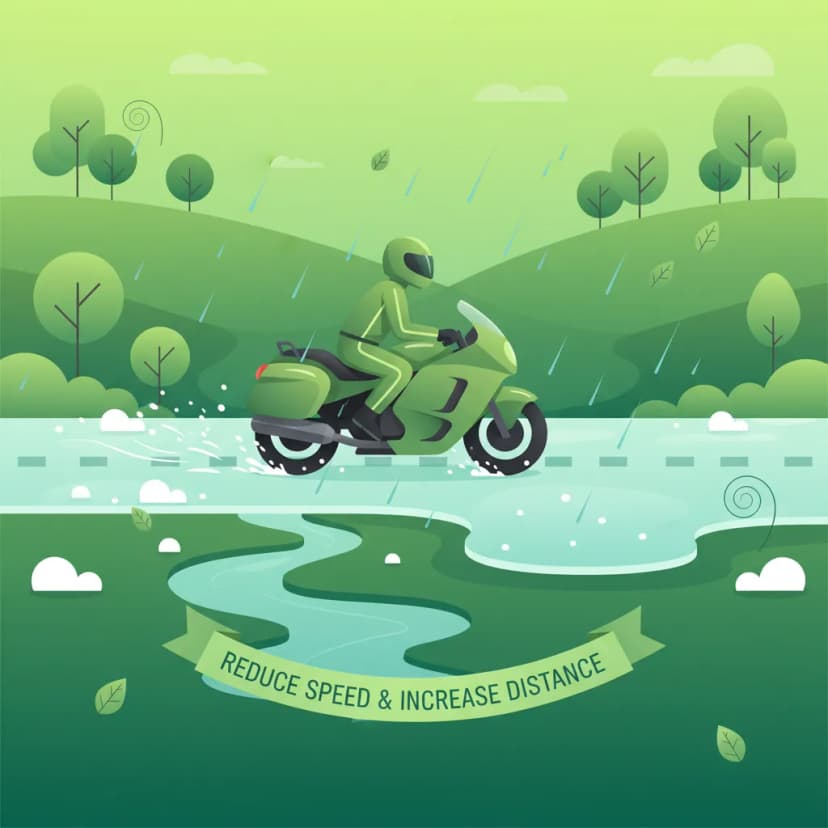
This lesson provides survival strategies for riding in the most challenging weather conditions, including heavy rain, snow, and potential ice. It emphasizes the importance of mental preparation, drastically reduced speeds, and hyper-smooth inputs for throttle, brakes, and steering. The content also covers identifying high-risk areas for 'black ice,' such as bridges and shaded spots, and the critical role of appropriate waterproof and insulated gear in preventing hypothermia and maintaining concentration.

Riding on two wheels requires special care on surfaces with reduced grip. This lesson teaches you how to handle challenging conditions like rain, ice, wet leaves, or tram tracks. Key principles include reducing speed significantly, making all control inputs (braking, accelerating, steering) much more smoothly and gradually, and increasing your following distance to allow for much longer stopping distances. Recognizing potentially slippery areas is a critical part of proactive hazard perception.

This lesson reinforces the critical relationship between adverse conditions, reduced traction, and massively increased stopping distances. It provides a clear framework for how much riders need to increase their following distance and reduce their overall speed to maintain a safe margin for error. The curriculum teaches riders to constantly reassess their speed based on visual feedback from the road surface and the level of visibility, ensuring they can always stop within the distance they can clearly see.
This lesson explores the often-overlooked factor of road surface temperature and its direct impact on tire grip and braking efficiency. It explains that cold tires on cold asphalt have significantly less grip, leading to longer stopping distances and a higher risk of skidding. The content discusses the importance of allowing tires to warm up through gentle riding and highlights the danger of isolated icy patches, even on otherwise clear winter days.

This lesson provides a detailed guide to riding in wet and low-visibility conditions. You will learn to make all your control inputs—braking, accelerating, and steering—exceptionally smooth to avoid breaking traction on slippery surfaces. The content covers the dangers of painted lines and manhole covers when wet, and the importance of increasing your following distance dramatically to account for longer braking distances.

This lesson explains the science behind reduced grip on wet surfaces and the dangerous phenomenon of hydroplaning, where a tire rides on a layer of water instead of the road. It details the critical roles of tire tread depth, tire pressure, and riding speed in maintaining contact with the asphalt. Riders will learn techniques for riding in the rain, including using exceptionally smooth control inputs and proactively reducing speed when approaching standing water.
This lesson provides a comprehensive guide to safe and effective deceleration on a motorcycle. You will learn the principles of controlled braking, including the progressive application of both the front and rear brakes to maximize stopping power while maintaining stability. The content also explains the role of engine braking in managing speed and how the Anti-lock Braking System (ABS) helps prevent wheel lock-up during hard braking.
This lesson explains the physics of why wet roads offer significantly less traction than dry ones, highlighting particular hazards like the first rain after a dry spell. It defines aquaplaning (when a tire rides on a layer of water instead of the road) and explains how speed and tire condition contribute to this dangerous phenomenon. The content provides clear strategies for riding in the rain, including reducing speed and applying all controls with extra smoothness.

Rain significantly reduces tire grip and rider visibility. This lesson covers the essential adjustments needed for wet-weather riding, including reducing speed, increasing following distance, and applying all controls more smoothly. It explains the danger of hydroplaning (aquaplaning) when tires lose contact with the road over standing water and how to avoid it. You will also learn about the importance of good tire tread depth for channeling water away and maintaining traction.

This lesson explains why the standard two-second rule is insufficient in adverse conditions and requires extension. It details how factors like rain, fog, and darkness reduce both visibility and tire grip, thereby significantly increasing total stopping distance. The content provides practical guidelines, such as extending the following gap to four seconds or more in the wet, to ensure the rider always has enough time and space to stop safely, regardless of the conditions.
Find clear answers to common questions learners have about Emergency Braking and the Role of ABS. Learn how the lesson is structured, which driving theory objectives it supports, and how it fits into the overall learning path of units and curriculum progression in the Netherlands. These explanations help you understand key concepts, lesson flow, and exam focused study goals.
Emergency braking involves applying maximum force to both brakes simultaneously and maintaining control without locking the wheels. Normal braking is more gradual and controlled, using less force. The goal of emergency braking is to stop in the shortest possible distance, which requires specific techniques and understanding of ABS.
ABS rapidly modulates brake pressure, preventing the wheels from locking up. If a wheel is about to lock, ABS momentarily releases and reapplies brake pressure, allowing the tyre to regain traction. This helps the rider maintain steering control, which is crucial for potentially swerving around an obstacle even while braking hard.
For emergency braking, you should shift your weight back towards the rear of the motorcycle, keeping your arms straight but relaxed. This action helps to keep the front wheel firmly on the ground and transfers weight to the front brake, which provides most of the stopping power. Avoid tensing up, as this can hinder your ability to react smoothly.
No, ABS is a safety aid, not a replacement for rider skill. While ABS significantly increases safety by preventing lock-up, understanding how to apply the brakes effectively and maintain balance is still essential. You still need to know how to brake hard and maintain control, and ABS will assist you in doing so more safely.
The CBR exam includes questions that assess your understanding of stopping distances, the function of ABS, and correct emergency procedures. Scenarios might involve calculating stopping distances under different conditions or identifying the correct action to take in a sudden hazard situation requiring maximum braking.