
Beyond just squeezing the brake levers, this lesson delves into advanced slowing techniques. You'll learn how engine braking can help you control your speed and how Anti-lock Braking Systems (ABS) can prevent skids during hard stops, crucial skills for your Category AM theory exam and safe riding.
Effective speed management and braking are fundamental skills for any rider of a Category AM vehicle, such as a moped or scooter. Beyond simply pulling the brake levers, understanding techniques like engine braking and the functionality of an Anti-lock Braking System (ABS) can significantly enhance your safety, control, and reduce wear on your vehicle. This lesson will delve into these advanced braking concepts, equipping you with the knowledge to react safely and confidently on Dutch roads.
Engine braking is a natural phenomenon that allows your vehicle to decelerate without constantly relying on the friction brakes. It is a crucial technique for controlled slowing and maintaining stability, especially in specific riding conditions.
When you release the throttle on a moped or scooter, the engine's internal resistance, primarily from compression and friction, works against the forward motion of the vehicle. This resistance acts as a braking force, helping to slow you down. This process is distinct from using your service brakes (front and rear brake levers), which rely on friction between brake pads and discs/drums. Engine braking can significantly contribute to managing your speed, especially on descents or when approaching a stop.
Engine braking can be broadly categorized into two types, depending on how it's applied:
This is the simplest form of engine braking and applies to virtually all mopeds and scooters. It occurs naturally when you simply close the throttle without changing gears. As the fuel supply to the engine is cut or reduced, the engine's rotation creates a vacuum and compression resistance, which slows the drive wheel. This method provides a smooth and gradual deceleration.
On some Category AM vehicles, particularly those with manual or semi-automatic gearboxes, you can enhance engine braking by downshifting to a lower gear. When you select a lower gear, the engine spins faster for the same road speed, increasing the rotational resistance and thus the braking effect. This technique provides a more pronounced deceleration than passive engine braking alone. However, it requires careful execution to avoid sudden jerks or wheel slip, especially on low-traction surfaces.
Engine braking offers several benefits that contribute to safer and more economical riding:
Consider using engine braking when:
Despite its benefits, improper use of engine braking can lead to problems:
An Anti-lock Braking System (ABS) is a significant safety feature that, when equipped, drastically improves control during hard braking situations. While not mandatory for all Category AM vehicles in the Netherlands, it is increasingly common on newer models.
When you apply the brakes forcefully, there's a risk that one or more wheels might stop rotating while the vehicle is still moving. This is called wheel lock-up. When a wheel locks, it loses traction, and the rider loses steering control, making a skid almost inevitable.
ABS works by monitoring the speed of each wheel. If it detects that a wheel is about to lock up (i.e., its rotational speed drops too quickly relative to the vehicle's speed), the system rapidly reduces and reapplies brake pressure to that specific wheel. This "pulsing" action happens many times per second, allowing the wheel to continue rotating just enough to maintain traction, even under maximal braking. This means you can brake hard and still steer around an obstacle.
While car ABS systems are typically four-channel (controlling each wheel independently), Category AM vehicles may feature various configurations:
A critical rule for ABS-equipped vehicles is to never pump the brakes. Dutch traffic law, specifically RVV 1990 Article 36-2, directly addresses this, stating that if a vehicle is equipped with ABS, the driver must not pump the brakes but should maintain steady, firm pressure.
When ABS is active, you might feel a pulsation or vibration through the brake lever and hear a grinding noise. This is completely normal and indicates the system is working. If you pump the brakes, you disrupt the rapid pressure modulation of the ABS, effectively disabling it temporarily and defeating its purpose. In an emergency, apply the brakes firmly and maintain steady pressure; let the ABS do its job.
Progressive braking is a fundamental technique applicable to all vehicles, regardless of whether they have ABS. It is the cornerstone of effective and safe braking.
The goal of braking is to slow down or stop efficiently without losing control. This requires careful management of the friction between your tyres and the road surface (traction). Applying maximum brake pressure instantly often exceeds the available traction, especially on mopeds and scooters with smaller tyres and less stable chassis, leading to wheel lock-up and a skid. Progressive braking allows you to gradually "feel" the limits of traction and apply the maximum possible braking force just short of lock-up.
For mopeds and scooters not equipped with ABS, mastering progressive braking is absolutely essential. It is your manual method of preventing wheel lock-up:
Even with ABS, progressive braking remains important. While ABS will prevent actual lock-up, a progressive approach still allows for smoother deceleration, reduces the sudden engagement of the ABS system, and helps you learn the limits of your vehicle's braking capabilities. It also prepares you for riding vehicles without ABS. Use progressive pressure until you feel the ABS activate, then maintain that steady pressure.
The safest and most efficient way to manage your speed involves a combined braking strategy that integrates engine braking, progressive service brake application, and ABS (if available).
A well-rounded braking strategy looks like this:
Your combined braking strategy must be adaptable to varying conditions:
The Dutch Traffic Regulations and Traffic Signs Act of 1990 (RVV 1990) provides the legal framework for safe driving, including aspects related to braking.
This article underscores the driver's responsibility to manage their vehicle's speed effectively. Using engine braking to control speed, especially on descents or when approaching hazards, aligns perfectly with this legal requirement. It demonstrates proactive and responsible driving.
This is a direct and unambiguous rule. Pumping the brakes on an ABS-equipped vehicle is not only a contravention of traffic law but also defeats the safety purpose of the system, increasing your risk of an accident. Always maintain steady pressure when ABS activates.
This article ensures that all mopeds and scooters on public roads have reliable braking capabilities. Regular checks of your brake levers for proper play and firm resistance are not just good practice but also a way to ensure compliance with this fundamental safety regulation. You must also use your service brakes to come to a full stop at stop signs or red lights; engine braking alone is not considered a complete stop.
This regulation emphasizes that merely stopping is not enough; the ability to steer and potentially avoid a collision during an emergency stop is also paramount. ABS directly supports this by preventing wheel lock-up and allowing directional changes while braking hard.
Understanding common mistakes can help you avoid them and enhance your safety on the road.
Even with advanced braking systems, your perception and reaction time are critical. Always look far ahead, anticipate potential hazards, and be prepared to brake. In an emergency, apply a controlled, firm pressure to your brakes (and maintain it if you have ABS), while simultaneously looking for an escape route and steering if possible.
Effective braking is not a one-size-fits-all skill. You must adapt your technique to the specific circumstances.
When road surfaces are wet, icy, or covered with loose gravel or leaves, the available tyre-road friction is significantly reduced.
Long, steep descents or riding with a heavy load (passenger, cargo) put additional strain on your braking system.
Understanding the underlying principles of braking enhances your appreciation for these techniques.
To stop a vehicle, its kinetic energy must be dissipated. Service brakes convert this energy into heat through friction. Engine braking, on the other hand, converts some kinetic energy into internal engine heat and resistance, reducing the amount of work required from the service brakes. This is why engine braking helps prevent brake fade – the reduction in braking effectiveness caused by overheating of brake components.
The amount of friction, or traction, between your tyres and the road dictates your maximum braking capability. This traction is influenced by road surface, tyre condition, and weather. ABS systems work by constantly monitoring the slip ratio – the difference between wheel speed and road speed – to ensure maximum traction is maintained without lock-up.
Your perception-reaction time – the time it takes from seeing a hazard to initiating a braking action – is a significant component of your total stopping distance. For a typical Category AM rider, this can be around 1.5 seconds. By using engine braking to anticipate speed reductions, you effectively shorten the amount of time needed for a final, intense brake application, reducing cognitive load in stressful situations. Training and understanding how your vehicle reacts under different braking scenarios builds muscle memory and confidence, contributing to quicker, more effective responses in emergencies.
To summarise the critical aspects of advanced braking for your moped or scooter:
Mastering these braking techniques is vital for safe riding and successfully navigating the challenges of Dutch traffic.
Lesson content overview
Explore all units and lessons included in this driving theory course.
Explore search topics learners often look for when studying Use of Engine Braking and ABS (if equipped). These topics reflect common questions about road rules, driving situations, safety guidance, and lesson level theory preparation for learners in the Netherlands.
Browse additional driving theory lessons that cover connected traffic rules, road signs, and common driving situations related to this topic. Improve your understanding of how different rules interact across everyday traffic scenarios.
Explore the theory behind advanced braking systems for mopeds and scooters in the Netherlands. Learn how ABS prevents wheel lock-up and how engine braking aids speed control, alongside relevant Dutch traffic laws.

This lesson teaches the procedure for executing an emergency stop in response to a sudden, extreme hazard. You will learn how to apply maximum braking pressure quickly and decisively while keeping the steering wheel straight to maintain control. The role of the Anti-lock Braking System (ABS) in preventing wheel lock-up and allowing the driver to continue steering is explained. The lesson also covers the importance of checking mirrors, if time permits, and securing the vehicle safely after the stop.

This lesson provides a comprehensive guide to safe and effective deceleration on a motorcycle. You will learn the principles of controlled braking, including the progressive application of both the front and rear brakes to maximize stopping power while maintaining stability. The content also explains the role of engine braking in managing speed and how the Anti-lock Braking System (ABS) helps prevent wheel lock-up during hard braking.
This lesson explains the function of an Anti-lock Braking System (ABS) on a motorcycle, detailing how it prevents wheel lock-up during heavy braking, thereby allowing the rider to maintain steering control. It clarifies that while ABS is a powerful safety aid, it does not defy physics and may sometimes increase stopping distances on loose surfaces. The content teaches riders to trust the system and apply the brakes fully and firmly in an emergency, letting the ABS manage traction.

This lesson explains the mechanical and hydraulic principles behind the common types of motorcycle brakes. It compares the operation and performance characteristics of disc brakes and drum brakes. The function of an Anti-lock Braking System (ABS) is also detailed, explaining how it prevents wheel lock-up during hard braking, thereby allowing the rider to maintain steering control and reduce stopping distances in many situations.

This lesson prepares you for a critical situation: performing a maximum-force emergency stop. You will learn the correct body posture and braking technique to stop in the shortest possible distance without losing control. The content provides a clear explanation of how ABS works by rapidly pulsing the brakes to prevent the wheels from locking, allowing you to maintain steering control even during a panic stop.
This lesson focuses on the three most critical safety systems of a car. You will learn the legal minimum tire tread depth (1.6 mm) and the importance of maintaining correct tire pressure for safety and fuel efficiency. The content covers the basics of the braking system, including how to check brake fluid and recognize warning signs of worn brakes. Additionally, the lesson explains the function of the steering system and the importance of ensuring it operates smoothly and without issue.

This lesson moves beyond basic braking to teach advanced techniques for optimal stopping performance. You will learn that the front brake provides the majority of your stopping power due to forward weight transfer, but that skillful application of the rear brake is crucial for stability. The content covers the concept of progressive braking—squeezing the levers smoothly—to manage traction and prevent wheel lock, especially on motorcycles without ABS.

This lesson focuses on the physical skill of an emergency stop, building on previous braking lessons. You will learn to adopt a braced body position, keeping your arms straight and looking ahead, not down. The content details the technique of applying both brakes rapidly but progressively to the point of maximum traction, and how to trust and utilize ABS if your motorcycle is equipped with it.

This lesson teaches the principles of performing a controlled emergency stop ('noodsremmen') to achieve the shortest possible stopping distance without losing control. It details the technique of applying both brakes firmly and progressively, managing the forward weight transfer, and maintaining an upright body posture to maximize braking efficiency. The content emphasizes braking in a straight line and looking ahead to where you want to stop, not at the obstacle.
This lesson provides a detailed breakdown of high-speed braking techniques, emphasizing the correct balance and application of the front ('voorrem') and rear ('achterrem') brakes. It explains the physics of weight transfer under braking and why the front brake provides the majority of stopping power. Techniques for progressive, smooth application to avoid overloading the front tire and losing traction are covered, ensuring riders can slow down quickly and safely from any speed.
Understand the legal framework for braking and speed control in the Netherlands, including specific regulations for ABS and general duties to adapt speed. Learn how to safely integrate engine braking and service brakes.
This lesson focuses on the three most critical safety systems of a car. You will learn the legal minimum tire tread depth (1.6 mm) and the importance of maintaining correct tire pressure for safety and fuel efficiency. The content covers the basics of the braking system, including how to check brake fluid and recognize warning signs of worn brakes. Additionally, the lesson explains the function of the steering system and the importance of ensuring it operates smoothly and without issue.
This lesson emphasizes the critical importance of adapting your speed to prevailing conditions, which may require driving slower than the legal limit. You will learn how factors like rain, fog, snow, and darkness significantly increase braking distances and reduce visibility. The curriculum explains the dangers of aquaplaning on wet roads and black ice in winter. The core principle taught is that a safe driver always adjusts their speed to ensure they can stop within the distance they can see to be clear.
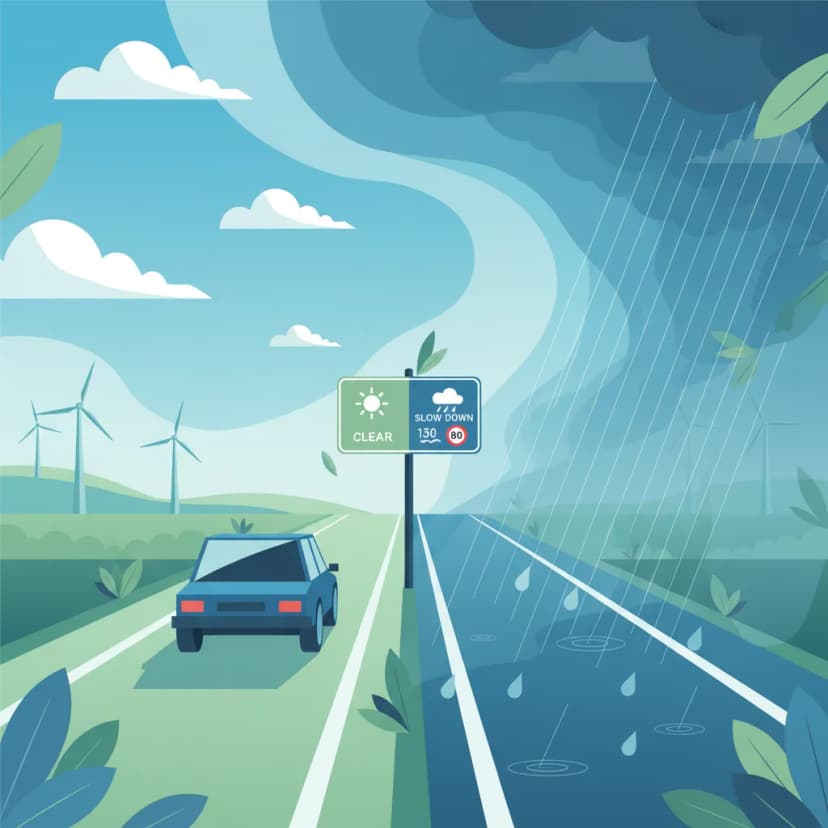
The posted speed limit is a maximum, not a target. This lesson teaches the crucial skill of adapting your speed to prevailing conditions. You will learn how to assess factors like traffic density, poor weather (rain, fog), limited visibility (at night), and slippery road surfaces. Adjusting your speed downwards in these situations provides you with more time to react to hazards and significantly reduces the risk of losing control or being involved in a collision.
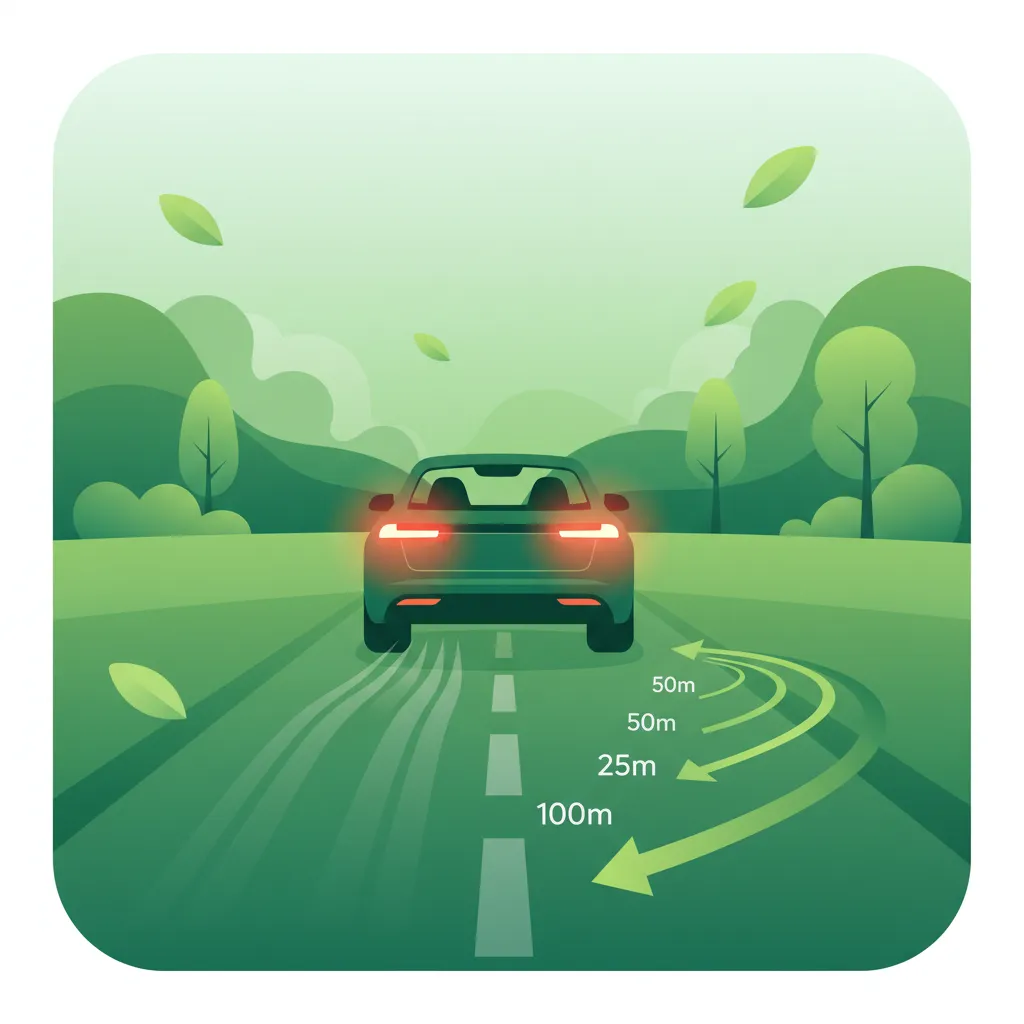
This lesson explains the components of the total stopping distance: the reaction distance (distance traveled before you start braking) and the braking distance (distance traveled while braking). You will learn the general formulas and rules of thumb for estimating these distances at different speeds. Understanding that braking distance increases exponentially with speed is a critical piece of knowledge that reinforces the importance of maintaining safe speeds and following distances.
This lesson covers the procedures and safety considerations for driving in reverse and turning around. You will learn that reversing should only be done over short distances and when it does not endanger or obstruct other road users. The curriculum details techniques for turning in the road and identifies situations and locations where U-turns are prohibited. The importance of all-around observation, checking blind spots, and yielding to all other traffic is a central theme.

This lesson covers the full range of lights and signals required on a vehicle for visibility and communication. You will learn about the mandatory requirements for headlights, taillights, brake lights, indicators, and reflectors. The curriculum emphasizes the driver's legal responsibility to ensure all lights are clean and functional before every journey. The correct use and function of the horn as an audible warning device in case of imminent danger are also explained.
This lesson teaches the procedure for executing an emergency stop in response to a sudden, extreme hazard. You will learn how to apply maximum braking pressure quickly and decisively while keeping the steering wheel straight to maintain control. The role of the Anti-lock Braking System (ABS) in preventing wheel lock-up and allowing the driver to continue steering is explained. The lesson also covers the importance of checking mirrors, if time permits, and securing the vehicle safely after the stop.
This lesson provides a detailed breakdown of high-speed braking techniques, emphasizing the correct balance and application of the front ('voorrem') and rear ('achterrem') brakes. It explains the physics of weight transfer under braking and why the front brake provides the majority of stopping power. Techniques for progressive, smooth application to avoid overloading the front tire and losing traction are covered, ensuring riders can slow down quickly and safely from any speed.
This lesson provides a clear action plan for when your car breaks down. You will learn to pull over to a safe location, preferably the hard shoulder on a motorway, and immediately activate your hazard warning lights. The curriculum explains the legal requirement to place a warning triangle a suitable distance behind the vehicle (if safe to do so) and the strong recommendation to wear a high-visibility jacket. Crucially, it instructs that all occupants should exit the vehicle on the safe side and wait behind the guardrail for assistance.

Riding on two wheels requires special care on surfaces with reduced grip. This lesson teaches you how to handle challenging conditions like rain, ice, wet leaves, or tram tracks. Key principles include reducing speed significantly, making all control inputs (braking, accelerating, steering) much more smoothly and gradually, and increasing your following distance to allow for much longer stopping distances. Recognizing potentially slippery areas is a critical part of proactive hazard perception.
Find clear answers to common questions learners have about Use of Engine Braking and ABS (if equipped). Learn how the lesson is structured, which driving theory objectives it supports, and how it fits into the overall learning path of units and curriculum progression in the Netherlands. These explanations help you understand key concepts, lesson flow, and exam focused study goals.
Brake levers directly apply friction to the wheels to slow down. Engine braking uses the engine's resistance (by releasing the throttle or downshifting) to reduce speed, which is a gentler way to slow down or maintain speed on a downhill slope. Both are often used together for optimal control.
Yes, engine braking is a fundamental principle for any internal combustion engine vehicle, including most bromfietsen and scooters. Automatic scooters primarily use throttle release, while manual scooters can also use downshifting. Electric scooters also provide regenerative braking through throttle release.
ABS is most useful during sudden, hard braking, especially on slippery surfaces like wet roads or gravel. It prevents the wheels from locking up, which could cause you to skid and lose control. This allows you to maintain steering while braking hard, a critical safety advantage.
No, if your wheels lock up during braking, you lose steering control. The vehicle will continue in the direction it was going before the skid started. ABS prevents this lock-up, ensuring you retain the ability to steer and maneuver even under heavy braking.
Yes, the Dutch CBR theory exam for Category AM includes questions about vehicle control, braking techniques, and safety features like ABS. Understanding these concepts is essential for answering scenario-based questions correctly and demonstrating your knowledge of safe riding practices.
When you downshift on a manual scooter, you engage a lower gear. This causes the engine to spin faster relative to the wheel speed, creating resistance that slows the rear wheel and thus the entire vehicle. It’s a form of controlled deceleration.