
Riding a motorcycle in adverse weather conditions like rain, fog, or heavy mist presents unique challenges. This lesson is part of the 'Visibility, Lighting, and Weather-Related Hazards' unit in your Complete CBR Theory Course for the Dutch Motorcycle License (Category A2). It will equip you with the essential knowledge to ride safely and maintain control when visibility is compromised and road surfaces are slick.

Motorcycle riding demands constant adaptation, and perhaps no conditions test a rider's skills and awareness more than rain, fog, and generally low visibility. These challenging environments drastically alter road surface friction, reduce your ability to see hazards, and make you less visible to other road users. For riders seeking a Dutch Category A2 motorcycle license, understanding and mastering safe riding techniques in adverse weather is not just crucial for passing the CBR theory exam; it is a fundamental skill for everyday safety on Dutch roads. This lesson provides a comprehensive guide to navigating these conditions, emphasizing traction management, visibility enhancement, and crucial adjustments to your riding inputs.
Adverse weather conditions fundamentally change the physics of riding, primarily by reducing the available grip (traction) and limiting your sensory input, particularly vision. Recognising these impacts is the first step towards safer riding.
A wet road surface is one of the most significant hazards for motorcyclists. Water acts as a lubricant between your tyres and the road, significantly reducing the coefficient of friction (μ). On a dry road, the friction coefficient might be around 0.8–0.9, but this can drop to 0.4–0.6 on a wet surface. This reduction directly translates to longer braking distances and a higher risk of losing traction during acceleration or cornering.
Light rain creates a thin film of water, causing a moderate reduction in grip. However, moderate to heavy rain can lead to standing water, which dramatically decreases traction and introduces the risk of hydroplaning. The Dutch Traffic Code, Reglement Verkeersregels en Verkeerstekens (RVV 1990), Article 12.4, explicitly states that drivers must adapt their speed to the weather and road conditions. This legal obligation underscores the importance of understanding how wetness affects your bike's capabilities. For instance, riding at 80 km/h on a wet autosnelweg (motorway) can increase your required stopping distance from approximately 35 meters on dry tarmac to over 60 meters.
Hydroplaning, also known as aquaplaning, occurs when a layer of water builds up between your tyre and the road surface, causing the tyre to lose direct contact with the tarmac and ride on a film of water. This phenomenon can result in a complete loss of steering and braking control.
There are two main types:
When hydroplaning, your steering and braking inputs will have little to no effect. The motorcycle can slide straight ahead, or in the direction it was last steered. If you experience hydroplaning, gradually reduce speed by closing the throttle gently, avoid abrupt braking or steering, and maintain a straight line until the tyres regain contact with the road.
Conditions like fog, heavy rain, and mist severely limit how far you can see and how far other road users can see you. Visibility is typically measured in meters, with dense fog often defined as visibility below 50 meters. Heavy rain can reduce visibility to between 50 and 150 meters due to water spray and reduced light penetration. Mist or dawn glare might reduce visibility to 150–300 meters.
Reduced visibility means you have less time to perceive hazards, react to changing traffic situations, and execute manoeuvres. It is crucial to increase your reaction time by decreasing your speed and expanding your visual search. RVV 1990 Article 8.1 mandates the use of headlights when visibility is insufficient for safe driving, and Article 12.2 requires drivers to maintain a distance that allows safe stopping under prevailing conditions. For example, in 30-meter fog, you might need to reduce your speed to 30 km/h on a road with a 50 km/h limit, use appropriate lighting, and dramatically increase your following distance.
Maintaining control of your motorcycle in rain or fog requires a conscious and deliberate adjustment of all your control inputs: braking, accelerating, and steering. The goal is always to avoid sudden changes that can break the limited available traction.
Traction management is the overarching principle for riding in wet conditions. It involves maintaining optimal tyre-road friction by executing all control inputs with exceptional smoothness and choosing an appropriate speed. Abrupt actions are the enemy of traction on slippery surfaces. Every input – a squeeze of the brake lever, a twist of the throttle, or a lean into a corner – must be gentle and progressive. This approach prevents sudden weight shifts or excessive force on the tyres that could lead to a loss of grip, wheel slip, or loss of steering control.
Braking effectively on wet roads demands a refined technique. The key is progressive braking: apply the rear brake gently first to stabilise the motorcycle and shift weight, then gradually increase pressure on the front brake lever. This technique maximises stopping power while minimising the risk of locking a wheel.
RVV 1990 Article 5 dictates that every driver must keep their vehicle under full control at all times, a rule particularly relevant during braking in adverse conditions.
Just like braking, steering inputs must be exceptionally smooth when riding on wet roads. Abrupt handlebar movements or quick changes in lean angle can overwhelm the limited available traction, leading to a sudden loss of grip and a slide.
When approaching a wet curve, reduce your speed well in advance, and then gently lean into the turn. Maintain a consistent, steady line through the curve, avoiding any sudden corrections. Your body movements should also be smooth and integrated with the bike's lean. The goal is to distribute forces gradually and maintain a stable contact patch between the tyres and the road surface.
After slowing down for a hazard or exiting a wet curve, resist the urge to accelerate hard. Sudden throttle application on a wet surface can easily cause the rear wheel to spin, leading to a loss of rear-wheel traction and potentially a high-side crash. Always increase throttle gently and progressively, especially when the motorcycle is still leaned over or when the road surface is unevenly wet. Wait until the bike is more upright and you are confident of sufficient traction before increasing power significantly.
In low-visibility conditions, your ability to see and be seen by others becomes critical. Proper lighting and rider apparel are essential safety measures.
The correct use of your motorcycle's lighting system is vital in rain, fog, or mist.
Never use your high-beam headlights in fog. The light will scatter off the water droplets, creating a blinding wall of light that reduces your forward visibility even further.
Beyond your motorcycle's lights, your personal visibility is paramount. Conspicuity refers to how noticeable you are to other road users.
Wearing dark, non-reflective clothing in poor weather severely compromises your safety, as you effectively become invisible to other drivers until they are very close.
Two of the most critical adjustments you can make in adverse weather are increasing your following distance and reducing your speed below the statutory limit. These measures directly provide more time to react and stop.
The Reglement Verkeersregels en Verkeerstekens (RVV 1990), Article 12.2, mandates that drivers must keep a distance that allows safe stopping under the given conditions. This is even more crucial for motorcyclists in rain and fog. Since braking distances increase significantly on wet surfaces and reaction times are hampered by reduced visibility, your safe following distance must be enlarged dramatically.
To estimate your following distance, pick a fixed point ahead (e.g., a road sign) that the vehicle in front passes. Count the seconds until your motorcycle passes the same point. If your count is less than the recommended duration, you are following too closely.
While statutory speed limits apply, they are set for ideal dry-road conditions. In rain or fog, you must apply dynamic speed limits, meaning you adjust your speed to the actual conditions, which will often be significantly lower than the posted limit. RVV 1990 Article 12.4 explicitly requires speed adaptation to weather, road conditions, and traffic.
General guidelines for speed reduction:
Certain features of the road surface become particularly dangerous when wet. Recognising and anticipating these hazards is crucial for preventing a loss of traction.
Painted road markings (such as white lines, lane dividers, arrows, or zebra crossings) and metal manhole covers become extremely slippery when wet. The paint or metal offers significantly less friction than asphalt or concrete, especially when combined with water, oil, or rubber deposits.
Large puddles or areas of standing water pose several threats:
If you cannot avoid a puddle:
Your motorcycle's condition plays a significant role in its performance and safety in wet weather. Tyre maintenance is especially critical.
The tyres are your only contact with the road, making their condition paramount in wet weather. RVV 1990 Article 9.4 states that motorcycles must be roadworthy, and tyres must have sufficient tread.
Understanding common errors can help you actively prevent dangerous situations.
The Dutch traffic laws (RVV 1990) provide a clear framework for safe riding in all conditions, with specific articles directly applicable to adverse weather:
Riding a motorcycle in rain, fog, and low visibility requires heightened awareness, refined control inputs, and strict adherence to safety principles and legal regulations. By understanding the physics of reduced traction, adapting your speed and following distance, ensuring your visibility, and maintaining your motorcycle, you can significantly mitigate the risks associated with adverse weather. Practice smooth braking, gentle steering, and progressive acceleration to maintain control and arrive safely at your destination. Your diligence in these challenging conditions is a hallmark of a responsible and skilled motorcyclist.
Lesson content overview
Explore all units and lessons included in this driving theory course.
Explore search topics learners often look for when studying Riding in Rain, Fog, and Low Visibility. These topics reflect common questions about road rules, driving situations, safety guidance, and lesson level theory preparation for learners in the Netherlands.
Browse additional driving theory lessons that cover connected traffic rules, road signs, and common driving situations related to this topic. Improve your understanding of how different rules interact across everyday traffic scenarios.
Understand the specific dangers of wet roads, reduced visibility, and hydroplaning for motorcycles. Learn crucial control adjustments and legal requirements for safe riding in adverse weather in the Netherlands.
This lesson addresses the dual challenge of poor visibility: being able to see the road ahead and ensuring other road users can see you. It covers techniques for riding in fog and heavy rain, such as using appropriate lights and reducing speed to match sight distance. The lesson also discusses practical issues like helmet visor fogging and the importance of wearing high-visibility or reflective clothing to enhance conspicuity in low-light conditions.
This lesson explains why the standard two-second rule is insufficient in adverse conditions and requires extension. It details how factors like rain, fog, and darkness reduce both visibility and tire grip, thereby significantly increasing total stopping distance. The content provides practical guidelines, such as extending the following gap to four seconds or more in the wet, to ensure the rider always has enough time and space to stop safely, regardless of the conditions.

This lesson focuses on the use of specialized lights for specific situations. You will learn the strict conditions under which fog lights may be used: the rear fog light is only permitted when visibility from fog or snow is less than 50 meters, and not in rain. The lesson also explains the correct use of hazard warning lights, which are intended to warn other drivers of a stationary obstruction (like a breakdown or the tail end of a sudden traffic jam) or while being towed.
Rain significantly reduces tire grip and rider visibility. This lesson covers the essential adjustments needed for wet-weather riding, including reducing speed, increasing following distance, and applying all controls more smoothly. It explains the danger of hydroplaning (aquaplaning) when tires lose contact with the road over standing water and how to avoid it. You will also learn about the importance of good tire tread depth for channeling water away and maintaining traction.

This lesson reinforces the critical relationship between adverse conditions, reduced traction, and massively increased stopping distances. It provides a clear framework for how much riders need to increase their following distance and reduce their overall speed to maintain a safe margin for error. The curriculum teaches riders to constantly reassess their speed based on visual feedback from the road surface and the level of visibility, ensuring they can always stop within the distance they can clearly see.
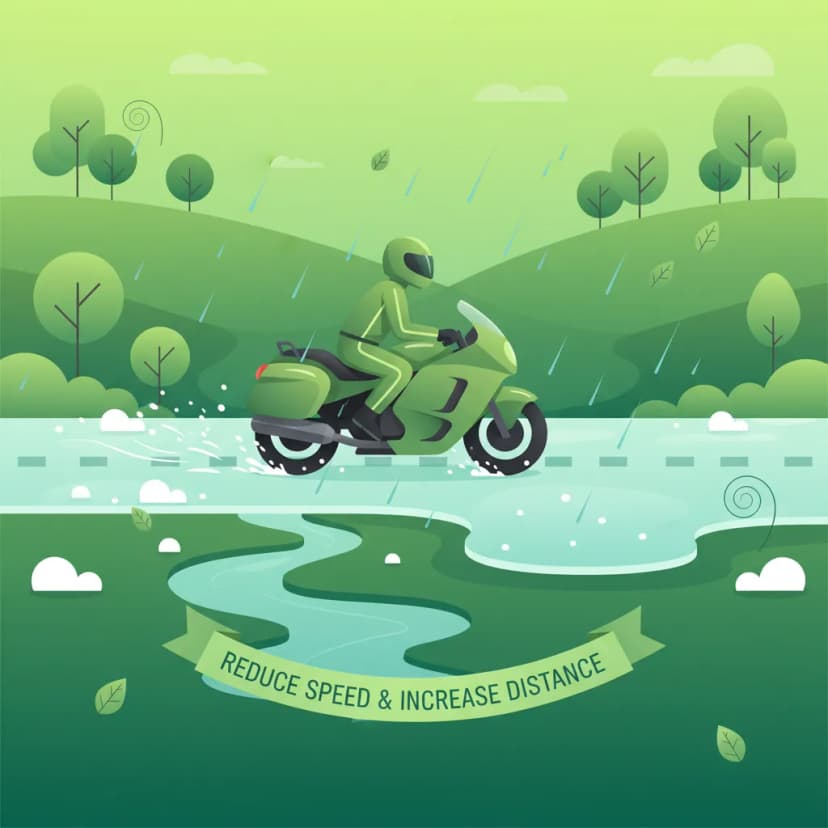
This lesson provides survival strategies for riding in the most challenging weather conditions, including heavy rain, snow, and potential ice. It emphasizes the importance of mental preparation, drastically reduced speeds, and hyper-smooth inputs for throttle, brakes, and steering. The content also covers identifying high-risk areas for 'black ice,' such as bridges and shaded spots, and the critical role of appropriate waterproof and insulated gear in preventing hypothermia and maintaining concentration.

Riding on two wheels requires special care on surfaces with reduced grip. This lesson teaches you how to handle challenging conditions like rain, ice, wet leaves, or tram tracks. Key principles include reducing speed significantly, making all control inputs (braking, accelerating, steering) much more smoothly and gradually, and increasing your following distance to allow for much longer stopping distances. Recognizing potentially slippery areas is a critical part of proactive hazard perception.
This lesson emphasizes the critical importance of adapting your speed to prevailing conditions, which may require driving slower than the legal limit. You will learn how factors like rain, fog, snow, and darkness significantly increase braking distances and reduce visibility. The curriculum explains the dangers of aquaplaning on wet roads and black ice in winter. The core principle taught is that a safe driver always adjusts their speed to ensure they can stop within the distance they can see to be clear.
This lesson focuses on the dual challenge of visibility: seeing the road ahead and ensuring other drivers see you. It covers the legal requirements and tactical use of headlights ('koplampen'), including when to use high and low beams, and the importance of daytime running lights. Additionally, it explores strategies for enhancing personal conspicuity through high-visibility and reflective clothing, and using lane positioning to stand out in traffic and avoid blind spots.
This lesson explains the physics of why wet roads offer significantly less traction than dry ones, highlighting particular hazards like the first rain after a dry spell. It defines aquaplaning (when a tire rides on a layer of water instead of the road) and explains how speed and tire condition contribute to this dangerous phenomenon. The content provides clear strategies for riding in the rain, including reducing speed and applying all controls with extra smoothness.
Master the use of motorcycle lights, fog lights, and reflective gear to enhance your visibility and conspicuity in rain, fog, and mist. Covers legal obligations under Dutch traffic law.
This lesson covers the mandatory lighting and signaling equipment for A2 motorcycles under Dutch law, ensuring you remain visible and communicate your intentions correctly. You will learn the rules for using headlights, taillights, turn signals, and brake lights in various conditions, including daytime and adverse weather. The content also addresses the importance of maintaining this equipment and using hand signals as a valid secondary method of communication in traffic.
This lesson addresses the dual challenge of poor visibility: being able to see the road ahead and ensuring other road users can see you. It covers techniques for riding in fog and heavy rain, such as using appropriate lights and reducing speed to match sight distance. The lesson also discusses practical issues like helmet visor fogging and the importance of wearing high-visibility or reflective clothing to enhance conspicuity in low-light conditions.
This lesson focuses on the dual challenge of visibility: seeing the road ahead and ensuring other drivers see you. It covers the legal requirements and tactical use of headlights ('koplampen'), including when to use high and low beams, and the importance of daytime running lights. Additionally, it explores strategies for enhancing personal conspicuity through high-visibility and reflective clothing, and using lane positioning to stand out in traffic and avoid blind spots.

This lesson covers the full range of lights and signals required on a vehicle for visibility and communication. You will learn about the mandatory requirements for headlights, taillights, brake lights, indicators, and reflectors. The curriculum emphasizes the driver's legal responsibility to ensure all lights are clean and functional before every journey. The correct use and function of the horn as an audible warning device in case of imminent danger are also explained.
This lesson goes beyond the legal requirements of lighting to teach you how to use it strategically to stand out in traffic. You will learn the importance of always riding with your low-beam headlight on, and the appropriate, considerate use of the high beam to make yourself more noticeable from a distance. The content also covers using turn signals well in advance and tapping the brakes to flash the brake light before slowing.

Riding at night presents two main challenges: seeing the road and being seen by others. This lesson covers the legal requirements for your vehicle's lighting system and how to use it effectively, including when to use high beams. It also emphasizes strategies to increase your own conspicuity, such as wearing bright or reflective clothing. You will learn how darkness affects your perception of speed and distance and how to adapt your riding to compensate for these limitations.
This lesson focuses on the use of specialized lights for specific situations. You will learn the strict conditions under which fog lights may be used: the rear fog light is only permitted when visibility from fog or snow is less than 50 meters, and not in rain. The lesson also explains the correct use of hazard warning lights, which are intended to warn other drivers of a stationary obstruction (like a breakdown or the tail end of a sudden traffic jam) or while being towed.
This lesson details the functions of the various lights on a car and the legal requirements for their use. You will learn the difference between dipped beams (dimlicht), which are the standard headlights for night driving and poor visibility, and main beams (grootlicht), which can only be used when they won't dazzle other road users. The content also covers the use of sidelights (stadslicht) for parking and the automatic function of Daytime Running Lights (DRLs). Correct usage is vital for visibility and avoiding blinding other drivers.
This lesson explains why the standard two-second rule is insufficient in adverse conditions and requires extension. It details how factors like rain, fog, and darkness reduce both visibility and tire grip, thereby significantly increasing total stopping distance. The content provides practical guidelines, such as extending the following gap to four seconds or more in the wet, to ensure the rider always has enough time and space to stop safely, regardless of the conditions.
This lesson provides survival strategies for riding in the most challenging weather conditions, including heavy rain, snow, and potential ice. It emphasizes the importance of mental preparation, drastically reduced speeds, and hyper-smooth inputs for throttle, brakes, and steering. The content also covers identifying high-risk areas for 'black ice,' such as bridges and shaded spots, and the critical role of appropriate waterproof and insulated gear in preventing hypothermia and maintaining concentration.
Find clear answers to common questions learners have about Riding in Rain, Fog, and Low Visibility. Learn how the lesson is structured, which driving theory objectives it supports, and how it fits into the overall learning path of units and curriculum progression in the Netherlands. These explanations help you understand key concepts, lesson flow, and exam focused study goals.
The most crucial adjustment is to make all your control inputs—braking, accelerating, and steering—exceptionally smooth. This is because wet surfaces drastically reduce tyre grip. Jerky movements can easily cause the wheels to lose traction, leading to a skid or fall. Always anticipate needs and act gently.
In rainy or foggy conditions, you must significantly increase your following distance. While the standard recommendation is two seconds, you should aim for at least four seconds, and potentially more in heavy rain or dense fog. This allows ample time to react and brake safely, considering the extended stopping distances on wet surfaces.
Yes, painted lines, road markings, metal plates, and manhole covers become extremely slippery when wet. They offer very little grip compared to the surrounding asphalt. You must be extra cautious when approaching or crossing these surfaces, ideally by riding in a straight line and avoiding any braking or steering inputs until you are past them.
Fog dramatically reduces visibility for both you and other road users. It's essential to use your headlights (even during the day) to increase your conspicuity. Slow down considerably, increase your following distance, and listen carefully for other traffic, as you may hear vehicles before you see them. Be prepared to stop if necessary.
On the highway in low visibility, maintain a very generous following distance and reduce your speed significantly below the posted limit. Use your headlights, and if possible, position yourself on the road where you are most visible to others, typically not in a blind spot. Avoid overtaking unless absolutely necessary and only when you have a clear view of the entire manoeuvre and surrounding traffic.