
Maintaining a safe distance to the vehicle ahead is a fundamental skill for motorcyclists. This lesson, part of the Dutch Traffic Laws for A1 Motorcycles unit, explains how to use the two-second rule and adjust your following distance based on road conditions and hazards. Proper distance management is key for safe riding and passing your CBR theory exam.

For any motorcyclist, especially those preparing for their Dutch A1 motorcycle license theory exam, mastering safe following distances is not just a recommendation—it's a critical safety practice. Maintaining an adequate gap, often called a "space cushion," between your motorcycle and the vehicle ahead is fundamental to collision avoidance. This lesson will explore the principles, legal requirements, and practical application of safe following distances in various traffic and environmental conditions encountered in the Netherlands.
The safe following distance is the buffer space a motorcyclist maintains behind the vehicle in front. This "space cushion" is essential as it provides the necessary time and physical distance to react to sudden hazards, adapt to unexpected traffic changes, or perform an emergency stop without colliding with the vehicle ahead. Unlike cars, motorcycles have a smaller contact patch with the road and can be more susceptible to loss of traction under aggressive braking, making an ample space cushion even more vital.
The underlying logic for this safety practice combines human perception and reaction with the physics of braking. It accounts for the time it takes a rider to detect a hazard, process it, and initiate an evasive action, followed by the actual distance the motorcycle travels while braking. Dutch traffic law, specifically Article 5 of the Reglement verkeersregels en verkeerstekens 1990 (RVV 1990), mandates that all road users must keep a "safe distance" to prevent danger. Time-based guidelines translate this legal duty into actionable riding practice.
The two-second rule serves as the fundamental baseline for maintaining a safe following distance under normal, ideal riding conditions. This rule dictates that a rider should be able to count "one-million-one, one-million-two" (approximately two seconds) between the moment the front of the leading vehicle passes a fixed point (like a lamp post, road sign, or shadow) and the moment your own front wheel passes the same point.
This minimum two-second gap is crucial because it generally accounts for an average rider's perception-response time (around 1.5 seconds) and provides a modest buffer for the initial phase of braking. In dry weather, during daylight, with good visibility, and in light to moderate traffic, the two-second rule offers a reasonable margin for safety.
For example, if you are riding at 60 km/h, a two-second gap translates to approximately 33 metres of physical distance. Failing to complete the "one-million-two" count before reaching the marker indicates that you are following too closely, a dangerous practice known as tailgating.
Practice Your Count: Regularly practice counting out two seconds using roadside markers while riding in normal conditions. This helps train your judgment for safe distances.
While the two-second rule is a vital baseline, riding conditions are rarely ideal. As conditions deteriorate, the required following distance must increase proportionally to maintain safety. This practice is known as adaptive following distance.
Under moderately adverse conditions, you should extend your following distance to a three-second gap. This provides an extra second of crucial buffer time to compensate for factors that might reduce your ability to stop or react quickly. Conditions necessitating a three-second gap include:
At 80 km/h on a wet road, a three-second gap would mean approximately 66 metres of physical distance. This additional metreage is critical for safely navigating these challenging situations.
In severe adverse conditions, extending your following distance to a four-second gap becomes imperative. This maximal safety buffer is essential when stopping distances are drastically extended, or visibility is severely limited. Conditions requiring a four-second gap include:
At 100 km/h on an unlit road at night, a four-second gap translates to approximately 111 metres of physical distance. This substantial distance is necessary to compensate for the significantly longer stopping distances and delayed hazard detection in such conditions.
Understanding the components that contribute to your overall stopping distance is essential for effectively applying the adaptive following distance rules. Total stopping distance is primarily composed of perception-response distance and braking distance.
The perception-response time (PRT) is the interval from the moment a rider detects a hazard (e.g., brake lights illuminate, an object appears in the road) to the moment they initiate an evasive action, such as applying the brakes or swerving.
The two-second rule inherently incorporates this PRT. If your PRT is longer due to personal factors or difficult conditions, the two-second gap might already be fully consumed before you even start braking.
Braking distance is the distance your motorcycle travels from the moment you apply the brakes until it comes to a complete stop. This distance is governed by several critical factors:
The formula for braking distance is approximately db = v² / (2 × μ × g). This formula clearly illustrates why reduced friction due to wet or icy conditions dramatically extends the required braking distance, necessitating a larger following gap.
Adding a passenger, carrying heavy luggage, or even a full fuel tank increases the overall mass of your motorcycle. This load factor has two main implications for safe following distances:
As a general rule, if you are riding with a passenger or significant cargo, you should increase your following distance by at least one second (e.g., from two seconds to three seconds in normal conditions).
Your ability to detect hazards quickly is directly tied to visibility. Reduced ambient light or visual obstructions significantly impact your PRT and overall safety:
Under these conditions, your eyes simply cannot gather information as quickly, forcing your brain to take longer to process potential dangers. Therefore, increasing your following distance to three or four seconds is a non-negotiable safety measure.
The inherent risk exposure of a particular riding environment should also influence your following distance. Some areas present a higher probability of sudden, unexpected events:
In such high-risk zones, it is prudent to adopt a three-second gap as a baseline, even in ideal weather conditions, to provide a larger buffer for anticipating and reacting to unexpected events. Developing strong situational awareness – constantly scanning the environment and anticipating potential hazards – is key to making these adaptive judgments.
Adhering to safe following distances is not merely a suggestion for good riding practice; it is a fundamental legal obligation under Dutch traffic law.
The cornerstone of this obligation is enshrined in Article 5 of the Reglement verkeersregels en verkeerstekens 1990 (RVV 1990), which states:
"Each road user shall keep a distance to the vehicle in front that is sufficient to avoid endangering other road users."
This article applies to all vehicle types, including motorcycles, and in all road conditions. While it doesn't specify a numerical distance or time, the "two-second rule" and its adaptive variations are widely accepted and taught as the practical means to fulfill this legal duty. Failure to maintain a safe distance and subsequently causing a collision can lead to fines, penalty points, and significant insurance implications.
The Centraal Bureau Rijvaardigheidsbewijzen (CBR), the authority responsible for issuing Dutch driving licenses, strongly recommends and enforces the two-second rule (and its adaptations) in both theoretical and practical training for the A1 motorcycle license. It serves as a measurable, easy-to-apply method for riders to demonstrate they are meeting the legal requirement of keeping a safe distance.
While not directly defining following distance, other RVV 1990 articles support the ability to maintain safe gaps:
Many collisions involving motorcycles are rear-end incidents, often due to inadequate following distances. Being aware of common violations and proactively correcting them is vital for safety.
| Situation | Why It’s Wrong | Correct Behaviour | Potential Consequence |
|---|---|---|---|
| Tailgating in dry daylight (two-second gap not maintained) | Insufficient reaction time; violates legal safe-distance duty. | Increase gap to at least two seconds (counting method). | Rear-end collision, fines, insurance impact. |
| Maintaining two-second gap in heavy rain | Wet road reduces friction, increasing braking distance; gap is too short. | Extend to three seconds (or four if visibility is poor). | Longer stopping distance may lead to a crash. |
| Night riding with two-second gap and low-beam off | Reduced visibility compromises hazard detection distance. | Turn on dipped beams, increase gap to four seconds. | Inability to see brake lights; higher crash risk. |
| Riding with a passenger but keeping two-second gap | Added load reduces braking efficiency and lengthens PRT. | Add at least one extra second (three-second gap minimum). | Longer stopping distance; potential loss of control. |
| Following closely through a school zone | High-risk area with frequent sudden stops (e.g., children entering road). | Adopt a three-second gap regardless of weather. | May not stop in time for unexpected pedestrian crossing. |
| Counting seconds incorrectly due to high speed | Human error leads to under-estimation of true distance. | Use visual distance estimation (e.g., car lengths) when speed >80 km/h; re-verify count. | Under-gapping, increased crash probability. |
| Following a large vehicle (bus/truck) that blocks view of road ahead | Visual obstruction extends perception time for hazards. | Increase gap to three or four seconds; position for clear line of sight. | Unexpected stop or obstacle may not be seen in time. |
| Rider’s brakes are slightly worn, but still riding with baseline gap | Reduced braking efficiency; stopping distance longer than assumed. | Perform pre-ride brake check; if wear is significant, increase gap or repair. | Brake fade could cause incomplete stop and collision. |
Let's apply these principles to practical riding situations common in the Netherlands:
Scenario 1: Urban Street, Dry, 40 km/h, Daylight
Scenario 2: Expressway, 100 km/h, Light Rain, Dusk
Scenario 3: Rural Road, Night, No Street Lighting, 60 km/h
Scenario 4: City Centre, 30 km/h, Heavy Traffic, Passenger Aboard
Maintaining safe following distances is one of the most fundamental yet impactful skills a motorcyclist can master. For those pursuing their Dutch A1 motorcycle license, understanding and consistently applying these principles is crucial for both passing the CBR exam and ensuring a lifetime of safe riding.
Remember the core tenets:
By consistently practicing adaptive following distances, you not only reduce your risk of collisions but also enhance your situational awareness, reduce rider stress, and contribute to a safer road environment for everyone.
Lesson content overview
Explore all units and lessons included in this driving theory course.
Explore search topics learners often look for when studying Safe Following Distances for Motorcycles. These topics reflect common questions about road rules, driving situations, safety guidance, and lesson level theory preparation for learners in the Netherlands.
Browse additional driving theory lessons that cover connected traffic rules, road signs, and common driving situations related to this topic. Improve your understanding of how different rules interact across everyday traffic scenarios.
Learn how to adjust your motorcycle's following distance beyond the two-second rule. Understand when to use three or four seconds for safety in rain, fog, and heavy traffic according to Dutch theory.
This lesson explains why the standard two-second rule is insufficient in adverse conditions and requires extension. It details how factors like rain, fog, and darkness reduce both visibility and tire grip, thereby significantly increasing total stopping distance. The content provides practical guidelines, such as extending the following gap to four seconds or more in the wet, to ensure the rider always has enough time and space to stop safely, regardless of the conditions.
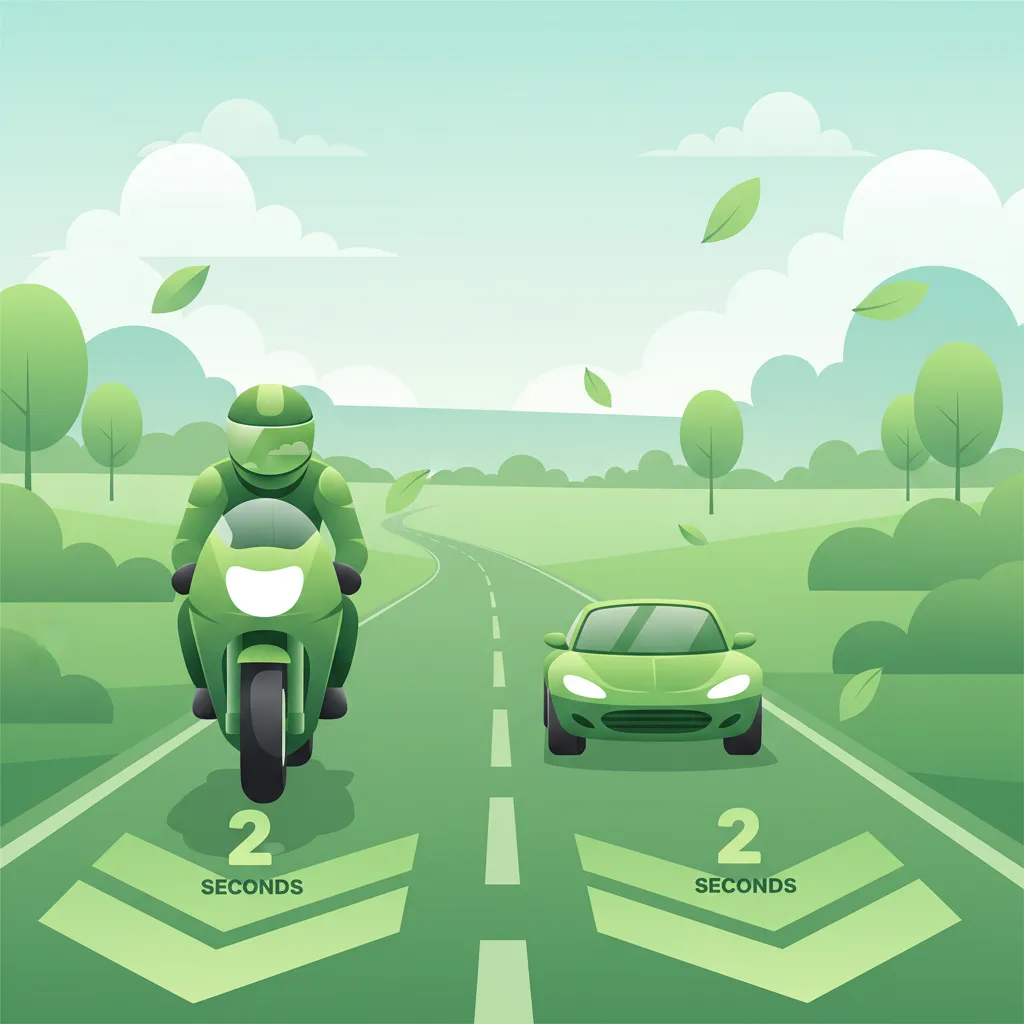
This lesson explains the two-second rule, a simple and effective technique for ensuring you have enough time to react and stop safely. You will learn how to use a fixed object on the roadside to measure the time gap between your motorcycle and the vehicle ahead. The content emphasizes why motorcyclists may need to extend this gap to three or more seconds in poor weather, at high speeds, or in heavy traffic.

This lesson provides a detailed explanation of the two-second rule as a simple yet effective method for maintaining a safe following distance in good conditions. It breaks down the concept of total stopping distance into its two components: reaction distance (the distance traveled before applying the brakes) and braking distance (the distance traveled while braking). Understanding this calculation is fundamental for appreciating the need for a sufficient space cushion to react to sudden events ahead.

This lesson covers the universal Dutch road rules with a specific focus on their application to light motorcycles. It details the various speed limits for different road types, from urban areas to motorways, and explains the correct procedures for overtaking and lane positioning. The legal aspects of lane filtering in congestion are also examined, alongside mandatory equipment use like daytime running lights, to ensure riders can integrate safely and legally into traffic flow.
This lesson focuses on the crucial safety strategy of adjusting your riding for adverse conditions. You will learn that on wet roads, your braking distance can double, necessitating a much larger following distance (e.g., a four-second gap or more). The content covers the risks of reduced visibility in fog and at night, and the destabilizing effects of strong crosswinds, explaining how a greater space cushion provides the time and space needed to react safely.

This lesson revisits the concept of following distance, emphasizing its heightened importance in the high-speed motorway environment. It explains how increased speeds dramatically lengthen both reaction and braking distances, making a minimum two-to-three-second gap absolutely critical for safety. The content also stresses the importance of maintaining a space cushion to the sides, creating potential escape routes in case of sudden incidents in adjacent lanes.

This lesson reinforces the critical relationship between adverse conditions, reduced traction, and massively increased stopping distances. It provides a clear framework for how much riders need to increase their following distance and reduce their overall speed to maintain a safe margin for error. The curriculum teaches riders to constantly reassess their speed based on visual feedback from the road surface and the level of visibility, ensuring they can always stop within the distance they can clearly see.
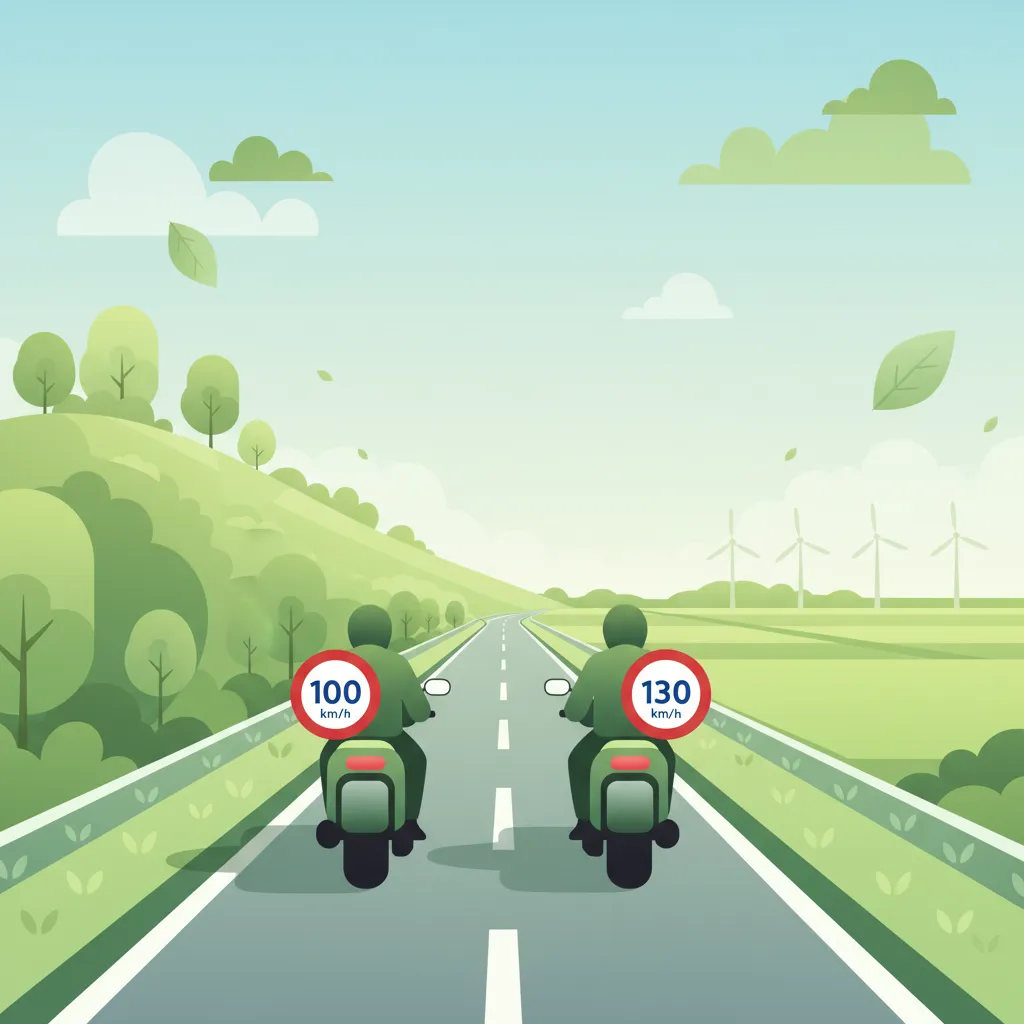
This lesson outlines the statutory national speed limits applicable to motorcycles in the Netherlands. It clearly defines the maximum permitted speeds on motorways ('snelwegen'), non-motorway rural roads ('buiten de bebouwde kom'), and within built-up areas ('binnen de bebouwde kom'). The content also addresses variations, such as time-dependent speed limits on certain motorways, ensuring riders have a complete and accurate understanding of the legal requirements for speed.
This lesson covers the mandatory lighting and signaling equipment for A2 motorcycles under Dutch law, ensuring you remain visible and communicate your intentions correctly. You will learn the rules for using headlights, taillights, turn signals, and brake lights in various conditions, including daytime and adverse weather. The content also addresses the importance of maintaining this equipment and using hand signals as a valid secondary method of communication in traffic.
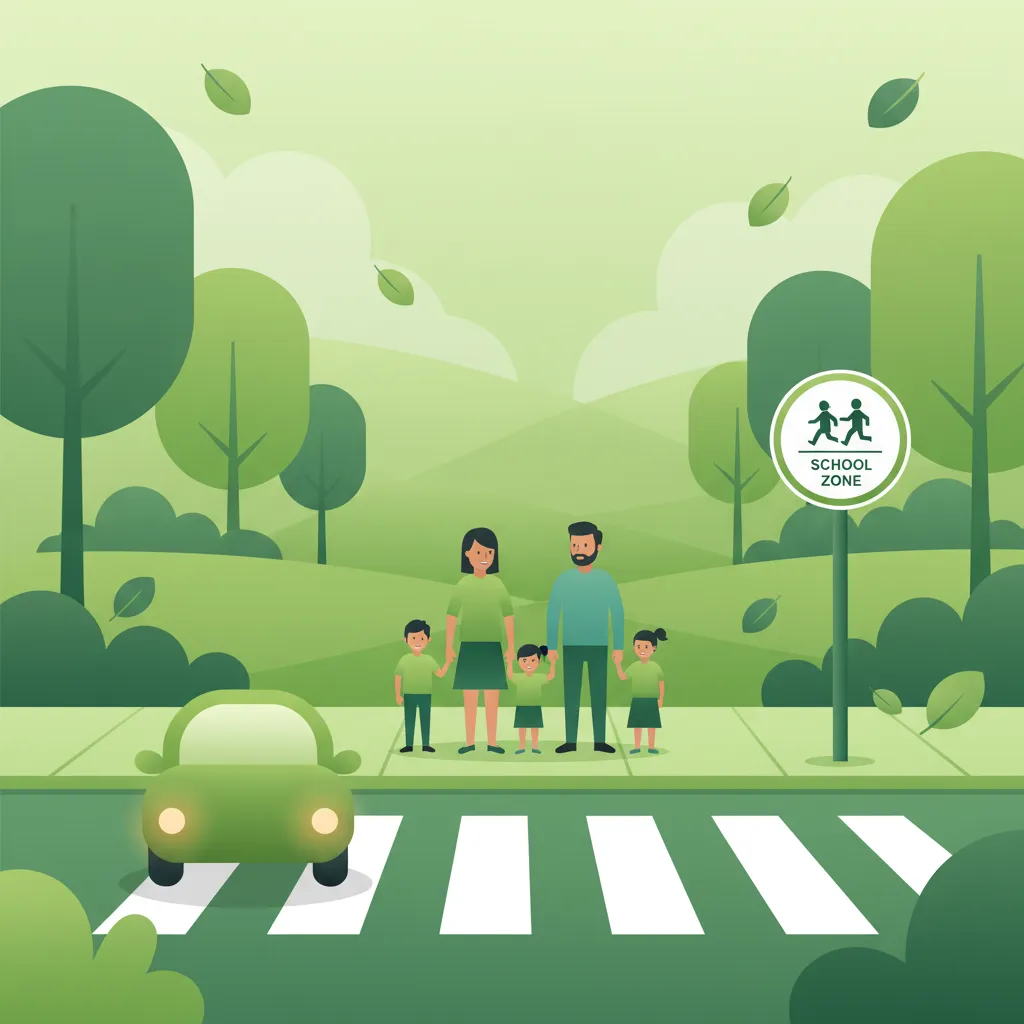
This lesson focuses on the legal requirements and safe practices for riding near pedestrian crossings ('zebrapaden') and designated school zones. It details the absolute obligation to yield to pedestrians on or about to use a crossing and the need for significantly reduced speeds and heightened vigilance in areas with children. The content underscores the importance of anticipation and being prepared for unpredictable movements from vulnerable road users to prevent serious incidents.
Understand the key elements that determine your motorcycle's stopping distance, including speed, road grip, and rider reaction time. Essential Dutch theory for safe riding and hazard perception.
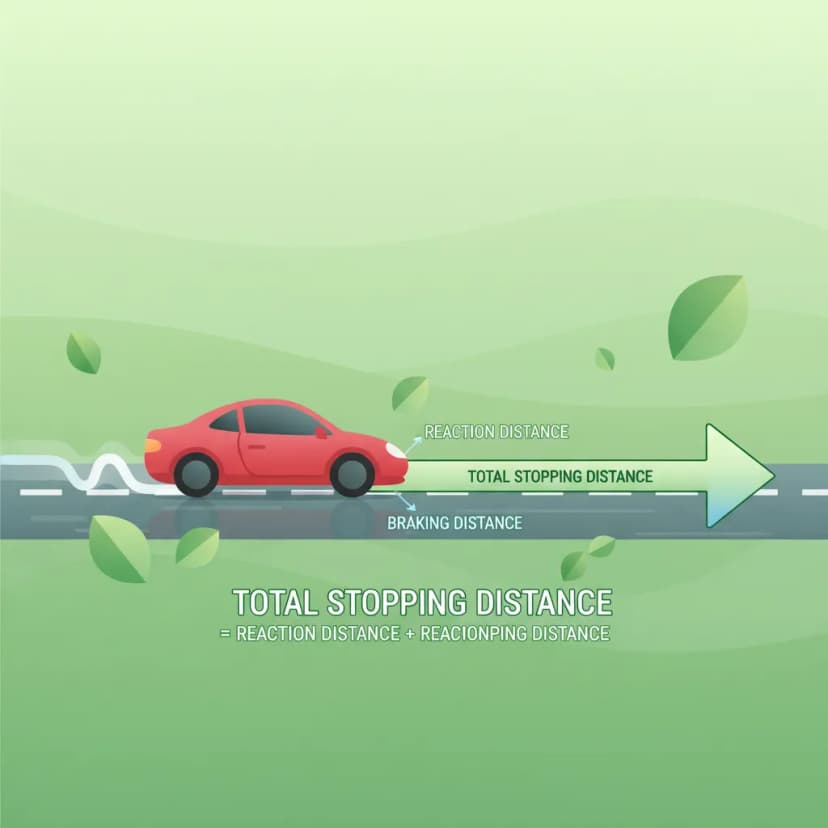
This lesson provides a theoretical understanding of the components that make up the total stopping distance. It explains how to calculate reaction distance (the distance traveled before applying the brakes) and braking distance (the distance traveled while braking). The content highlights how speed exponentially increases stopping distance and how other variables like rider alertness, road grip, and brake condition play a significant role in the final calculation.
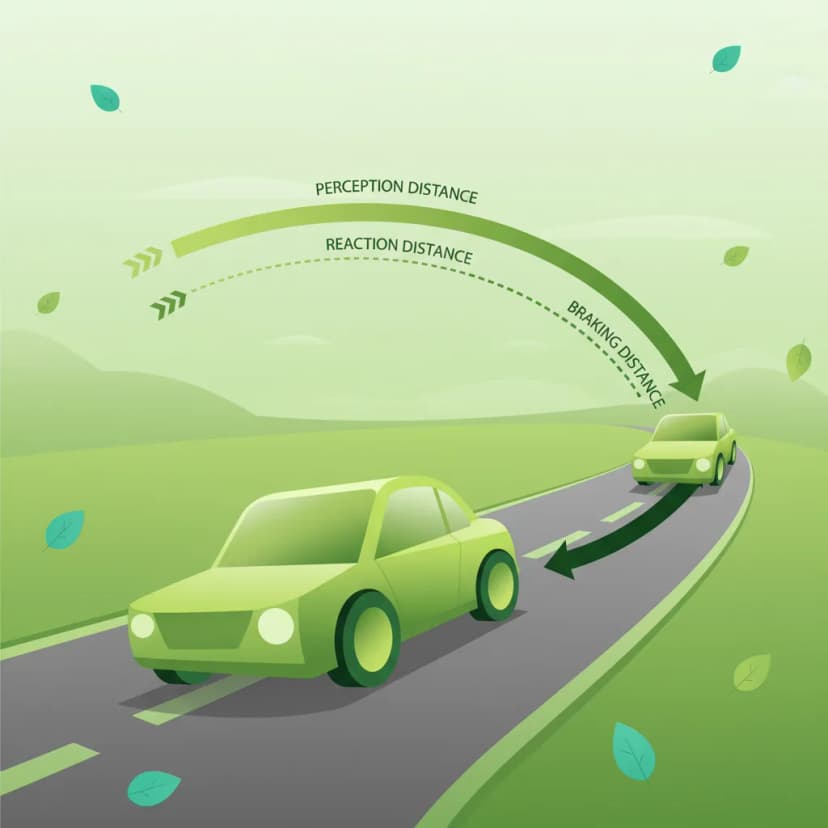
This lesson breaks down the concept of total stopping distance into its two key parts: the distance traveled during your reaction time and the distance the motorcycle travels after the brakes are applied. You will learn the formulas and rules of thumb for estimating these distances at various speeds. The content highlights how factors like rider fatigue, road surface conditions, and tyre quality can significantly increase your overall stopping distance.
This lesson provides a detailed explanation of the two-second rule as a simple yet effective method for maintaining a safe following distance in good conditions. It breaks down the concept of total stopping distance into its two components: reaction distance (the distance traveled before applying the brakes) and braking distance (the distance traveled while braking). Understanding this calculation is fundamental for appreciating the need for a sufficient space cushion to react to sudden events ahead.
This lesson explains why the standard two-second rule is insufficient in adverse conditions and requires extension. It details how factors like rain, fog, and darkness reduce both visibility and tire grip, thereby significantly increasing total stopping distance. The content provides practical guidelines, such as extending the following gap to four seconds or more in the wet, to ensure the rider always has enough time and space to stop safely, regardless of the conditions.
This lesson reinforces the critical relationship between adverse conditions, reduced traction, and massively increased stopping distances. It provides a clear framework for how much riders need to increase their following distance and reduce their overall speed to maintain a safe margin for error. The curriculum teaches riders to constantly reassess their speed based on visual feedback from the road surface and the level of visibility, ensuring they can always stop within the distance they can clearly see.

This lesson provides a comprehensive guide to safe and effective deceleration on a motorcycle. You will learn the principles of controlled braking, including the progressive application of both the front and rear brakes to maximize stopping power while maintaining stability. The content also explains the role of engine braking in managing speed and how the Anti-lock Braking System (ABS) helps prevent wheel lock-up during hard braking.
This lesson explains the two-second rule, a simple and effective technique for ensuring you have enough time to react and stop safely. You will learn how to use a fixed object on the roadside to measure the time gap between your motorcycle and the vehicle ahead. The content emphasizes why motorcyclists may need to extend this gap to three or more seconds in poor weather, at high speeds, or in heavy traffic.
This lesson explains the components of the total stopping distance: the reaction distance (distance traveled before you start braking) and the braking distance (distance traveled while braking). You will learn the general formulas and rules of thumb for estimating these distances at different speeds. Understanding that braking distance increases exponentially with speed is a critical piece of knowledge that reinforces the importance of maintaining safe speeds and following distances.

This lesson teaches the principles of performing a controlled emergency stop ('noodsremmen') to achieve the shortest possible stopping distance without losing control. It details the technique of applying both brakes firmly and progressively, managing the forward weight transfer, and maintaining an upright body posture to maximize braking efficiency. The content emphasizes braking in a straight line and looking ahead to where you want to stop, not at the obstacle.
This lesson revisits the concept of following distance, emphasizing its heightened importance in the high-speed motorway environment. It explains how increased speeds dramatically lengthen both reaction and braking distances, making a minimum two-to-three-second gap absolutely critical for safety. The content also stresses the importance of maintaining a space cushion to the sides, creating potential escape routes in case of sudden incidents in adjacent lanes.
Find clear answers to common questions learners have about Safe Following Distances for Motorcycles. Learn how the lesson is structured, which driving theory objectives it supports, and how it fits into the overall learning path of units and curriculum progression in the Netherlands. These explanations help you understand key concepts, lesson flow, and exam focused study goals.
The standard minimum following distance for a motorcycle is the 'two-second rule'. This means there should be at least a two-second gap between your motorcycle and the vehicle in front. You can test this by observing when the vehicle ahead passes a fixed point, and then counting how many seconds it takes you to reach the same point.
You must significantly increase your following distance in adverse conditions. This includes wet roads, fog, heavy rain, snow, poor visibility, or when following large vehicles that may obscure your view. For these conditions, a three or four-second gap is recommended to allow for longer reaction and braking times.
Motorcycles are more vulnerable than cars and have less stability, especially during braking. A larger following distance provides a critical buffer, giving you more time to react to sudden stops or swerving from the vehicle ahead. It also allows for smoother braking and reduces the risk of a rear-end collision or running into the back of another vehicle.
The Dutch CBR theory exam frequently tests your understanding of safe following distances. Questions will often present scenarios where you need to choose the correct following distance based on speed, road conditions, and visibility. Understanding and applying the two-second rule, and knowing when to extend it, is crucial for passing these questions.
Tailgating, or following too closely, is extremely dangerous for motorcyclists. It drastically reduces your reaction time, making it impossible to avoid collisions if the vehicle ahead brakes suddenly. It also increases the risk of a serious accident if you need to take evasive action, and can lead to significant fines and points on your license in the Netherlands.