
While standard priority rules often involve traffic from the right, some situations grant absolute or special priority. This lesson focuses on these exceptions, preparing you for complex scenarios often tested in the Dutch driving theory exam. Understanding these specific rules is vital for both exam success and ensuring the safety of all road users, especially emergency services and public transport.
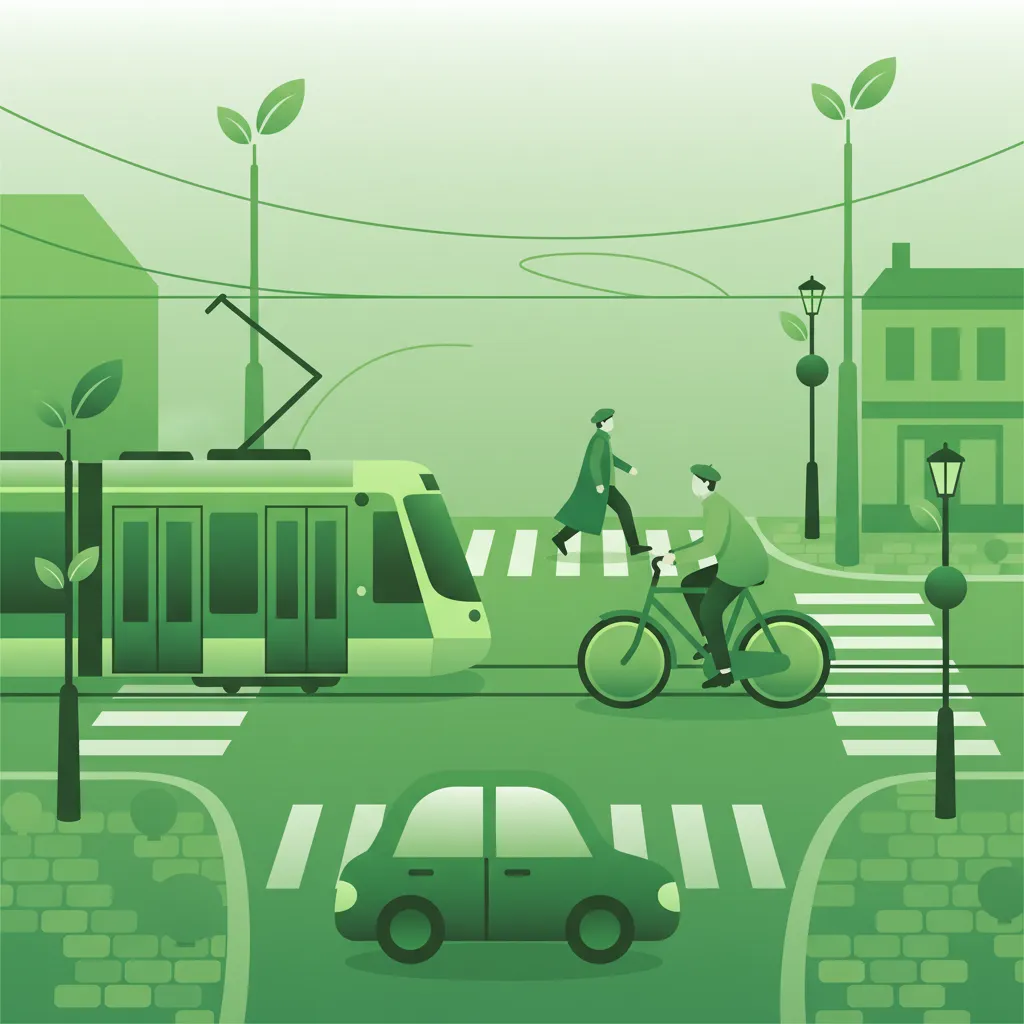
Navigating the roads safely in the Netherlands requires a thorough understanding of standard right-of-way rules. However, certain situations demand special attention, where these typical rules are superseded by absolute or conditional priority. This lesson delves into these critical scenarios, ensuring you are equipped to react appropriately, prevent accidents, and maintain smooth traffic flow.
Understanding these special priority rules is not just about compliance with RVV 1990 (Reglement Verkeersregels en Verkeerstekens – Regulations for Traffic Rules and Traffic Signs) and the Code of Road Traffic; it is fundamental for road safety. Ignoring these regulations can lead to severe consequences, especially when involving emergency services or vulnerable road users.
This lesson builds upon your existing knowledge of general right-of-way principles, including the right-hand rule, yield and stop signs, and roundabout priorities. We will focus on the absolute priority granted to emergency vehicles with sirens and flashing lights, the specific rules for trams, the protocols for military columns and official funeral processions, and the crucial obligation to yield to pedestrians at zebra crossings.
Special priority situations exist to protect life, ensure efficient functioning of essential services, maintain predictable traffic patterns, and honor societal protocols. They represent a legal mandate to break the usual flow of traffic for a greater good.
A fundamental distinction exists between absolute priority and conditional priority.
In these special situations, the standard right-hand priority rule and other general right-of-way principles are superseded. This ensures that higher-priority vehicles and individuals are never blocked by motorists. Your primary task as a driver is to identify these situations promptly and react safely, always prioritizing the safety of all road users.
Emergency vehicles are critical for public safety, and their rapid response can be a matter of life or death. Recognizing and appropriately yielding to these vehicles is a cornerstone of safe driving in the Netherlands.
In the Netherlands, emergency vehicles typically include ambulances, fire engines, and police vehicles. They signal their urgency through two primary means:
According to RVV 1990 §7 and the Code of Road Traffic §3.2, you must always give priority to emergency vehicles that are using both audible sirens and flashing lights, or even just flashing lights. The presence of flashing lights alone is sufficient to indicate an urgent mission requiring your immediate attention, even if the siren is temporarily off.
When you encounter an emergency vehicle using its signals, your immediate response should be to facilitate its passage safely and efficiently.
Trams are an integral part of public transport in many Dutch cities. Their fixed tracks and limited maneuverability necessitate special priority rules to ensure safety and maintain public transport schedules.
In the Netherlands, trams generally have priority over other vehicles at intersections, even when no specific tram priority signs are present. This is stipulated in RVV 1990 §8 and reinforced by the Code of Road Traffic §6.5.
Always assume a tram has priority unless specific traffic signals or signs explicitly indicate otherwise for the tram itself. This is a safe driving principle.
Military columns, or convoys of military vehicles, are given absolute priority on Dutch roads. These columns, whether for defensive exercises, transport, or ceremonial parades, represent official government activity and require unconditional yielding from civilian traffic.
A military column typically consists of several military vehicles traveling together. They are often marked with specific flags or lighting to indicate their status as a convoy.
The Code of Road Traffic §7.1 and RVV 1990 §9 stipulate that all vehicles must yield to a military column, irrespective of traffic signals or general right-of-way rules.
Official funeral processions are granted special priority out of respect for the deceased and their families, and to ensure solemn progress without interruption. These processions are not to be confused with general traffic and must be treated with due deference.
An official funeral procession typically consists of a hearse (often black or dark-colored) followed by a line of vehicles, usually with their hazard lights flashing or displaying specific flags or insignia to indicate their participation in the procession.
RVV 1990 §10 and the Code of Road Traffic §7.2 mandate that motorists must yield to funeral processions in all cases.
Pedestrians are among the most vulnerable road users, and their safety is paramount. Zebra crossings (zebrapaden) are designated areas specifically designed to provide pedestrians with a safe means to cross the road, granting them absolute priority.
A zebra crossing is identified by distinctive white stripes painted on the road surface, perpendicular to the flow of traffic. These markings indicate a crossing intended solely for pedestrians. There are no traffic lights or specific signals for vehicles at these crossings, although sometimes they are combined with additional signage or street lighting.
RVV 1990 §12 and the Code of Road Traffic §8.3 clearly state that pedestrians at a zebra crossing have absolute right of way.
While the core rules for special priority remain constant, various environmental and contextual factors can influence how you must react as a driver.
Ignoring or misinterpreting special priority rules can lead to dangerous situations and legal penalties. Here are some common violations:
Understanding special priority situations is critical for safe and responsible driving in the Netherlands.
Adhering to these special priority rules ensures smoother traffic flow, significantly reduces the risk of accidents involving critical services and vulnerable road users, and reinforces a culture of safety on Dutch roads.
Lesson content overview
Explore all units and lessons included in this driving theory course.
Explore search topics learners often look for when studying Special Priority Situations. These topics reflect common questions about road rules, driving situations, safety guidance, and lesson level theory preparation for learners in the Netherlands.
Browse additional driving theory lessons that cover connected traffic rules, road signs, and common driving situations related to this topic. Improve your understanding of how different rules interact across everyday traffic scenarios.
Understand the Dutch traffic laws regarding absolute priority for emergency vehicles, trams, military columns, and funeral processions. Essential knowledge for your driving theory exam and safe road navigation.
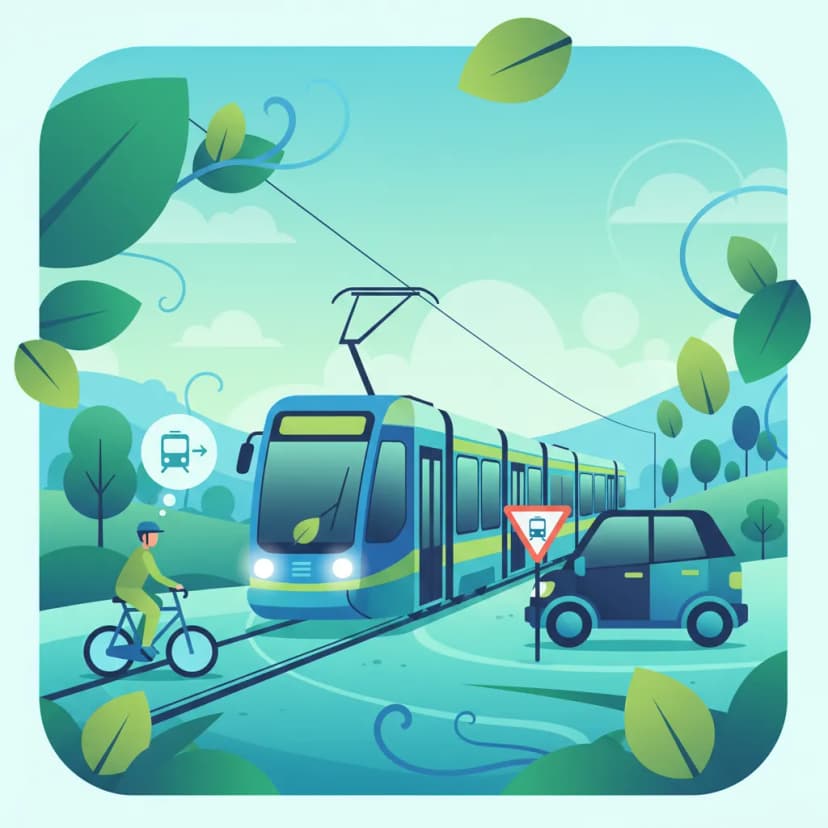
This lesson addresses the unique priority rules concerning trams in urban environments, clarifying that trams generally have priority unless signs or signals indicate otherwise. It explains the specific hazards motorcyclists face, such as slippery tracks (especially in wet conditions) and the long stopping distance of trams. Riders will learn how to safely cross tram lines, navigate shared lanes, and correctly interpret tram-specific traffic signals to avoid dangerous conflicts.
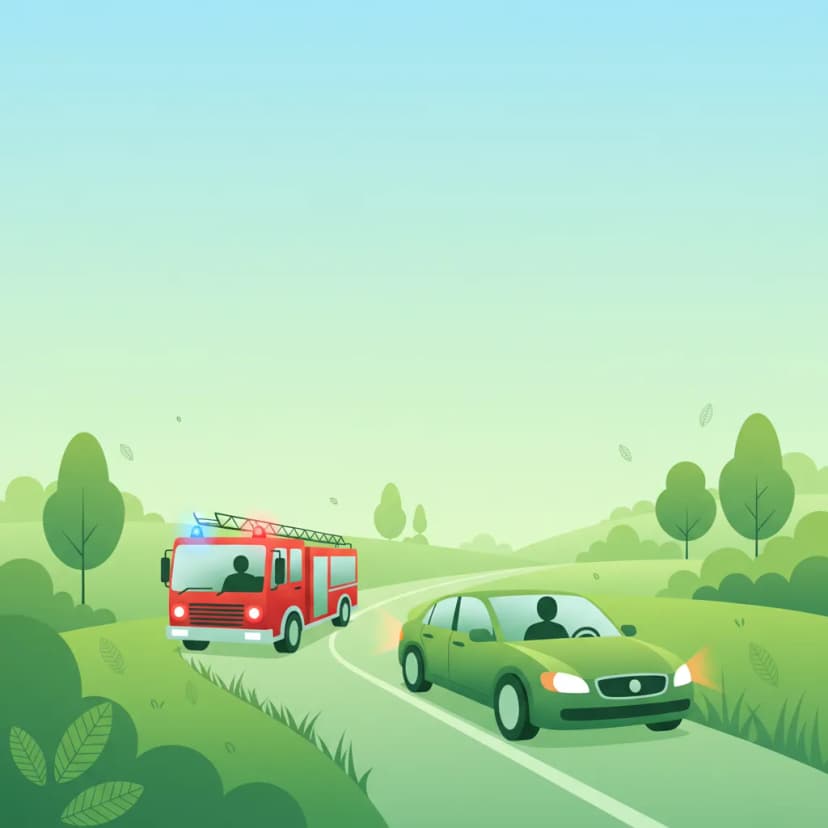
This lesson details the legal obligation and safe procedures for yielding to emergency vehicles ('noodvoertuigen' or 'voorrangsvoertuigen') that are using audible and visual warnings. It provides clear guidance on how to safely create space, whether by pulling over, adjusting speed, or clearing an intersection, without causing a secondary hazard. The content emphasizes maintaining composure and making predictable maneuvers to allow emergency services to pass quickly and safely.
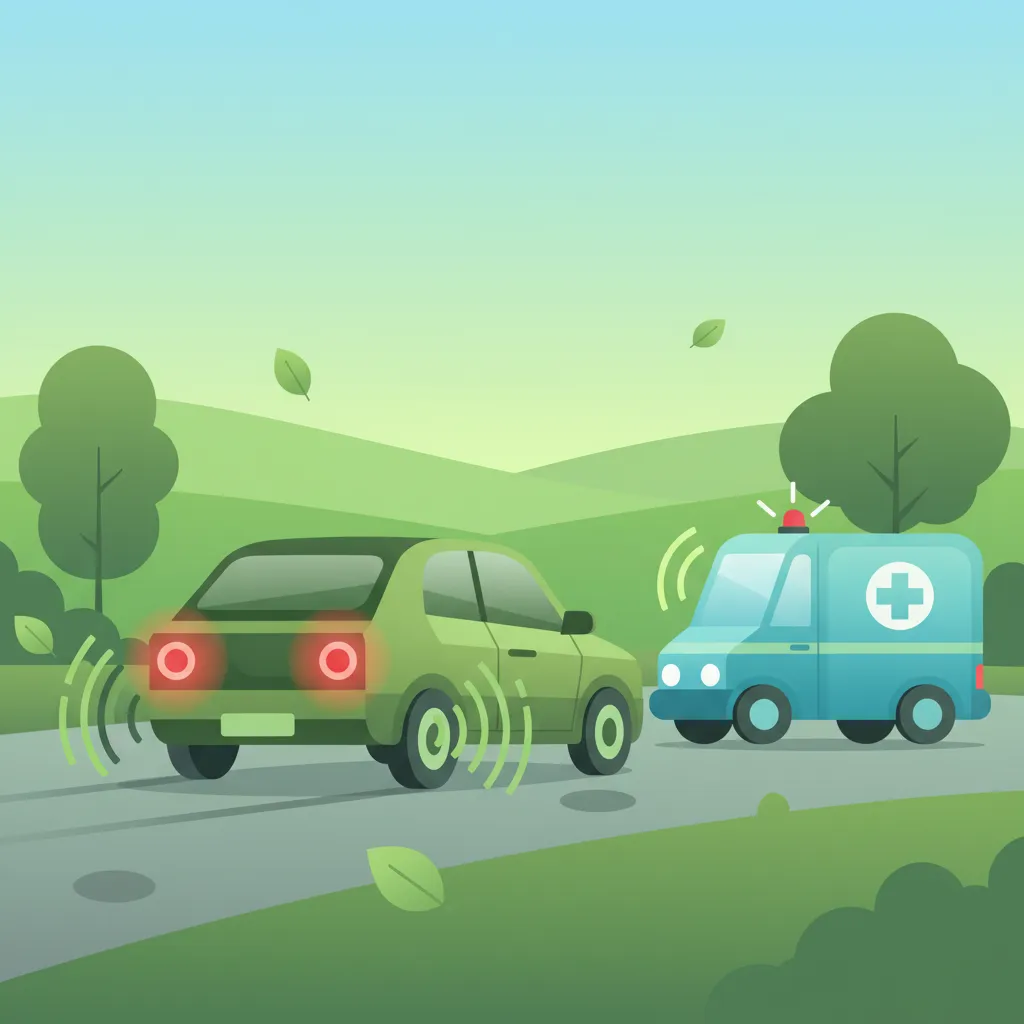
When an emergency vehicle approaches with sirens and blue flashing lights, you are legally required to give way. This lesson explains the correct procedure: check your surroundings, signal your intention, and move to the side of the road as safely and quickly as possible to create a clear path. It also covers the procedure for making an emergency stop due to a vehicle breakdown, including the use of hazard warning lights and positioning your vehicle for maximum safety.
This lesson explains the critical rules of priority involving pedestrians and cyclists to ensure the safety of vulnerable road users. You will learn the absolute requirement to stop for pedestrians on or waiting to use a 'zebrapad' (zebra crossing). The content also covers situations where you must yield to cyclists crossing your path, such as when turning across a dedicated bicycle lane (fietspad).
Riding in Dutch cities often means interacting with trams, which present unique risks for two-wheeled vehicles. This lesson details the absolute priority that trams have in most situations and explains how to interpret specific tram traffic signals. It provides crucial safety techniques for crossing tram tracks at a safe angle to prevent your wheels from getting stuck and emphasizes maintaining a safe distance from moving trams, which is a vital aspect of urban hazard perception.
This lesson explains the foundational 'priority to the right' rule, which applies at intersections of equal roads where no other signs or markings dictate priority. You will learn to identify such junctions and understand your obligation to yield to traffic approaching from your right side. The lesson also clarifies important exceptions, such as when exiting a driveway, entering a paved road from an unpaved one, or when encountering a tram. Mastering this rule is crucial for navigating residential areas and city streets where signage is often minimal.
This lesson introduces the foundational principles of right-of-way in the Netherlands, starting with the road user hierarchy and the default rule of giving priority to traffic from the right at equal intersections. You will learn to identify a priority road, marked by sign BORD 30, and understand how this designation overrides the default rule. The content establishes the legal framework for making priority decisions in the absence of specific signs or signals.
This lesson focuses on the rules governing interactions with pedestrians. You will learn the absolute requirement to stop for pedestrians who are on or clearly intending to cross at a designated zebra crossing. The curriculum also covers how to share the road in a 'woonerf' (home zone) where pedestrians have priority. It emphasizes being particularly cautious around children, the elderly, and disabled pedestrians, who may require more time or behave unpredictably.
As a motorized road user, you have a special responsibility towards more vulnerable participants. This lesson focuses on the rules giving priority to pedestrians at marked zebra crossings and the importance of anticipating the movements of cyclists, children, and the elderly. You will learn about maintaining a safe lateral distance when overtaking cyclists and how to navigate shared spaces with heightened awareness, a key component of social and safe driving behavior.
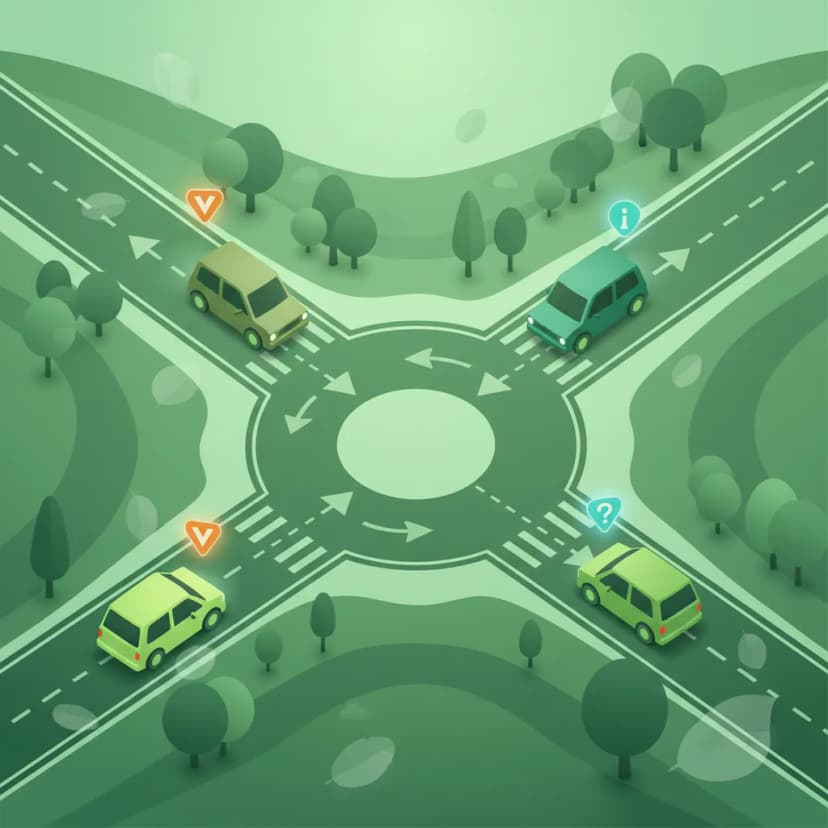
This lesson addresses the challenge of navigating equal-priority intersections, where no signs or markings dictate the right-of-way. You will master the fundamental Dutch traffic rule of giving priority to all drivers approaching from your right ('rechts voor'). The content focuses on developing advanced observational skills and clear communication to safely manage these situations, which are common in residential and urban areas.
Learn the critical Dutch driving rules for yielding to pedestrians at zebra crossings and understanding conditional priority situations. Essential theory for cyclist and pedestrian safety.
This lesson focuses on the rules governing interactions with pedestrians. You will learn the absolute requirement to stop for pedestrians who are on or clearly intending to cross at a designated zebra crossing. The curriculum also covers how to share the road in a 'woonerf' (home zone) where pedestrians have priority. It emphasizes being particularly cautious around children, the elderly, and disabled pedestrians, who may require more time or behave unpredictably.
This lesson explains the critical rules of priority involving pedestrians and cyclists to ensure the safety of vulnerable road users. You will learn the absolute requirement to stop for pedestrians on or waiting to use a 'zebrapad' (zebra crossing). The content also covers situations where you must yield to cyclists crossing your path, such as when turning across a dedicated bicycle lane (fietspad).
As a motorized road user, you have a special responsibility towards more vulnerable participants. This lesson focuses on the rules giving priority to pedestrians at marked zebra crossings and the importance of anticipating the movements of cyclists, children, and the elderly. You will learn about maintaining a safe lateral distance when overtaking cyclists and how to navigate shared spaces with heightened awareness, a key component of social and safe driving behavior.
This lesson focuses on the legal requirements and safe practices for riding near pedestrian crossings ('zebrapaden') and designated school zones. It details the absolute obligation to yield to pedestrians on or about to use a crossing and the need for significantly reduced speeds and heightened vigilance in areas with children. The content underscores the importance of anticipation and being prepared for unpredictable movements from vulnerable road users to prevent serious incidents.
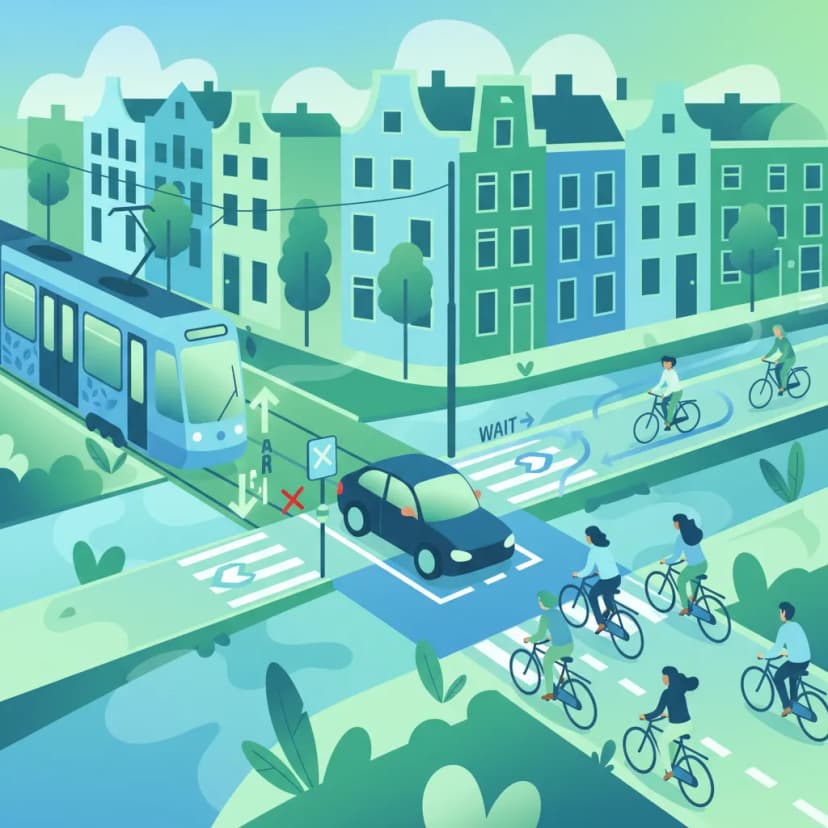
This lesson breaks down the rules of priority at intersections. You will learn to identify an 'equal' intersection where the default rule of giving way to traffic from the right applies. It also explains how priority is regulated by signs (such as the B6 Stop sign and B7 priority road sign) and road markings ('shark's teeth'). Understanding these hierarchies is crucial for making safe and correct decisions when crossing or turning at any junction.

This lesson focuses on the legal and moral responsibility to be extra vigilant around certain groups of vulnerable road users. You will learn that children can be impulsive and have poor traffic awareness, requiring drivers to be prepared to stop suddenly, especially near schools and playgrounds. The content also discusses the need for patience with elderly or disabled road users, who may move more slowly. You will learn to recognize signs of disability, like a white cane or a guide dog, and give these individuals extra space and time.
This lesson is critical for driving in the Netherlands, a country with more bicycles than people. You will learn about the different types of cycle paths and how priority rules apply, especially at junctions. The content stresses the importance of checking the blind spot for cyclists before turning right ('dode hoek'). It also covers the rules for different types of mopeds (snorfiets and bromfiets) and the importance of giving all two-wheeled road users ample space when overtaking.
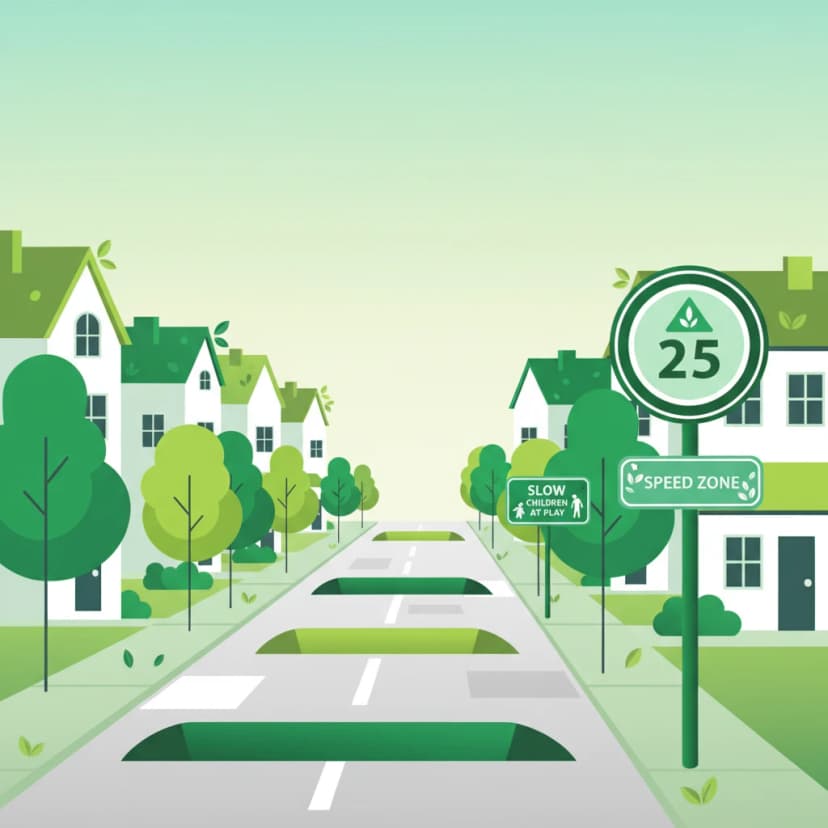
This lesson explains speed limits in specially designated zones designed to protect vulnerable road users. You will learn the rules of a 'woonerf' (home zone), where the speed limit is walking pace (max 15 km/h) and pedestrians can use the full width of the road. The content also covers 30 km/h zones, common in residential areas and around schools, which are often enforced through road design like speed bumps. Understanding the purpose and rules of these zones is key to driving responsibly in urban environments.
This lesson explains the foundational 'priority to the right' rule, which applies at intersections of equal roads where no other signs or markings dictate priority. You will learn to identify such junctions and understand your obligation to yield to traffic approaching from your right side. The lesson also clarifies important exceptions, such as when exiting a driveway, entering a paved road from an unpaved one, or when encountering a tram. Mastering this rule is crucial for navigating residential areas and city streets where signage is often minimal.
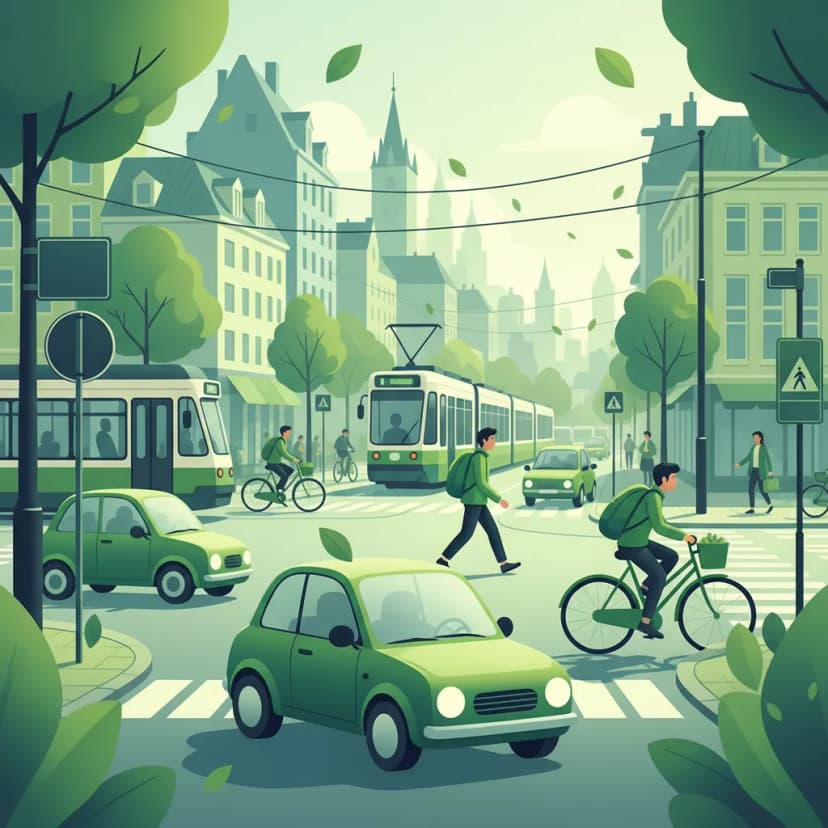
This lesson establishes the foundational rule of priority in Dutch traffic law: yielding to traffic from the right at intersections of equal roads unless otherwise indicated. It explains how to identify an unmarked or 'equal' junction and the correct procedure for approaching, assessing, and proceeding safely. The content also introduces the primary signs and markings, such as 'shark's teeth,' that override this default rule, forming the basis for all other priority scenarios.
Find clear answers to common questions learners have about Special Priority Situations. Learn how the lesson is structured, which driving theory objectives it supports, and how it fits into the overall learning path of units and curriculum progression in the Netherlands. These explanations help you understand key concepts, lesson flow, and exam focused study goals.
Yes, emergency vehicles (police, ambulance, fire brigade) that are actively responding to an emergency and are using both their flashing blue lights and audible siren have absolute priority. You must take all necessary measures to give them way safely and as quickly as possible.
In most situations, trams have priority over other traffic, even if traffic is coming from the right. You must generally give way to trams, especially when they are entering or crossing an intersection or when you are turning across their path. Always be aware of tram tracks and their likely path.
You must give way to official funeral processions. These are usually indicated by a funeral director's car leading the way and often involve a police escort. Be patient and allow the procession to pass without interruption.
Similar to funeral processions, you must give way to military columns if they are being supervised by the military police. Be alert for their presence and allow them to proceed without interference.
Pedestrians have priority at zebra crossings (zebrapad). You must always be prepared to stop and allow pedestrians to cross safely. Do not overtake other vehicles at or just before a zebra crossing.