
Navigating multi-lane roads and joining traffic requires confidence and correct technique. This lesson focuses on the crucial skills of safely merging onto a carriageway and changing lanes, essential for both your AM theory exam and everyday riding in the Netherlands.

Navigating the dynamic environment of Dutch carriageways, whether in urban settings, on rural roads, or motorways, requires precise judgment and adherence to established safety procedures. For riders of mopeds and scooters (Category AM), mastering merging and lane-changing techniques is not just about convenience; it is paramount for preventing collisions, maintaining smooth traffic flow, and fulfilling legal obligations under Dutch traffic law. This lesson provides a comprehensive guide to these essential maneuvers.
The cornerstone of safe lateral vehicle movement is a systematic approach known as the Mirror-Signal-Blind Spot (MSB) routine. This sequential safety checklist ensures that you are fully aware of your surroundings and communicate your intentions effectively before altering your position on the road. Omitting any step significantly increases the risk of an accident and may constitute a breach of the Dutch traffic regulations (RVV 1990).
The MSB routine, often expanded to Mirror → Signal → (Speed) Adjust → Blind-Spot Check → Execute, is more than just a mnemonic; it is a critical process designed to compensate for the physical limitations of vision and vehicle design. By consistently applying this routine, you gain crucial situational awareness and provide adequate warning to other road users, allowing them to anticipate your actions and react safely.
An acceleration lane, known in Dutch as an invoegstrook, is a dedicated strip of roadway designed to allow vehicles to increase their speed before entering the main flow of traffic on a carriageway. These lanes are common on urban arterial roads, provincial roads, and motorways. They begin with a solid white line, indicating that merging is not yet permitted, and transition to a dashed white line at the point where you are allowed to join the main traffic stream.
The primary purpose of an acceleration lane is to facilitate a smooth and safe transition. Riders use this lane to match their speed to that of the traffic already on the main carriageway, minimizing the relative speed difference and reducing the potential for disruption or collisions.
Important Note: Do not stop or park in an acceleration lane. Its sole purpose is for accelerating to merge.
The merge point (invoegpunt) is the critical location where the acceleration lane ends and the dashed line signifies that merging is permitted. This is the precise spot where, having completed the initial steps of the MSB routine, you should be ready to smoothly integrate into the traffic flow.
The specific location on a carriageway where an acceleration lane concludes, marked by a dashed line, indicating where traffic is permitted to join the main flow.
According to RVV 1990, article 5.1.1, vehicles must not merge before this designated merging point (i.e., while the line is still solid). Attempting to merge too early can force main-lane traffic to brake abruptly, creating a dangerous situation and violating traffic regulations.
A crucial aspect of safe merging is speed matching. This involves adjusting your vehicle's speed to be within approximately ±10 km/h of the prevailing traffic flow on the main carriageway before you attempt to merge.
Why Speed Matching Matters: When your speed closely matches that of the traffic you are joining, the relative speed difference is minimal. This reduces the kinetic energy involved in a potential collision and gives both you and other drivers more time to react, making it easier to find and enter a safe gap.
Failing to reach an adequate speed in the acceleration lane, or merging at a significantly lower speed than the main traffic, can lead to dangerous situations. It might force you to brake abruptly after merging, posing a rear-end collision risk for vehicles behind you, and it violates RVV 1990, article 6.2.1, which mandates merging without impeding existing traffic.
Even with well-adjusted mirrors, there are areas immediately adjacent to your moped or scooter that remain invisible. This unseen zone is known as the blind spot (dode hoek). For mopeds, this area typically extends from the side of the vehicle to about 1.5 meters behind and 0.5 meters laterally. This blind spot is created by your own body, the vehicle's frame, and the limitations of mirror angles.
Motorcyclists, cyclists, and even smaller cars can easily be hidden within this zone, making a direct visual check absolutely essential before any lateral movement.
To compensate for the blind spot, you must perform a shoulder check. This is a quick but thorough head turn, glancing over the appropriate shoulder (left for a left merge/lane change, right for a right merge/lane change) to confirm that no vehicle occupies the unseen area.
A quick, deliberate head turn performed by a driver to visually inspect the blind spot directly adjacent to their vehicle before executing a lateral movement like merging or changing lanes.
A proper shoulder check should be swift, typically lasting less than one second, but long enough to clearly identify any hidden vehicles. While performing the check, it is crucial to maintain control of your moped and be aware of traffic directly ahead.
RVV 1990, article 5.2.4 explicitly states that drivers must ensure the lane is clear before changing lanes, which implicitly includes checking the blind spot. Failure to do so is a common cause of side-impact collisions, especially involving two-wheeled vehicles.
Relying solely on your mirrors is one of the most common and dangerous mistakes riders make. While mirrors provide an excellent initial overview of surrounding traffic, they cannot provide a complete picture. The convex shape of many mirrors, designed to offer a wider field of view, also distorts distances, making objects appear further away than they actually are. This distortion, combined with the physical blind spots, necessitates the direct visual confirmation offered by a shoulder check.
Gap selection is the process of identifying a suitable space in the main traffic flow into which you can safely merge or change lanes without disrupting other road users. This requires a keen eye for estimating speed, distance, and the acceleration/deceleration capabilities of all surrounding vehicles.
As a moped rider, you must accurately evaluate the gap using visual cues such as the speed and length of vehicles, and their distance from each other. Mental calculations are essential to determine if the time-to-collision (how long it would take for you to reach the position of another vehicle) allows for a safe maneuver.
A fundamental rule under RVV 1990, article 6.2.2, states that drivers must not cause any other road user to brake or adjust their speed due to a merge or lane change. This means the gap you choose must be large enough to allow you to enter without forcing anyone else to take evasive action.
Attempting to squeeze into a small or insufficient gap not only violates this rule but also creates traffic turbulence, increasing the risk of chain-reaction crashes and potential road rage incidents. Always err on the side of caution; if a gap feels too small, it probably is.
After successfully merging or changing lanes, it is crucial to immediately establish and maintain a safe following distance from the vehicle ahead. A general rule of thumb is to maintain at least a 2-second gap. At speeds above 50 km/h, this translates to roughly 30 meters. This distance provides adequate reaction time for unexpected maneuvers by the lead vehicle and prevents rear-end collisions.
Using your turn indicators, or "blinkers," is a legal requirement and a vital communication tool. RVV 1990, article 8.4.2 mandates that turn signals must be given in good time, typically at least 2 seconds before the maneuver is executed. This lead time provides other road users with sufficient warning of your intended lane change or merge, allowing them to adjust their speed or position accordingly.
The act of indicating intended lane changes or merges using turn indicators (blinkers) or, if unavailable, hand signals, providing other road users with timely warning.
Lane discipline refers to the practice of keeping your vehicle within the designated lane, respecting all lane markings, and only changing lanes when necessary and safe to do so. This practice is crucial for predictability and preventing side-swipe collisions.
Road markings, such as solid and dashed lines, are not merely suggestions; they are regulatory. A solid line prohibits crossing or changing lanes at that point, while a dashed line indicates that lane changes or merging are permitted. Ignoring these markings not only constitutes a traffic violation but also creates confusion and danger for other drivers.
Solid Line Rule: Never merge onto a main carriageway if the line separating the acceleration lane from the main lane is still solid. This is a common mistake that can lead to immediate danger and penalties.
Lane changes involve a lateral movement from one lane to an adjacent one and must always be performed after thoroughly completing the MSB routine and confirming a safe gap. RVV 1990, article 5.3.1, specifies that all lane changes must be smooth, controlled, and without endangering other road users.
On urban and rural roads, speeds are generally lower, and traffic density can vary significantly. When changing lanes in these environments:
Motorways involve higher speeds, which inherently demand larger safety margins:
Lane changes are often performed for specific reasons:
When merging or changing lanes, particularly in urban and rural areas, heightened awareness of vulnerable road users (VRUs) is non-negotiable. This category includes pedestrians, cyclists, and often motorcyclists, all of whom have a higher risk of injury in a collision.
Road users such as pedestrians, cyclists, and motorcyclists who are at a significantly higher risk of severe injury in the event of a collision due to their lack of external protection.
You must be especially cautious to avoid encroaching on cycle tracks or lanes adjacent to the carriageway, and always respect the priority of pedestrians at crosswalks. Cyclists can be difficult to spot, especially if they are riding close to the right edge of a lane or in a designated bike lane.
RVV 1990, article 5.5.4, explicitly mandates that drivers must give way to VRUs where the law specifies. This means:
Failing to give way to VRUs not only endangers lives but also carries severe legal consequences, including fines and potential liability in the event of an accident. Always assume that VRUs might not have seen you, and give them ample space and time.
The following articles from the Reglement verkeersregels en verkeerstekens 1990 (RVV 1990) are fundamental to understanding the legal requirements for merging and changing lanes in the Netherlands. Adherence to these regulations is mandatory for all road users, including moped and scooter riders.
| Regulation | Rule Statement | Applicability | Rationale |
|---|---|---|---|
| RVV 1990, art 5.1.1 | Vehicles must not merge before the dashed line on the acceleration lane. | Acceleration lanes | Prevents sudden entry that forces main-lane traffic to brake. |
| RVV 1990, art 5.2.4 | Drivers must ensure the lane is clear (including blind spot) before changing lanes. | All lane-change maneuvers | Eliminates side-impact collisions caused by unseen vehicles. |
| RVV 1990, art 6.2.1 | Merging must be performed without impeding traffic already on the carriageway. | Merges from acceleration lanes, slip roads | Keeps traffic flow smooth and avoids forced braking. |
| RVV 1990, art 6.2.2 | Drivers must not cause any other road user to brake due to their merging or lane-change. | All lateral movements | Reduces chain-reaction crashes and maintains safety. |
| RVV 1990, art 8.4.2 | Turn signals must be given at least 2 seconds before the maneuver. | All signalling situations | Provides adequate warning to other users, allowing for safe reactions. |
| RVV 1990, art 5.3.1 | Lane changes must be smooth and without endangering other road users. | All lane change situations | Abrupt moves increase risk of loss of control and collisions. |
| RVV 1990, art 5.5.4 | Drivers must give way to vulnerable road users where legally required (e.g., cyclists in bike lanes). | Interactions with VRUs | Protects users with higher injury risk. |
| RVV 1990, art 5.1.5 | Vehicles may only occupy the acceleration lane for the purpose of gaining speed for a merge. | Acceleration lanes | Prevents misuse of acceleration lanes for overtaking or other purposes. |
Violating these regulations can lead to significant consequences beyond just fines. Improper merging or lane changes are frequently cited as causes in collision reports, potentially leading to:
Understanding common errors is crucial for developing safe driving habits. Here are some frequent mistakes made during merging and lane changes, along with corrective actions:
Safe merging and lane changes are not static procedures; they require adaptation based on environmental and situational factors.
Understanding the "why" behind traffic rules deepens your ability to make safe decisions.
Dutch traffic data consistently highlights the risks associated with improper merging and lane changes. For example, recent analyses (e.g., by Rijkswaterstaat) indicate that a significant percentage, sometimes as high as 28%, of side-impact collisions involving two-wheeled vehicles are directly attributable to failures in checking blind spots during lane changes. These statistics underscore the critical importance of diligent application of the MSB routine.
Smooth traffic flow, free from sudden braking or acceleration, is vital for road safety and efficiency. Illegal or abrupt merges create "shockwaves" within traffic, causing vehicles upstream to brake suddenly and disrupting the entire flow. These disruptions are major contributors to increased crash risk and congestion. By merging smoothly and predictably, you contribute to overall road safety and efficiency.
Lesson content overview
Explore all units and lessons included in this driving theory course.
Explore search topics learners often look for when studying Merging and Lane Changes on Carriageways. These topics reflect common questions about road rules, driving situations, safety guidance, and lesson level theory preparation for learners in the Netherlands.
Browse additional driving theory lessons that cover connected traffic rules, road signs, and common driving situations related to this topic. Improve your understanding of how different rules interact across everyday traffic scenarios.
Explore complex situations for merging and changing lanes on Dutch roads beyond basic rules. Learn to navigate challenging multi-lane traffic, understand interactions with different road users, and adapt techniques for varied conditions to improve road safety and traffic flow.

This lesson reinforces the fundamental rule of Dutch highway driving: use the rightmost lane available and use the lanes to the left only for overtaking. You will learn the complete, safe overtaking procedure: check mirrors, signal, perform a shoulder check for the blind spot, smoothly move over, accelerate past the vehicle, and then return to the right lane when safe.
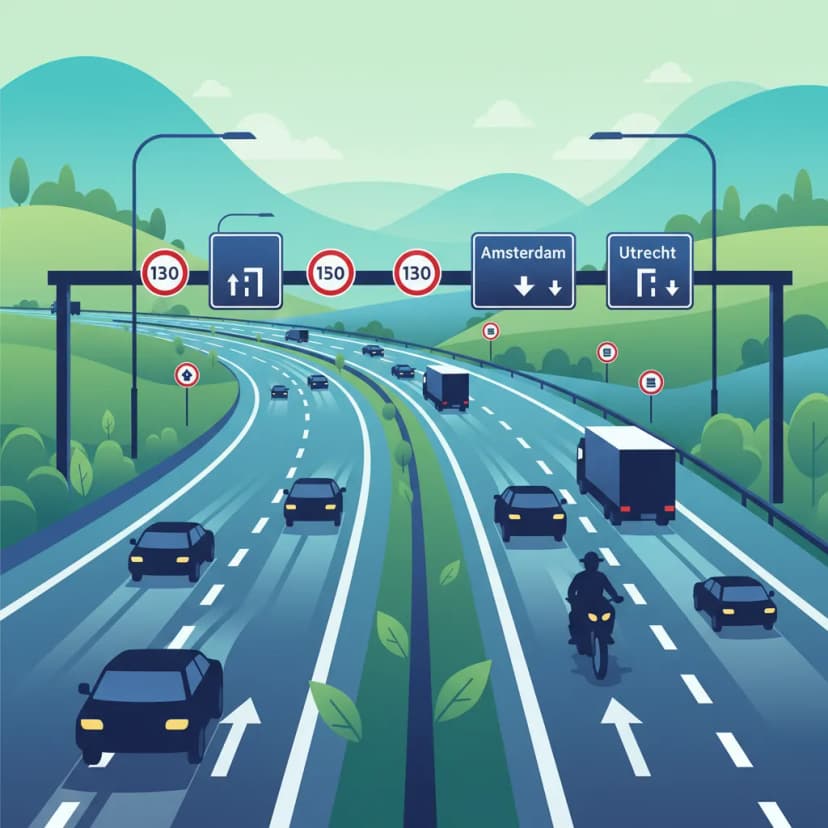
This lesson details the specific regulations for driving on Dutch motorways, identifiable by the G1 sign. You will learn the correct procedure for joining the flow of traffic using the acceleration lane and for leaving via the deceleration lane. The curriculum reinforces the 'keep right unless overtaking' rule for lane discipline. It also explains that stopping is strictly forbidden, and the hard shoulder (vluchtstrook) may only be used for genuine emergencies.
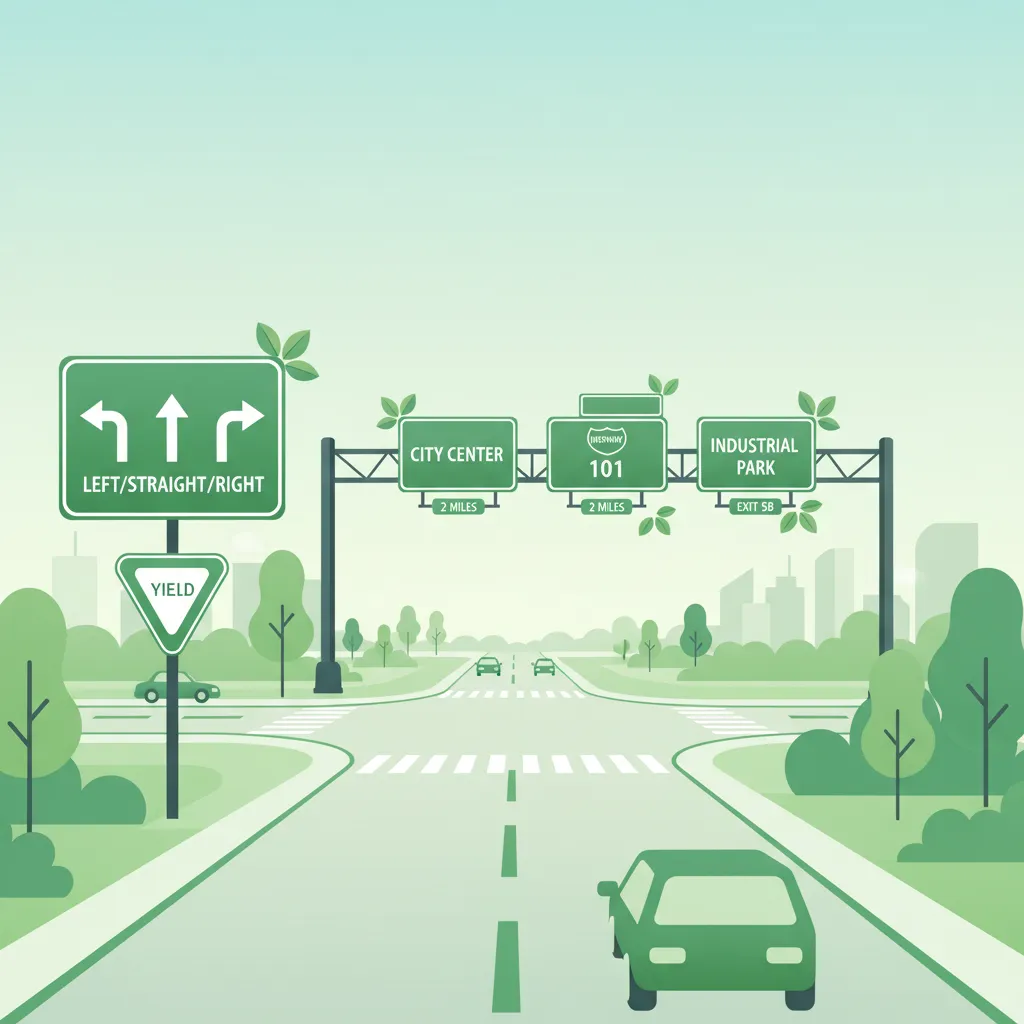
This lesson focuses on the array of signs used to manage traffic at intersections and along multi-lane roads. You will learn to interpret overhead gantry signs, lane designation signs, and markings that guide drivers into the correct lane for their intended direction. The curriculum covers signs indicating priority at upcoming junctions, such as the B3 and B4 signs, which clarify right-of-way rules in complex scenarios. Proper interpretation of these signs is essential for smooth lane changes, efficient navigation, and preventing conflicts at junctions.
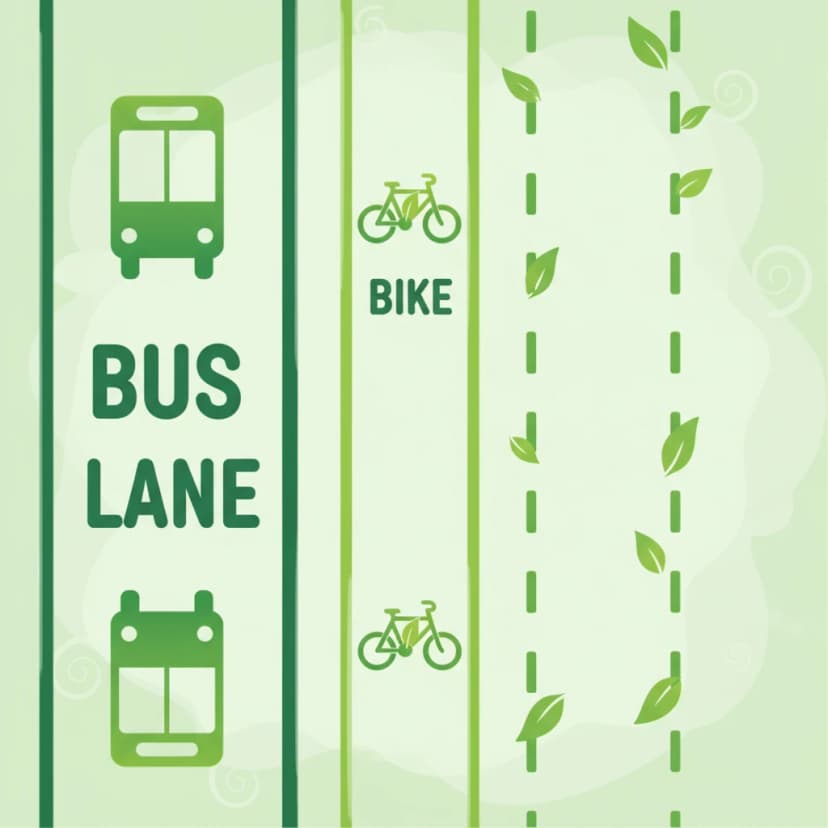
This lesson covers a variety of lanes and markings with specific rules. You will learn to recognize and respect bus lanes, which are reserved for public transport, and rush-hour lanes (spitsstrook), which are only open during busy periods as indicated by electronic signs. The curriculum also explains the meaning of different line types (solid, broken, double lines) that dictate whether lane changes or overtaking are permitted. Understanding these special lanes and markings is key to navigating Dutch infrastructure correctly.
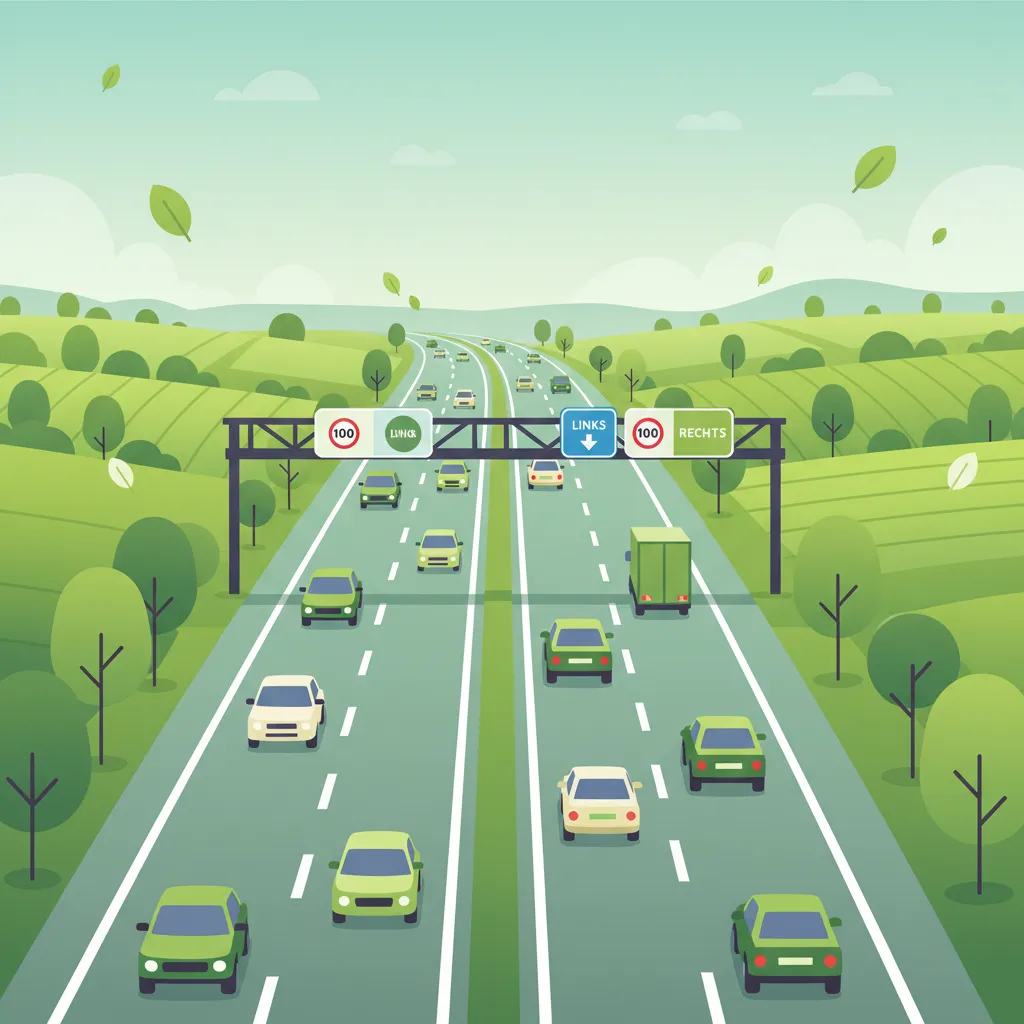
This lesson covers the specific articles of the Dutch Road Traffic Act that apply to motorways, with a primary focus on the strict rule of keeping to the rightmost available lane unless overtaking. It explains the legal and safety reasons for only passing on the left and discusses the correct positioning within a lane for maximum visibility and safety. The content also addresses the nuances of lane usage during heavy congestion, ensuring riders comply with the law and contribute to smooth traffic flow.

This lesson details the critical manoeuvres of entering and exiting a highway. You will learn to use the full length of the on-ramp to accelerate to the speed of the highway traffic before looking for a safe gap to merge into. The content also covers the process of exiting, including signaling early, moving into the deceleration lane, and adjusting your speed for the off-ramp curve.
This lesson focuses on the rules and techniques for safely navigating Dutch roundabouts, a common feature of the road network. You will learn that traffic circulating on the roundabout typically has priority and that you must yield before entering. The content covers correct lane selection for your intended exit, proper use of turn signals, and maintaining awareness of cyclists who may have priority on adjacent paths.

This lesson provides a detailed guide on the rules and safety precautions for overtaking. You will learn that overtaking must almost always be done on the left and requires careful judgment of speed and distance. The content covers situations where overtaking is forbidden, such as before pedestrian crossings, at intersections, or where there are solid white lines. Key steps like checking mirrors, signaling intention, checking blind spots, and returning to the lane safely are explained thoroughly.

This lesson covers the procedures and safety considerations for driving in reverse and turning around. You will learn that reversing should only be done over short distances and when it does not endanger or obstruct other road users. The curriculum details techniques for turning in the road and identifies situations and locations where U-turns are prohibited. The importance of all-around observation, checking blind spots, and yielding to all other traffic is a central theme.
This lesson explains the specific rules and best practices for lane filtering in traffic jams ('file rijden') in the Netherlands. You will learn the conditions under which it is permitted, such as the limited speed difference between you and the cars. The content emphasizes heightened awareness, watching for drivers changing lanes unexpectedly, and the importance of performing this manoeuvre at a low, controlled speed.
Identify and understand frequent errors made during merging and lane changes on Dutch roads. This lesson details issues like blind spot neglect, improper signalling, and poor gap assessment, explaining the theory behind why these mistakes are dangerous and how to avoid them for safe driving.
This lesson focuses on the array of signs used to manage traffic at intersections and along multi-lane roads. You will learn to interpret overhead gantry signs, lane designation signs, and markings that guide drivers into the correct lane for their intended direction. The curriculum covers signs indicating priority at upcoming junctions, such as the B3 and B4 signs, which clarify right-of-way rules in complex scenarios. Proper interpretation of these signs is essential for smooth lane changes, efficient navigation, and preventing conflicts at junctions.

This lesson provides critical instruction on managing blind spots ('dode hoek') to prevent collisions, particularly during lane changes. It covers the correct setup and use of mirrors, but stresses their limitations and the absolute necessity of the 'lifesaver' shoulder check before any lateral movement. Furthermore, it teaches riders how to be aware of the large blind spots around cars and especially trucks, and how to position themselves on the road to remain visible to other drivers at all times.
This lesson details the critical manoeuvres of entering and exiting a highway. You will learn to use the full length of the on-ramp to accelerate to the speed of the highway traffic before looking for a safe gap to merge into. The content also covers the process of exiting, including signaling early, moving into the deceleration lane, and adjusting your speed for the off-ramp curve.
This lesson reinforces the fundamental rule of Dutch highway driving: use the rightmost lane available and use the lanes to the left only for overtaking. You will learn the complete, safe overtaking procedure: check mirrors, signal, perform a shoulder check for the blind spot, smoothly move over, accelerate past the vehicle, and then return to the right lane when safe.

This lesson explains that where you ride in your lane is a critical safety choice. You will learn to avoid lingering in the blind spots ('dode hoek') of cars and trucks, and how to position yourself to be clearly visible in their mirrors. The content teaches you to constantly adjust your lane position to create a space cushion and ensure you always have a planned escape path in case of an emergency.

This lesson covers the critical safety practice of maintaining 360-degree awareness through the effective use of mirrors and blind-spot checks. It details a systematic approach to scanning mirrors and performing a physical head check (shoulder check) before any change in position or direction. Understanding the limitations of mirrors and identifying the motorcycle's blind spots are key learning outcomes for preventing collisions with other vehicles.
This lesson provides a detailed guide on the rules and safety precautions for overtaking. You will learn that overtaking must almost always be done on the left and requires careful judgment of speed and distance. The content covers situations where overtaking is forbidden, such as before pedestrian crossings, at intersections, or where there are solid white lines. Key steps like checking mirrors, signaling intention, checking blind spots, and returning to the lane safely are explained thoroughly.
This lesson covers a variety of lanes and markings with specific rules. You will learn to recognize and respect bus lanes, which are reserved for public transport, and rush-hour lanes (spitsstrook), which are only open during busy periods as indicated by electronic signs. The curriculum also explains the meaning of different line types (solid, broken, double lines) that dictate whether lane changes or overtaking are permitted. Understanding these special lanes and markings is key to navigating Dutch infrastructure correctly.

This lesson revisits the concept of following distance, emphasizing its heightened importance in the high-speed motorway environment. It explains how increased speeds dramatically lengthen both reaction and braking distances, making a minimum two-to-three-second gap absolutely critical for safety. The content also stresses the importance of maintaining a space cushion to the sides, creating potential escape routes in case of sudden incidents in adjacent lanes.
This lesson details the specific regulations for driving on Dutch motorways, identifiable by the G1 sign. You will learn the correct procedure for joining the flow of traffic using the acceleration lane and for leaving via the deceleration lane. The curriculum reinforces the 'keep right unless overtaking' rule for lane discipline. It also explains that stopping is strictly forbidden, and the hard shoulder (vluchtstrook) may only be used for genuine emergencies.
Find clear answers to common questions learners have about Merging and Lane Changes on Carriageways. Learn how the lesson is structured, which driving theory objectives it supports, and how it fits into the overall learning path of units and curriculum progression in the Netherlands. These explanations help you understand key concepts, lesson flow, and exam focused study goals.
The 'mirror-signal-blind spot' (MSDN) procedure is a safety routine for changing lanes. First, check your mirror to see traffic behind you. Second, signal your intention to move. Third, turn your head over your shoulder to check your blind spot for any vehicles, cyclists, or pedestrians you might not have seen. Only proceed if it is safe to do so.
You should accelerate on the merging lane to match the speed of the traffic on the main road as closely as possible. This allows you to merge smoothly into a safe gap without forcing other drivers to brake suddenly.
If there isn't a suitable gap, do not force your way in. Continue on the acceleration lane until you have sufficient space or wait for an opportunity. Sometimes, waiting for a driver to let you in is possible, but always be prepared to continue if no gap appears.
The 'dode hoek' or blind spot is the area around your vehicle that cannot be seen using your mirrors. For AM category vehicles like mopeds and scooters, this area is significant, especially to the rear and sides. This is why a physical head check or shoulder check is crucial before changing direction or lane.
Yes, the principles are the same: match traffic speed and find a safe gap. However, you must be extra vigilant as you are often merging with faster traffic. Always use the full acceleration lane to gain speed and perform thorough checks before entering the main carriageway.