
This lesson focuses on the critical rules for 'Stop' and 'Give Way' signs at Dutch intersections, essential for all A2 motorcycle riders. You'll learn the specific legal requirements and safe actions to take, building on your general priority knowledge. Mastering these rules is vital for preventing accidents and successfully navigating complex traffic situations during your CBR theory exam and on the road.
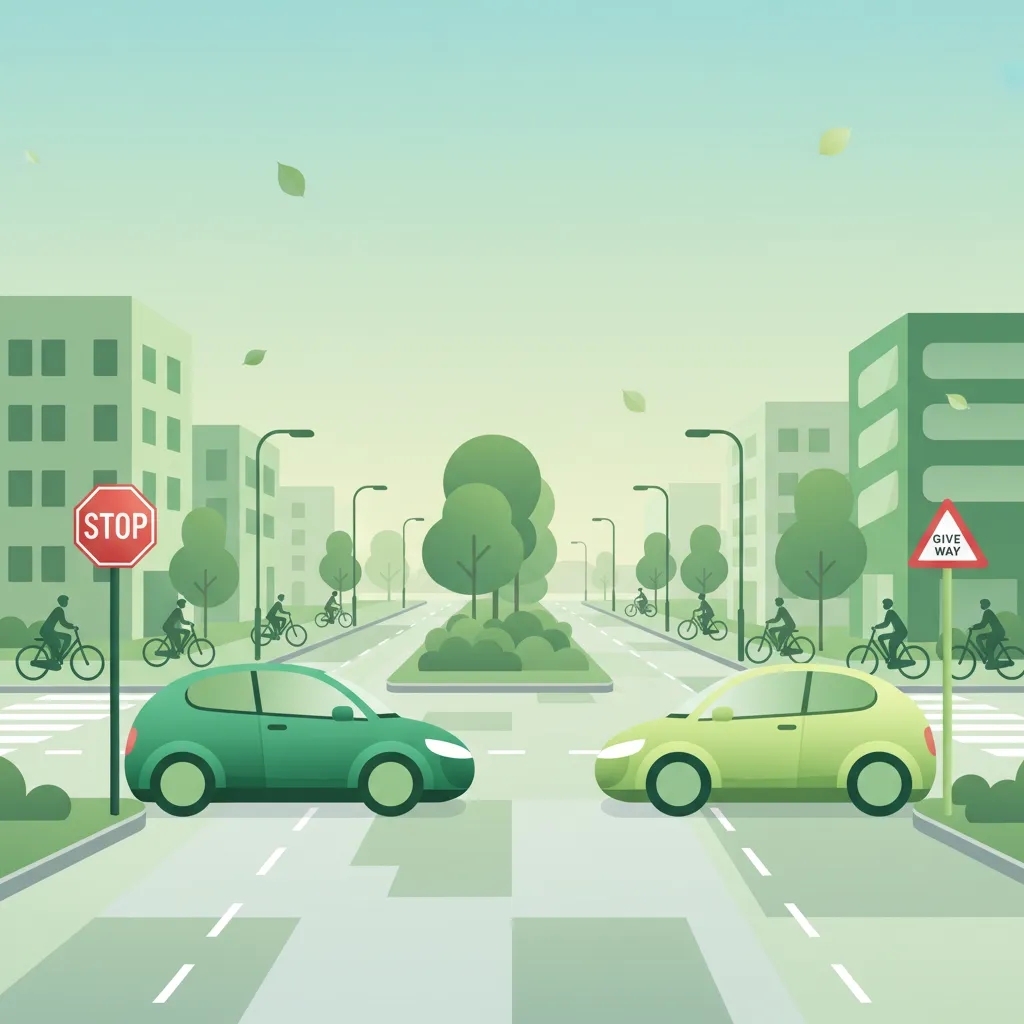
Navigating intersections is a critical skill for any road user, and for motorcyclists, it demands heightened awareness, precise control, and strict adherence to priority rules. This lesson, part of your Complete CBR Theory Course for the Dutch Motorcycle License (Category A2), focuses specifically on intersections controlled by 'Stop' (BORD 44) and 'Give Way' (BORD 25) signs. Mastering these situations is paramount to preventing collisions and ensuring your safety on Dutch roads.
The correct handling of these intersections directly impacts your ability to prevent right-of-way collisions, which are a significant cause of urban crashes involving motorcyclists. You will learn the legal requirements for coming to a complete stop, effectively yielding to crossing traffic, and accurately assessing gaps, ensuring you ride safely and confidently.
At its core, intersection priority is about assigning who has the right to proceed first. This system prevents conflicts and ensures a smooth, predictable flow of traffic. When approaching an intersection, your primary goal is to determine who has priority and act accordingly. The underlying logic of these rules is rooted in safety, legal intent, and the physics of vehicle movement. A mandatory stop or a clear yielding action eliminates uncertainty, reduces speed to a manageable level, and provides sufficient time for a rider to react to unexpected traffic, especially given the dynamic nature of motorcycles.
The Dutch Traffic Act (Wegenverkeerswet 1994) and the Road Traffic Regulations (RVV 1990) explicitly prescribe actions to harmonize traffic flow and protect all road users. For motorcyclists, understanding these rules is particularly crucial as their smaller profile and different handling characteristics can sometimes make them less visible or their intentions harder to predict for other drivers. The principles discussed here build upon general right-of-way hierarchies learned in previous sections and are vital for advanced techniques like braking and cornering.
A Stop sign demands absolute compliance. When you encounter this sign, your vehicle must come to a complete halt before proceeding. This rule is non-negotiable and is one of the most fundamental requirements for safe intersection navigation.
The Stop sign, officially designated as BORD 44 in the Netherlands (though often referred to by its international standard B7), is easily recognizable by its red octagonal shape and the word "STOP" in white. This sign always indicates that drivers must bring their vehicle to a complete stop at a designated stop line.
The stop line is a crucial element. It is typically a solid white line painted perpendicular to the traffic flow at the intersection. Its purpose is to clearly mark the point where your vehicle's front wheels must be stationary. If no stop line is present, you must stop at a point where you have a clear view of the intersecting road without obstructing traffic. This ensures you can properly assess the traffic situation before entering the intersection.
A complete stop means bringing your motorcycle to a full halt, such that no forward motion occurs, and your wheels are entirely stationary for a perceptible duration. While there's no precise legal duration, aiming for at least two seconds ensures you've genuinely stopped and had time to scan the intersection effectively.
For motorcyclists, executing a complete stop safely involves:
Motorcyclists sometimes make critical errors at stop signs due to haste or misjudgment.
Rolling Stop: One of the most common violations is a "rolling stop," where the rider slows down but does not bring the vehicle to a complete halt. This is illegal and significantly reduces your reaction time, potentially leading to collisions. Always ensure your wheels are fully stationary.
Another mistake is stopping after the line. This encroaches on the path of intersecting traffic, especially pedestrians and cyclists, and can be deemed illegal. Always stop before the painted stop line. If the line is obscured or missing, stop where you can clearly see the intersecting road without entering it.
The Give-Way sign (known as BORD 25 or internationally as B1) is a triangular red-bordered sign with a white interior. It indicates that drivers must yield to traffic on the intersecting road. This means you must allow other traffic to proceed before you, but unlike a stop sign, you are not necessarily required to come to a complete stop if a safe gap exists.
Often accompanying the BORD 25 sign are distinctive road markings known as "haaientanden" (shark's teeth). These are white triangles painted on the road surface, pointing towards the approaching driver, reinforcing the yielding requirement. These markings are crucial visual cues, especially when the physical sign might be temporarily obscured. They define the yield line, similar to how a stop line works.
Yielding safely requires careful approach speed management and precise gap assessment. You must reduce your speed well before the intersection, allowing you to react if an approaching vehicle on the main road is too close. For motorcyclists, this means maintaining stability and control while decelerating.
Gap assessment is the estimation of the time interval between the arrival of an approaching vehicle at the conflict point and your intended entry. This is often calculated as Time-to-Collision (TTC):
The time remaining before a moving object reaches the point of potential conflict. It is approximately calculated as Distance to Conflict Point ÷ Speed of Approaching Vehicle.
For motorcyclists, a minimum TTC of 3-4 seconds is generally recommended in urban settings under good conditions. This accounts for your perception-reaction time (PRT) (the time it takes to detect a hazard and initiate a response, typically around 1.5-2.5 seconds for motorcyclists) plus a crucial safety margin. In adverse conditions (rain, fog, night, heavy traffic), this safety margin should be extended, requiring a TTC of 5 seconds or more.
Failing to yield when required is a common cause of intersection collisions, particularly for motorcyclists. Entering an intersection when a vehicle on the intersecting road is within a "reasonable distance" (often interpreted as too close to prevent a collision if you were to proceed) constitutes a violation. Misjudging the speed or distance of oncoming traffic can have severe consequences, as collisions at speed significantly increase injury risk for motorcyclists. Always err on the side of caution; if in doubt, wait for a larger, safer gap.
Beyond basic compliance, several advanced techniques enhance safety at priority intersections, particularly for motorcyclists.
For right-hand traffic jurisdictions like the Netherlands, the left-right-left scanning technique is vital.
This systematic sweep compensates for reduced peripheral vision, especially when wearing a helmet, and helps detect vehicles in your blind spots or those that might be turning.
Managing your approach speed well before a priority intersection is a cornerstone of safe riding. This means reducing your speed to a level that allows for a complete stop or controlled yield with ample reaction time, while maintaining motorcycle stability. High speeds reduce your observation time, increase your stopping distance, and make it harder to react to sudden changes. Aim to be able to stop comfortably within your line of sight to the stop or yield line. In urban areas, reducing speed to 30 km/h or less often provides the necessary control.
Vulnerable Road Users (VRUs) include pedestrians, cyclists, and other motorcyclists. These road users have a higher probability of severe injury in a crash due to their lack of protective enclosure. At stop and give-way intersections, VRUs often have additional priority, or their presence demands extra caution. Always perform a dedicated "VRU scan" for movement in your peripheral vision before proceeding, especially checking for children who may act unpredictably.
Pedestrian Crossing Priority: Remember that pedestrians have absolute priority when crossing at a marked zebra crossing, even if you are at a stop or give-way sign. You must remain stopped until they have completely cleared the crossing.
Compliance with stop and give-way signs is not just a matter of safety; it is a legal requirement enforced by Dutch traffic law.
The main regulations governing stop and give-way signs are found in the Reglement Verkeersregels en Verkeerstekens 1990 (RVV 1990) and the Wegenverkeerswet 1994 (Road Traffic Act).
Failure to comply with stop or give-way signs is considered a serious traffic offense in the Netherlands, punishable by substantial fines and potentially penalty points, especially if it leads to a dangerous situation or an accident. A rolling stop, for example, can result in a significant fine. These legal deterrents are in place to encourage strict compliance and enhance road safety for everyone.
Safe intersection navigation is not static; it requires dynamic adaptation to changing conditions.
Effective handling of stop and give-way intersections is a fundamental skill that underpins safe motorcycle riding. It relies on a blend of legal knowledge, precise execution, and continuous risk assessment.
Before you proceed at any stop or give-way intersection, quickly review this mental checklist:
Scenario 1 – Nighttime Give-Way with Poor Lighting On a rural side road at night, with a give-way sign and no street lighting, an approaching vehicle has dim headlights. Correct Behaviour: The rider slows to 15 km/h, uses the high-beam briefly (if safe and no oncoming traffic) to illuminate the intersection, assesses the gap (e.g., vehicle 150 meters away at 70 km/h, yielding a TTC of approximately 7.7 seconds), and proceeds when confident the gap is sufficiently large, considering reduced visibility. Reasoning: Low visibility demands a significantly larger TTC and careful use of lighting to compensate for limited perception.
Scenario 2 – Urban Stop Sign with a Blind Spot You approach a stop sign in a busy urban area. There's a delivery van parked immediately to your left, obscuring your view of traffic from that direction. Correct Behaviour: The rider performs a complete stop at the stop line. Due to the blind spot, the rider must then carefully edge forward slightly (while scanning and ready to stop instantly) until a clear line of sight to the left is achieved without entering the intersection or obstructing traffic. Only then, after a thorough left-right-left scan, does the rider proceed. Reasoning: A complete stop is mandatory, but blind spots require an additional, cautious maneuver to ensure full visibility before committing to the intersection.
This lesson has provided a deep dive into the specific requirements for Stop and Give-Way signs. These are fundamental rules that are tested extensively in the CBR theory exam and are critical for your everyday safety as a motorcyclist. Continuous practice of these skills in various real-world conditions will solidify your understanding and refine your judgment.
Lesson content overview
Explore all units and lessons included in this driving theory course.
Explore search topics learners often look for when studying Intersection Priority: Stop and Give-Way Signs. These topics reflect common questions about road rules, driving situations, safety guidance, and lesson level theory preparation for learners in the Netherlands.
Browse additional driving theory lessons that cover connected traffic rules, road signs, and common driving situations related to this topic. Improve your understanding of how different rules interact across everyday traffic scenarios.
Explore advanced right-of-way scenarios and complex intersection layouts beyond basic stop and give-way signs. Understand priority in situations with multiple lanes, varied traffic signals, and less common road configurations. Essential for comprehensive Dutch driving theory.
This lesson breaks down the rules of priority at intersections. You will learn to identify an 'equal' intersection where the default rule of giving way to traffic from the right applies. It also explains how priority is regulated by signs (such as the B6 Stop sign and B7 priority road sign) and road markings ('shark's teeth'). Understanding these hierarchies is crucial for making safe and correct decisions when crossing or turning at any junction.
This lesson addresses the challenge of navigating equal-priority intersections, where no signs or markings dictate the right-of-way. You will master the fundamental Dutch traffic rule of giving priority to all drivers approaching from your right ('rechts voor'). The content focuses on developing advanced observational skills and clear communication to safely manage these situations, which are common in residential and urban areas.
This lesson establishes the foundational rule of priority in Dutch traffic law: yielding to traffic from the right at intersections of equal roads unless otherwise indicated. It explains how to identify an unmarked or 'equal' junction and the correct procedure for approaching, assessing, and proceeding safely. The content also introduces the primary signs and markings, such as 'shark's teeth,' that override this default rule, forming the basis for all other priority scenarios.
This lesson explains the foundational 'priority to the right' rule, which applies at intersections of equal roads where no other signs or markings dictate priority. You will learn to identify such junctions and understand your obligation to yield to traffic approaching from your right side. The lesson also clarifies important exceptions, such as when exiting a driveway, entering a paved road from an unpaved one, or when encountering a tram. Mastering this rule is crucial for navigating residential areas and city streets where signage is often minimal.
This lesson delves into the hierarchy of priority rules on Dutch roads, clarifying who has the right-of-way in various intersection scenarios. It explains the meaning of signs like 'voorrangsweg' and road markings such as shark's teeth ('haaientanden'). Special attention is given to the correct procedure for entering, navigating, and exiting roundabouts on a motorcycle, including proper signaling and lane choice to ensure safe and efficient passage.
This lesson introduces the foundational principles of right-of-way in the Netherlands, starting with the road user hierarchy and the default rule of giving priority to traffic from the right at equal intersections. You will learn to identify a priority road, marked by sign BORD 30, and understand how this designation overrides the default rule. The content establishes the legal framework for making priority decisions in the absence of specific signs or signals.
This lesson focuses on the rules and techniques for safely navigating Dutch roundabouts, a common feature of the road network. You will learn that traffic circulating on the roundabout typically has priority and that you must yield before entering. The content covers correct lane selection for your intended exit, proper use of turn signals, and maintaining awareness of cyclists who may have priority on adjacent paths.
This lesson addresses special situations where standard priority rules are superseded. You will learn the absolute priority of emergency vehicles using sirens and flashing lights, and the correct procedure for giving them way safely. The content also explains the specific priority rules for trams, which often have right-of-way over other traffic, as well as for military columns and official funeral processions. Furthermore, the lesson reinforces the rules for yielding to pedestrians at designated zebra crossings.
This lesson explains the critical rules of priority involving pedestrians and cyclists to ensure the safety of vulnerable road users. You will learn the absolute requirement to stop for pedestrians on or waiting to use a 'zebrapad' (zebra crossing). The content also covers situations where you must yield to cyclists crossing your path, such as when turning across a dedicated bicycle lane (fietspad).
This lesson reinforces the fundamental rule of Dutch highway driving: use the rightmost lane available and use the lanes to the left only for overtaking. You will learn the complete, safe overtaking procedure: check mirrors, signal, perform a shoulder check for the blind spot, smoothly move over, accelerate past the vehicle, and then return to the right lane when safe.
Learn about frequent errors motorcyclists make at intersections controlled by Stop and Give Way signs in the Netherlands. This lesson focuses on identifying and preventing critical mistakes in scanning, stopping, and yielding to ensure safer navigation and CBR exam success.
This lesson breaks down the rules of priority at intersections. You will learn to identify an 'equal' intersection where the default rule of giving way to traffic from the right applies. It also explains how priority is regulated by signs (such as the B6 Stop sign and B7 priority road sign) and road markings ('shark's teeth'). Understanding these hierarchies is crucial for making safe and correct decisions when crossing or turning at any junction.
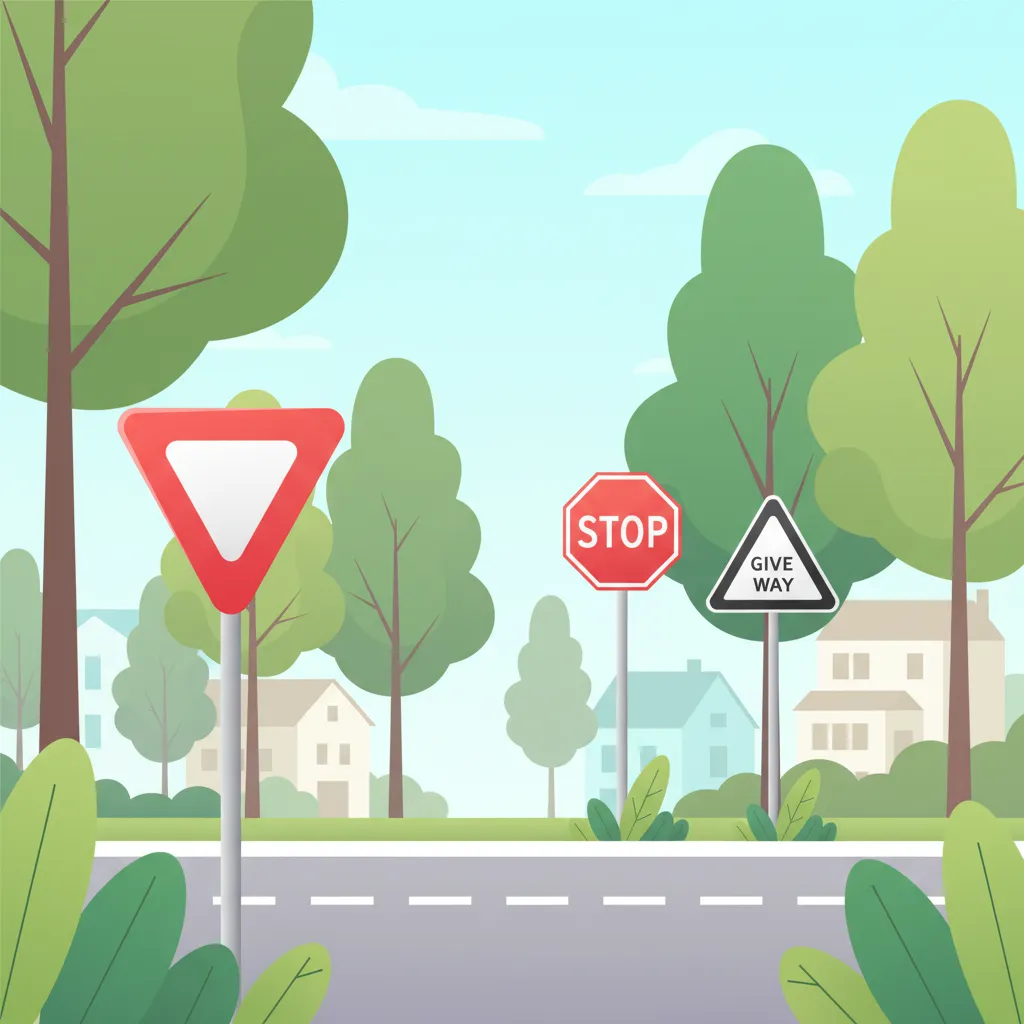
This lesson details the function of signs and markings that explicitly assign priority at intersections. You will learn the difference between the B5 yield sign, which requires giving way to intersecting traffic, and the B6 stop sign, which mandates a complete stop before proceeding. The content also covers the 'haaientanden' (shark teeth) road markings, which function similarly to a yield sign. Understanding how these signs interact with priority road signs (B1) is essential for correctly navigating controlled intersections.
This lesson focuses on Dutch regulatory signs that enforce mandatory rules and restrictions, particularly those impacting A2 motorcyclists. You will learn to recognize and obey prohibition signs, such as those indicating a motorcycle ban (BORD 40), speed limits, and overtaking restrictions (BORD 21). The content explains the legal consequences of non-compliance and how to apply these rules in practical riding scenarios to ensure full adherence to Dutch traffic law.
This lesson focuses on the rules and techniques for safely navigating Dutch roundabouts, a common feature of the road network. You will learn that traffic circulating on the roundabout typically has priority and that you must yield before entering. The content covers correct lane selection for your intended exit, proper use of turn signals, and maintaining awareness of cyclists who may have priority on adjacent paths.
This lesson focuses on the meaning of different road markings and their implications for motorcycle lane discipline. You will learn the legal distinction between solid and broken lines regarding overtaking, how to interpret directional arrows for lane choice, and the rules for using special lanes. The content emphasizes maintaining a safe and strategic position within the lane to maximize visibility and create a safety buffer from other vehicles.
This lesson details the legal obligation and safe procedures for yielding to emergency vehicles ('noodvoertuigen' or 'voorrangsvoertuigen') that are using audible and visual warnings. It provides clear guidance on how to safely create space, whether by pulling over, adjusting speed, or clearing an intersection, without causing a secondary hazard. The content emphasizes maintaining composure and making predictable maneuvers to allow emergency services to pass quickly and safely.
This lesson reinforces the fundamental rule of Dutch highway driving: use the rightmost lane available and use the lanes to the left only for overtaking. You will learn the complete, safe overtaking procedure: check mirrors, signal, perform a shoulder check for the blind spot, smoothly move over, accelerate past the vehicle, and then return to the right lane when safe.
This lesson details the interpretation of Dutch warning signs, which alert riders to potential dangers and changing road conditions. You will study signs indicating sharp curves, road narrowing (BORD 30), and temporary hazards like road works (BORD 36), learning to adjust speed and road position proactively. The content emphasizes how the A2 motorcycle's characteristics require earlier hazard recognition and response compared to other vehicles for maintaining control.
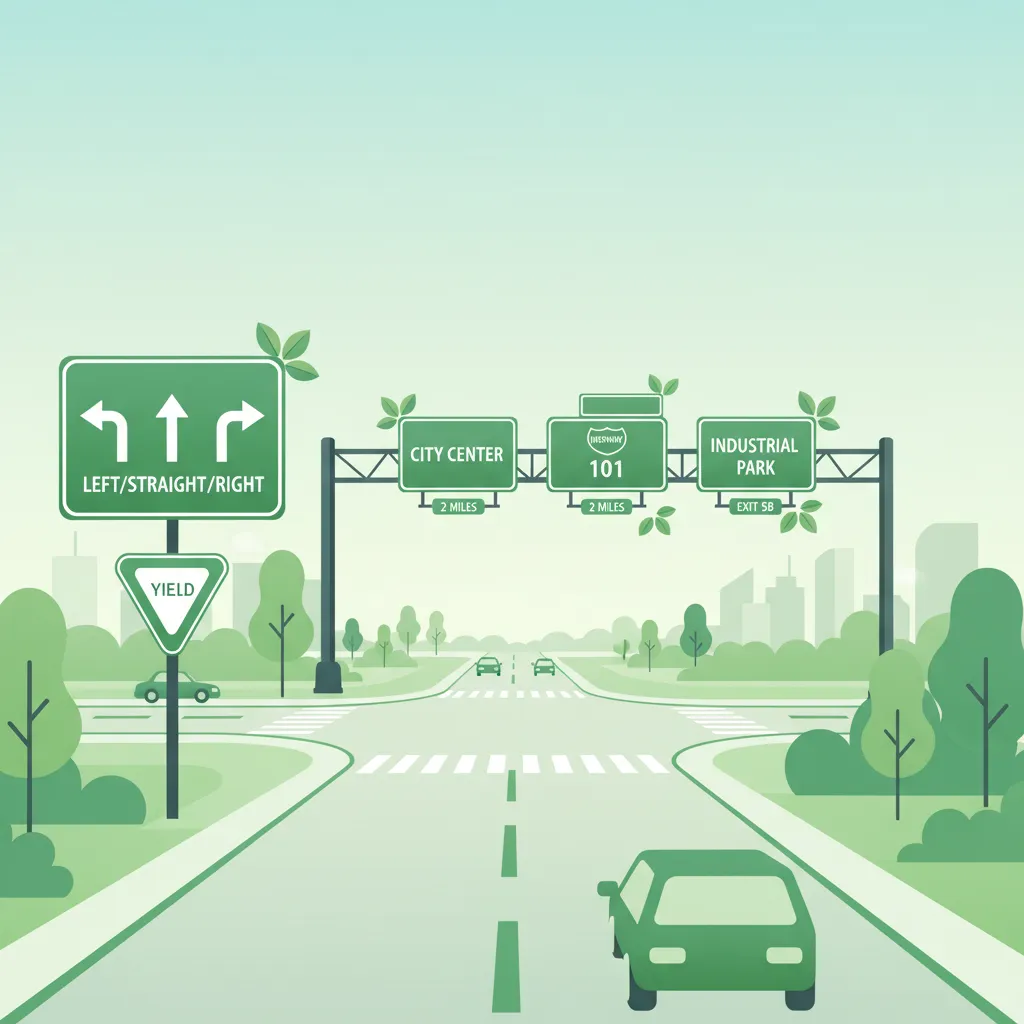
This lesson focuses on the array of signs used to manage traffic at intersections and along multi-lane roads. You will learn to interpret overhead gantry signs, lane designation signs, and markings that guide drivers into the correct lane for their intended direction. The curriculum covers signs indicating priority at upcoming junctions, such as the B3 and B4 signs, which clarify right-of-way rules in complex scenarios. Proper interpretation of these signs is essential for smooth lane changes, efficient navigation, and preventing conflicts at junctions.
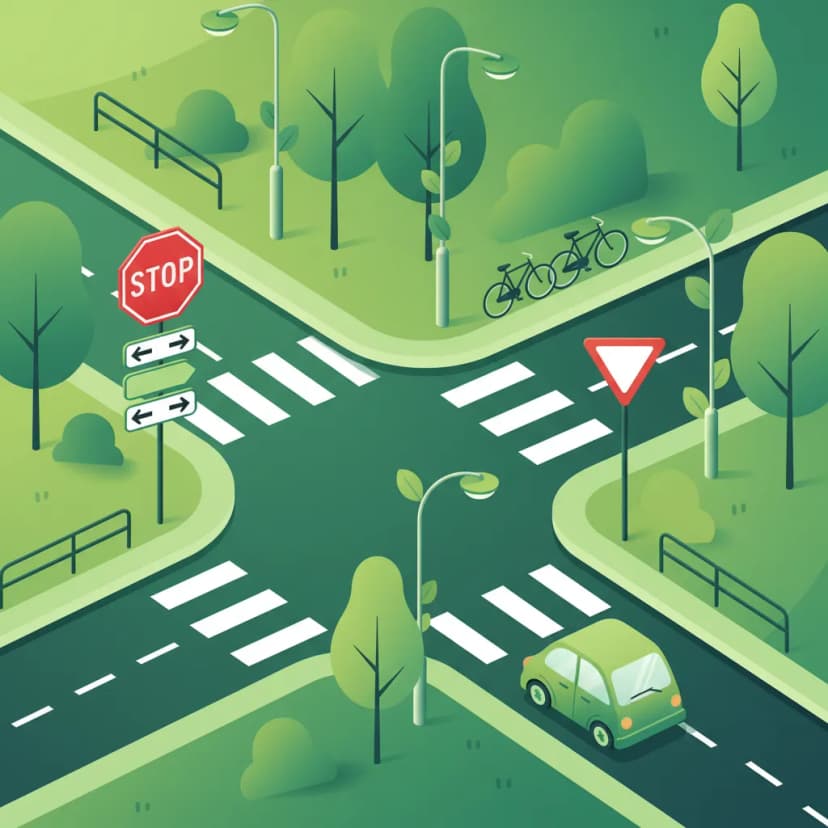
This lesson focuses on regulatory signs, which impose legal obligations on drivers and are essential for maintaining traffic order. You will learn to identify and act upon fundamental signs such as the octagonal B6 Stop sign, the diamond-shaped B1 Priority Road sign, and various compulsory direction arrows. The content explains the legal implications of these signs, detailing when a driver must stop completely, when they have priority, or the required path they must follow. Understanding these commands is crucial for safe and lawful driving at intersections and on designated routes.
Find clear answers to common questions learners have about Intersection Priority: Stop and Give-Way Signs. Learn how the lesson is structured, which driving theory objectives it supports, and how it fits into the overall learning path of units and curriculum progression in the Netherlands. These explanations help you understand key concepts, lesson flow, and exam focused study goals.
Yes, legally, a Stop sign (BORD 44) requires you to bring your motorcycle to a complete halt behind the stop line, regardless of traffic. Failing to do so is a serious offence and will result in a failed theory exam question.
A Give Way sign (BORD 30) explicitly tells you to yield to all crossing traffic, often supported by 'haaientanden' markings. At an intersection with no signs, the general rule is to yield to traffic from the right (priority from the right), which is a different rule entirely.
Actively scan left, right, then left again before proceeding. For motorcycles, it's crucial to also anticipate blind spots of other vehicles and ensure they see you. A slight head turn makes your presence more obvious.
While lane filtering (file rijden) is permitted in specific slow-moving traffic situations, you must still adhere to all traffic signs. This means if the main lane is stopped at a Stop sign, you must also stop behind the line and yield before proceeding.
No, the rules for Stop and Give Way signs apply universally to all vehicle categories, including A2 motorcycles, without specific exceptions. Your smaller profile does not grant you special priority; you must follow the same legal obligations.