
Welcome to the lesson on Fixed Speed Limits and Sign Interpretation, a key part of your Dutch Category A2 motorcycle theory preparation. Understanding and obeying speed limits is fundamental to safe riding and passing your CBR exam. This lesson builds on general traffic rule knowledge and sets the stage for dynamic speed adjustments on Dutch roads.
Navigating the Dutch road network safely and legally requires a comprehensive understanding of speed limits. This lesson provides a detailed overview of fixed speed limits, the traffic signs that communicate them, and the default limits that apply in the absence of explicit signage. For Category A2 motorcycle riders, mastering these rules is not just a legal requirement but a fundamental aspect of road safety. We will explore how to identify maximum speed signs (BORD xx series) and apply the correct limits within built-up areas, on rural roads, and on motorways. Constant awareness and strict compliance are crucial to avoid penalties and ensure the safety of all road users.
Fixed speed limits are foundational to road safety and traffic management in the Netherlands. They are legally binding maximum speeds that apply to specific sections of the road network, irrespective of traffic volume or prevailing weather conditions, unless superseded by temporary signage. These limits are communicated through permanent, static road signs that provide clear, unambiguous instructions to all road users, including motorcyclists.
Fixed speed limits are a core component of the Dutch traffic regulations, primarily defined by the Reglement Verkeersregels en Verkeerstekens 1990 (RVV 1990). They are designed to create a predictable and safe environment by setting an upper bound on vehicle speeds. These limits are determined based on factors such as road design, potential for conflict with vulnerable road users, and environmental considerations. For motorcyclists, understanding these limits is crucial for maintaining control, minimizing stopping distances, and reacting safely to unexpected situations. The consistent application of fixed limits reduces ambiguity, helping all drivers and riders anticipate traffic flow and behaviour.
Fixed speed limits are predominantly communicated through specific traffic signs from the BORD series. These signs are easily recognizable: they are rectangular or square, feature a white background, a black border, and a prominent numeric value in the centre, indicating the maximum speed in kilometres per hour (km/h).
The most common BORD signs you will encounter include:
These signs indicate the absolute maximum speed. This means that even if conditions seem favourable (e.g., clear visibility, light traffic), you must not exceed the posted limit. Supplemental panels may accompany these signs, providing additional conditions or specifying the vehicle categories to which the limit applies. For example, a panel stating "vrachtwagens" (trucks) means the speed limit applies only to trucks and not to motorcycles. Always read the main sign and any supplemental panels carefully to understand its full applicability.
While BORD xx signs provide explicit instructions, there are many situations where no speed-limit sign is present. In such cases, the default speed limit applies, as defined by the RVV 1990 based on the type of road. Motorcyclists must know these default limits by heart, as they serve as the baseline speed control mechanism across the Dutch road network.
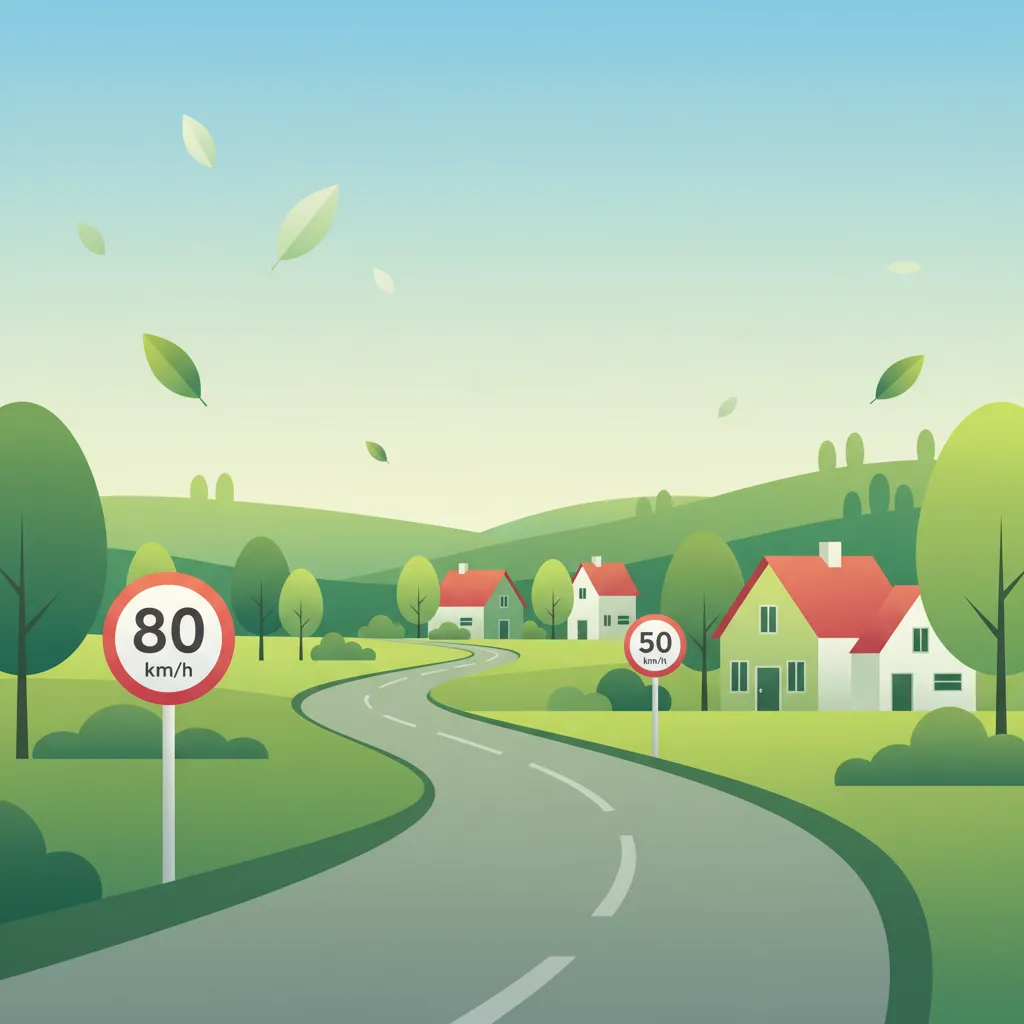
Upon entering a built-up area, often indicated by a white sign with the town name, the default speed limit automatically becomes 50 km/h unless a different BORD xx sign is posted. Within these areas, you may also encounter "30 km/h zones" which are usually marked by specific zone signs or road markings. These 30 km/h zones are designed to increase safety for vulnerable road users such as pedestrians and cyclists.
The 50 km/h default in built-up areas is crucial for motorcycle riders. These environments often feature complex intersections, parked cars, driveways, and the sudden presence of children or cyclists. Adhering to this limit significantly reduces stopping distances and provides more time to react to hazards, minimizing the severity of potential collisions.
Outside built-up areas, commonly referred to as buiten de bebouwde kom, the default speed limit is generally 80 km/h. This applies to most roads that are not motorways or expressways. However, narrower or more winding rural roads might have specific sections where a BORD 70 sign is posted, overriding the 80 km/h default. Some rural roads might also feature two separate lanes in each direction, which could technically allow for higher limits if signed, but the 80 km/h default remains until explicitly stated otherwise.
For motorcycle riders, rural roads present unique challenges, including sharper curves, potentially uneven surfaces, and interactions with agricultural vehicles or slow-moving traffic. The 80 km/h limit balances efficient travel with the need for safety on roads that often lack clear physical separation from opposing traffic.
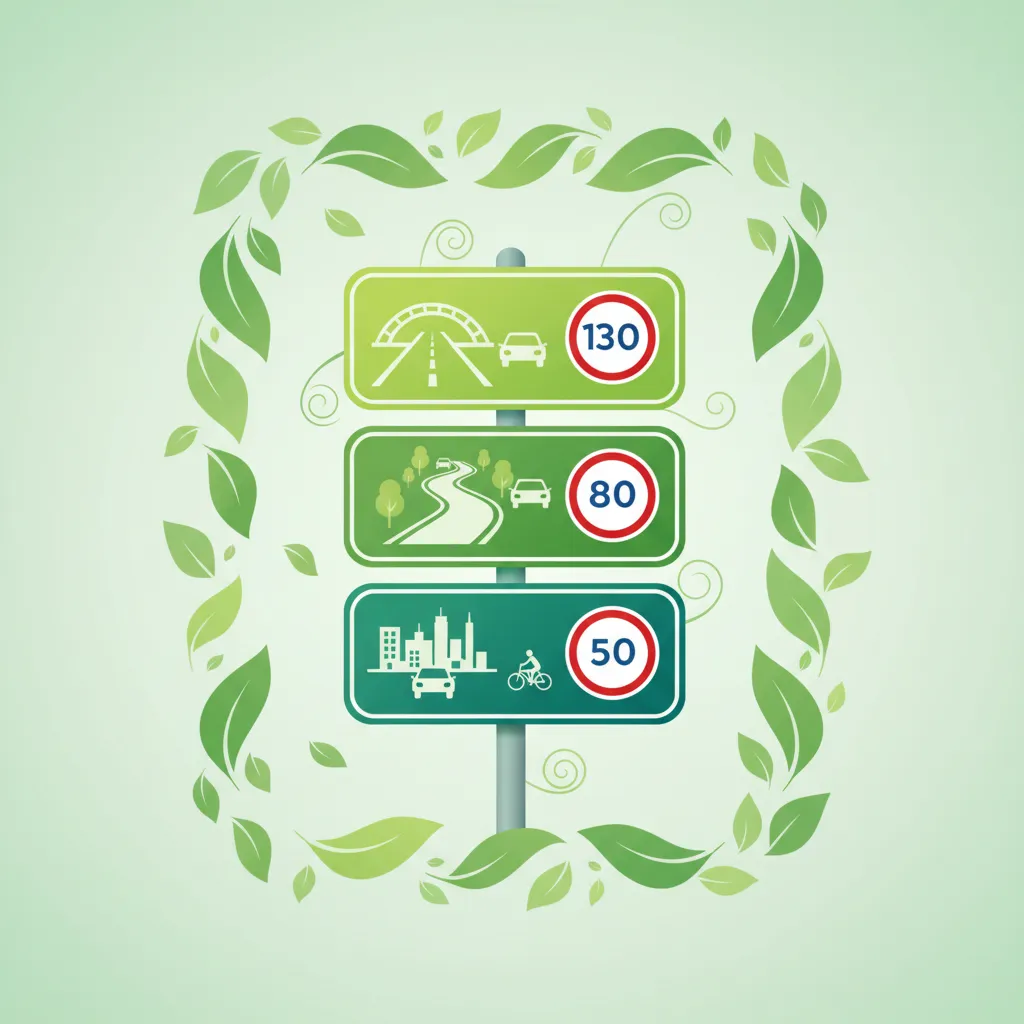
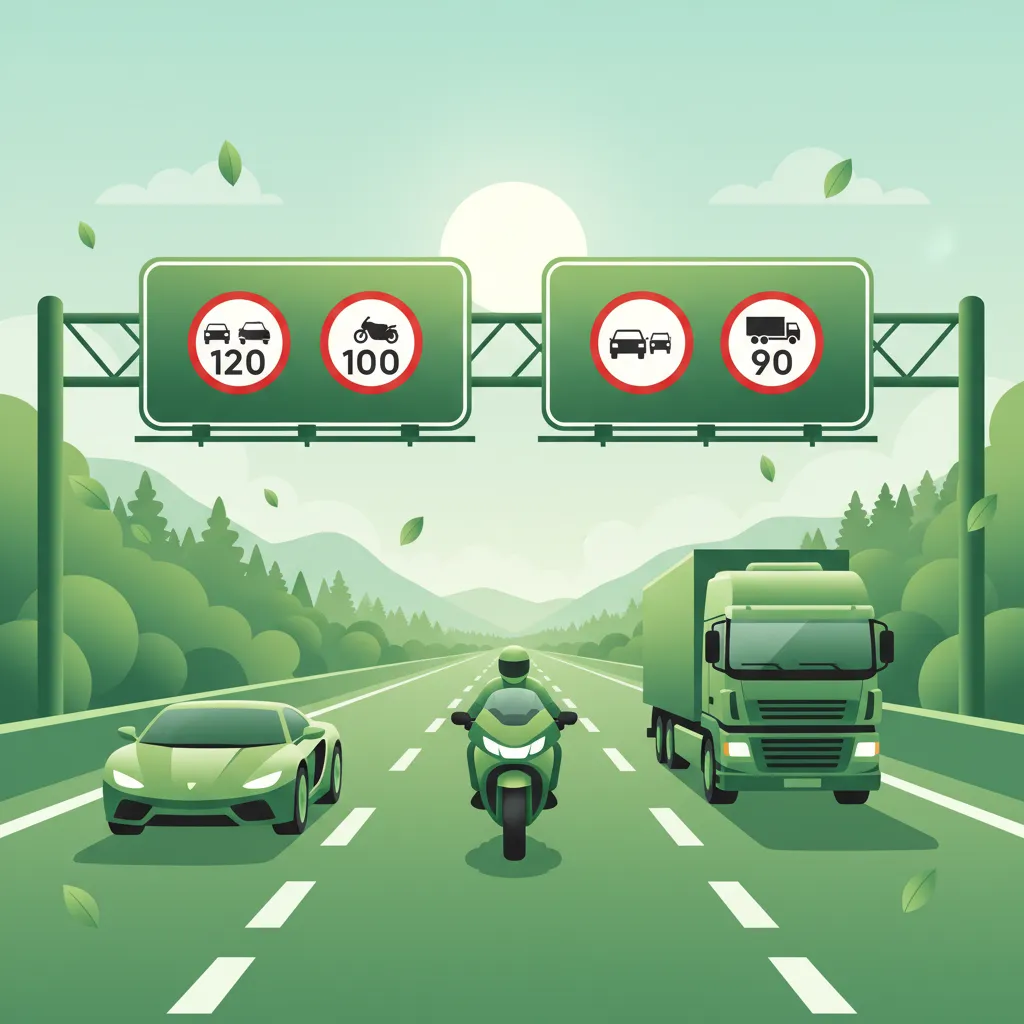
On motorways, or autosnelwegen, the general default speed limit is 130 km/h. This applies when no specific speed limit sign is displayed. However, it's very common to encounter sections where the limit is temporarily or permanently reduced to 120 km/h, 100 km/h, or even lower, often due to environmental considerations (nitrogen emissions), traffic density, or during specific hours of the day.
Motorways are designed for high-speed travel with controlled access, minimal intersections, and separated opposing traffic flows. Despite the higher speeds, Category A2 riders must exercise extreme caution. Speed management on motorways, as covered in a later lesson, is critical for safety, involving aspects like safe following distance and lane discipline. Always be vigilant for overhead electronic signs or static BORD xx signs that might impose a lower limit than the default 130 km/h.
In practical driving situations, you may encounter multiple speed limits that could potentially apply to a single road section. Understanding the legal hierarchy of traffic rules is essential to correctly determine which speed limit is binding. This hierarchy ensures that the most restrictive and situation-appropriate limit takes precedence, preventing ambiguity and enhancing safety.
The fundamental principle of sign hierarchy is that explicit signs always override default limits. If you are on a rural road where the default is 80 km/h, but you encounter a BORD 70 sign, you must immediately reduce your speed to 70 km/h. The posted sign is a specific instruction for that particular road segment, overriding the general rule for the road type.
Conversely, if you pass a sign indicating the end of a specific speed limit (e.g., a white circular sign with a black diagonal line, or a sign like BORD 50 with a diagonal red line through it, signifying the end of a 50 km/h zone), the applicable default limit for the road type then takes over. For example, leaving a 50 km/h zone in a built-up area means you should then revert to the 50 km/h default for the remainder of the built-up area until you exit it.
Temporary speed limits always take precedence over permanent fixed signs and default limits. These limits are introduced to address specific, short-term road conditions that require reduced speeds for safety. Common scenarios include:
It is critical for motorcyclists to be highly vigilant for temporary signs, as they may appear suddenly and demand immediate speed adjustment. Ignoring these signs can lead to severe penalties and significantly increase accident risk.
While most speed limits apply universally, there are specific exceptions for certain vehicle categories. For Category A2 motorcycle learner riders (often referred to as A-in training), there is a category-specific speed limit of 45 km/h that applies regardless of the posted signs or default limits.
This strict limit compensates for a learner's inexperience and developing skills, ensuring they operate at speeds that allow for greater control and reaction time. Even if a BORD 70 sign is posted on a rural road, a learner rider must not exceed 45 km/h. Failure to comply with this specific rule will result in fines and potential additional training requirements. This rule underscores the principle that safety always takes precedence, especially for those still developing their riding proficiency.
Adhering to speed limits is a legal obligation for all road users in the Netherlands, and Category A2 motorcyclists are no exception. Violating speed limits carries significant legal and financial consequences. It's crucial not only to know the limits but also to understand the enforcement mechanisms and the thresholds for penalties.
Dutch traffic law includes a small enforcement threshold or tolerance margin when measuring speed. This margin accounts for minor inaccuracies in speedometers and measurement devices. It's not a grace period to intentionally exceed the limit, but rather a practical allowance.
The typical enforcement thresholds are:
Your motorcycle's speedometer might also have a slight inaccuracy, often displaying a speed slightly higher than your actual speed. This is a safety feature, but it means you should still be cautious about relying solely on the instrument's reading to stay within the exact threshold.
Speed violations in the Netherlands are treated seriously and can result in various penalties, impacting your wallet and your riding privileges:
Compliance with speed limits is not just about avoiding penalties; it's about demonstrating responsible riding behavior and contributing to overall road safety.
The rationale behind fixed and default speed limits extends far beyond mere legal compliance. These limits are meticulously set based on fundamental principles of physics, human perception, and statistical safety data. Understanding these underlying reasons helps foster a deeper appreciation for why adhering to limits is so vital for motorcyclists.
One of the most critical relationships in road safety is between speed, kinetic energy, and stopping distance.
Fixed limits are calibrated to ensure that most road users can stop safely within foreseeable distances and that crash forces remain within limits designed to protect human life.
In built-up areas especially, fixed speed limits (e.g., 50 km/h or 30 km/h zones) are primarily set to protect Vulnerable Road Users (VRUs), which include pedestrians, cyclists, and mobility scooter users.
The perception-reaction gap refers to the time delay between when a rider perceives a hazard and when they initiate a physical response (like braking or steering). This gap is influenced by a rider's alertness, fatigue, experience, and the complexity of the situation. At higher speeds, this gap translates into a greater distance covered before any evasive action can begin, making it much harder to avoid obstacles or react to sudden changes. Fixed speed limits help manage this gap by ensuring that, even with an average reaction time, the distance covered is not excessively large, allowing for safer responses.
Even experienced riders can sometimes make mistakes regarding speed limits. Being aware of common misunderstandings and pitfalls can help Category A2 motorcyclists avoid violations and enhance their safety.
One frequent error is misinterpreting or overlooking supplemental panels attached to main speed-limit signs.
Always read the entire sign assembly to ensure you understand its precise applicability.
While GPS navigation systems are invaluable tools, they should never be the primary source for speed limit information.
Use GPS as a supplementary aid, but your eyes must constantly be on the road, actively scanning for official traffic signs.
A malfunctioning or inaccurate speedometer can directly lead to unintentional speeding. If your speedometer is broken or you suspect it's inaccurate, it's illegal to ride your motorcycle until it's repaired or calibrated. Without a functioning speedometer, you cannot verify your compliance with speed limits, making it impossible to ride safely and legally. Always ensure your motorcycle is in good working order, including all instruments.
This is a dangerous misconception. As discussed, the absence of an explicit speed limit sign does not mean there is no limit. Instead, the default speed limit for the specific road type (built-up area, rural road, motorway) automatically applies. Always be aware of the road type you are on and its corresponding default limit.
While fixed and default speed limits provide a legal maximum, a responsible Category A2 rider understands that these limits represent the absolute ceiling, not necessarily a recommended speed for all conditions. Various contextual factors may necessitate driving below the posted limit to ensure safety.
Weather conditions significantly impact a motorcycle's handling, braking capability, and a rider's visibility and perception.
The specific design of a road, even within a general road type, can influence safe speeds:
Your motorcycle's state and load can also influence safe speeds.
Even outside explicit 30 km/h zones, the presence of vulnerable road users (pedestrians, cyclists, children playing) demands extra caution and often a reduction in speed below the posted limit. While not a legal requirement to reduce speed unless explicitly signed, failing to adjust your speed in such situations could be considered dangerous or reckless under general road traffic law, particularly if it contributes to an incident. Always prioritize safety over strictly adhering to the maximum legal speed.
Understanding fixed and default speed limits is best solidified through practical application. These scenarios illustrate how various rules of sign interpretation and hierarchy come into play during real-world riding.
Residential Street without Signage:
Highway Entry with Posted Limit:
Temporary Construction Zone:
Learner Rider on a 70 km/h Road:
Conflicting Signs at an Intersection:
This lesson has provided a foundational understanding of fixed speed limits and sign interpretation crucial for your Dutch Category A2 motorcycle licence. Speed management, however, is a dynamic and multifaceted skill. As you progress, you will build upon this knowledge by exploring how speed interacts with various road conditions and advanced riding techniques.
This lesson is a critical stepping stone towards developing comprehensive speed management strategies, which are essential for safe and confident motorcycle riding.
Lesson content overview
Explore all units and lessons included in this driving theory course.
Explore search topics learners often look for when studying Fixed Speed Limits and Sign Interpretation. These topics reflect common questions about road rules, driving situations, safety guidance, and lesson level theory preparation for learners in the Netherlands.
Browse additional driving theory lessons that cover connected traffic rules, road signs, and common driving situations related to this topic. Improve your understanding of how different rules interact across everyday traffic scenarios.
Understand the difference between default speed limits and those indicated by signs like BORD 50 in the Netherlands. This lesson clarifies rules for built-up areas, rural roads, and motorways, crucial for your A2 motorcycle theory.
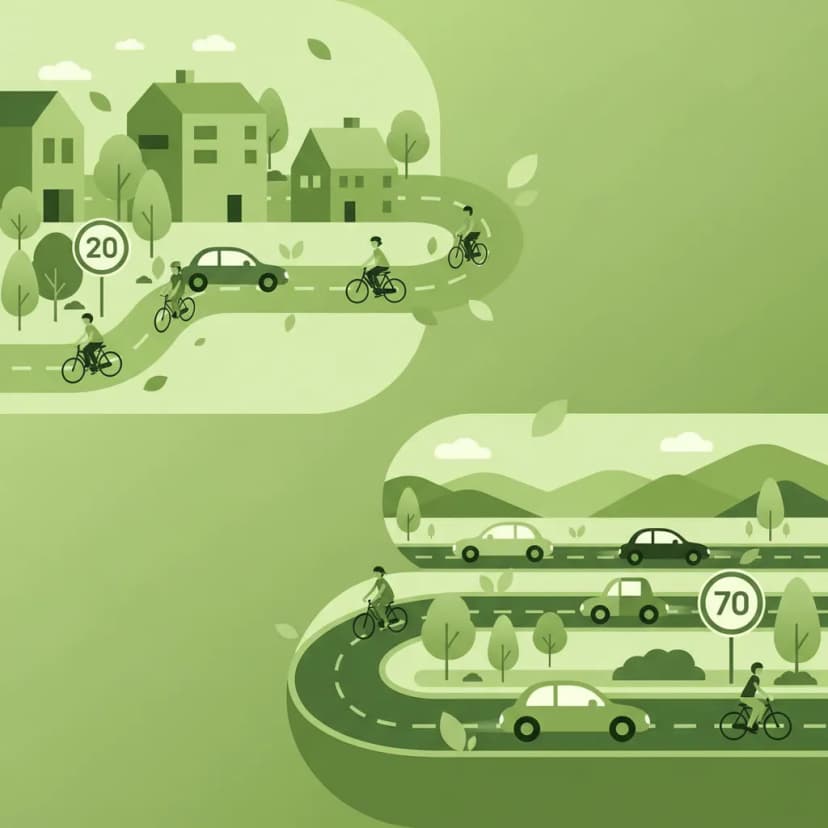
This lesson details the default speed limits that apply in the absence of specific signs. You will learn to recognize the signs (H1 and H2) that mark the beginning and end of a built-up area, where the default speed limit is 50 km/h. Outside these areas, on non-highway roads, the standard limit is 80 km/h. The content explains the rationale behind these limits, which are based on factors like pedestrian density, road design, and potential hazards, ensuring you can apply the correct speed in any location.
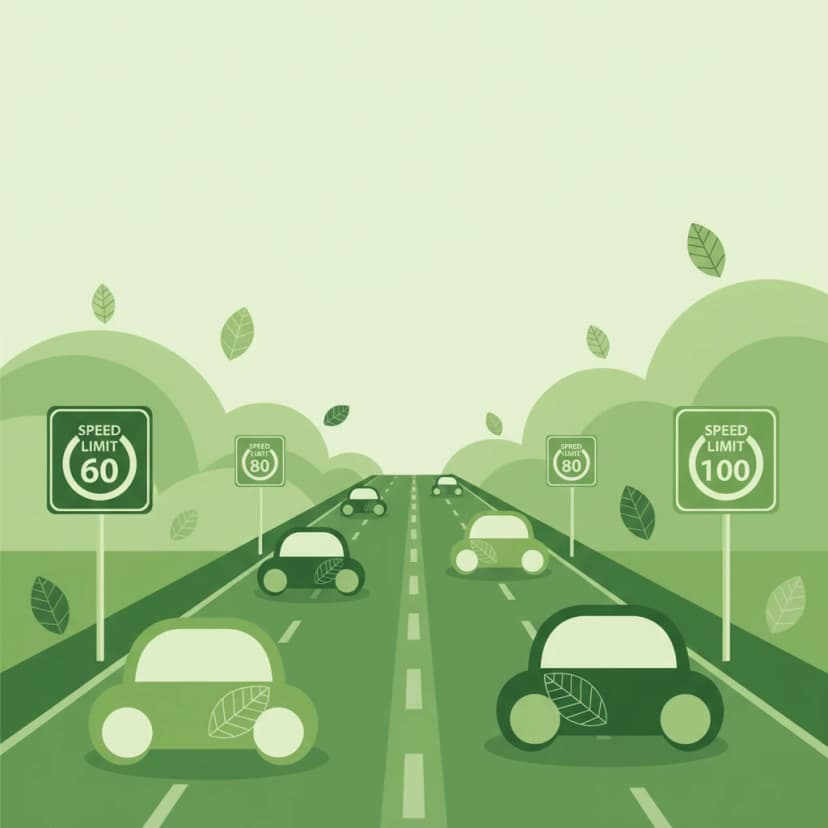
This lesson focuses on the specific speed regulations for major highways in the Netherlands. You will learn to identify an 'autosnelweg' (motorway, G1 sign), where the speed limit is 100 km/h between 6:00 and 19:00 and often 130 km/h at other times, unless indicated otherwise. The lesson also covers the 'autoweg' (expressway, G3 sign), which typically has a speed limit of 100 km/h. Furthermore, you will study dynamic speed limits indicated on electronic signs, which can change due to traffic or weather conditions.
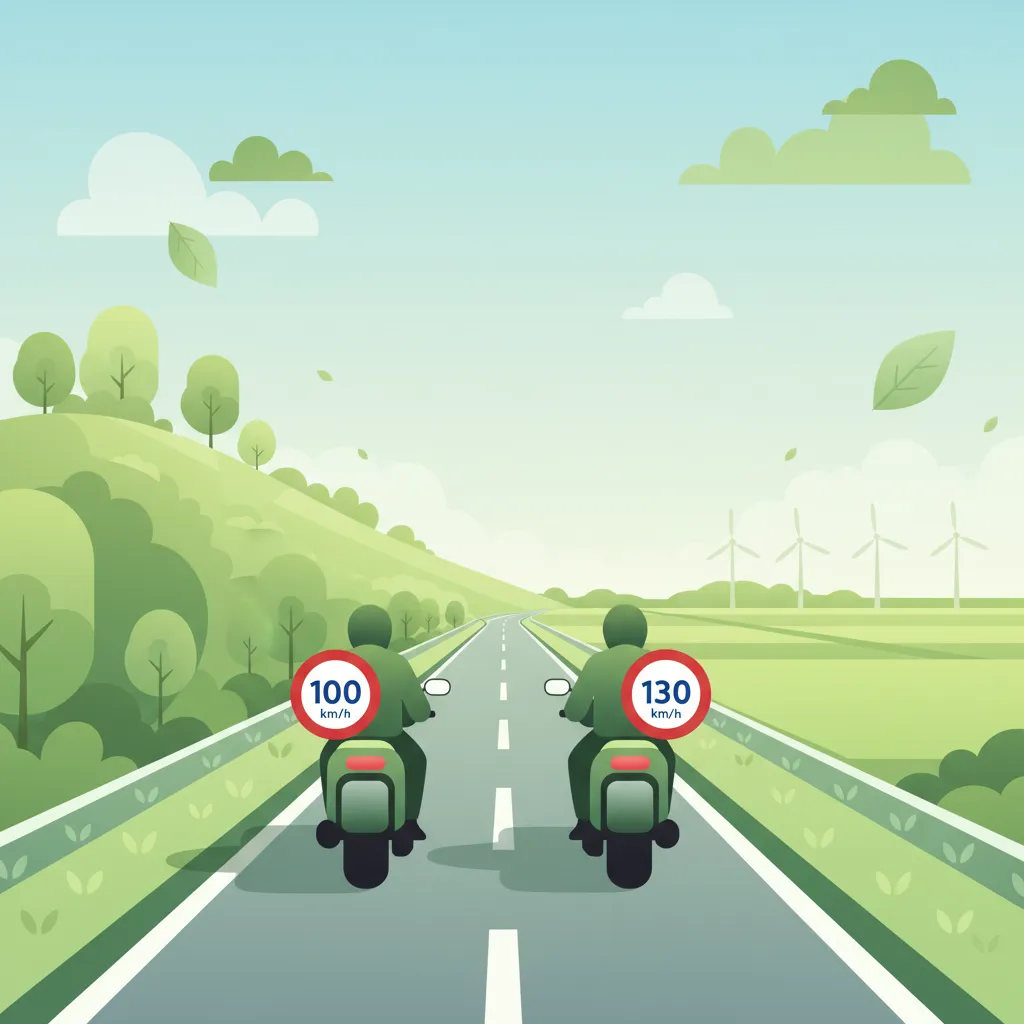
This lesson outlines the statutory national speed limits applicable to motorcycles in the Netherlands. It clearly defines the maximum permitted speeds on motorways ('snelwegen'), non-motorway rural roads ('buiten de bebouwde kom'), and within built-up areas ('binnen de bebouwde kom'). The content also addresses variations, such as time-dependent speed limits on certain motorways, ensuring riders have a complete and accurate understanding of the legal requirements for speed.
This lesson provides a definitive guide to the legal speed limits on different types of Dutch roads. It covers the rules for built-up areas (typically 50 km/h), rural roads (80 km/h), expressways ('autowegen'), and motorways ('snelwegen'), including time-dependent variations. Understanding these official limits is the first step in managing speed legally and appropriately for the road environment, a core topic on the CBR theory test.
This lesson focuses on identifying different types of speed zones and understanding the rationale behind their limits. It explains how to recognize the start and end of a 'built-up area' ('binnen de bebouwde kom') via place-name signs and discusses special zones like 30 km/h zones and 'woonerven' (residential yards). The curriculum emphasizes adapting riding style to the specific hazards present in each type of zone, from high pedestrian activity in urban areas to unexpected curves on rural roads.

This lesson explains how to respond to variable speed limits shown on overhead electronic signs, which are used to manage traffic flow in real-time. You will learn why these limits are adjusted for factors like congestion, accidents, or bad weather, and the legal requirement to obey them. The content focuses on the importance of anticipatory riding, scanning far ahead for these signs to allow for smooth and safe speed adjustments.
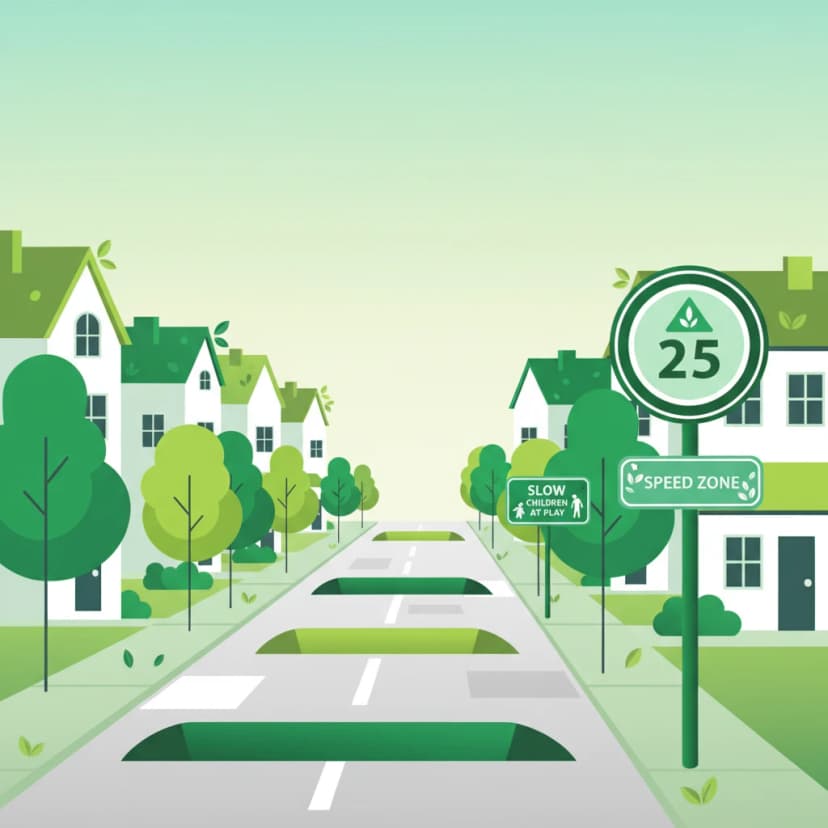
This lesson explains speed limits in specially designated zones designed to protect vulnerable road users. You will learn the rules of a 'woonerf' (home zone), where the speed limit is walking pace (max 15 km/h) and pedestrians can use the full width of the road. The content also covers 30 km/h zones, common in residential areas and around schools, which are often enforced through road design like speed bumps. Understanding the purpose and rules of these zones is key to driving responsibly in urban environments.
This lesson details the statutory maximum speeds for each Category AM vehicle: 25 km/h for snorfietsen, and 45 km/h for both bromfietsen and speed pedelecs on the carriageway. It explains how these limits apply within built-up areas, outside built-up areas, and on specific road types like residential zones ('woonerf'). The content covers how to interpret speed limit signs and the legal consequences of exceeding these strict limits, which is a key component of the CBR theory exam.

The posted speed limit is a maximum, not a target. This lesson teaches the crucial skill of adapting your speed to prevailing conditions. You will learn how to assess factors like traffic density, poor weather (rain, fog), limited visibility (at night), and slippery road surfaces. Adjusting your speed downwards in these situations provides you with more time to react to hazards and significantly reduces the risk of losing control or being involved in a collision.
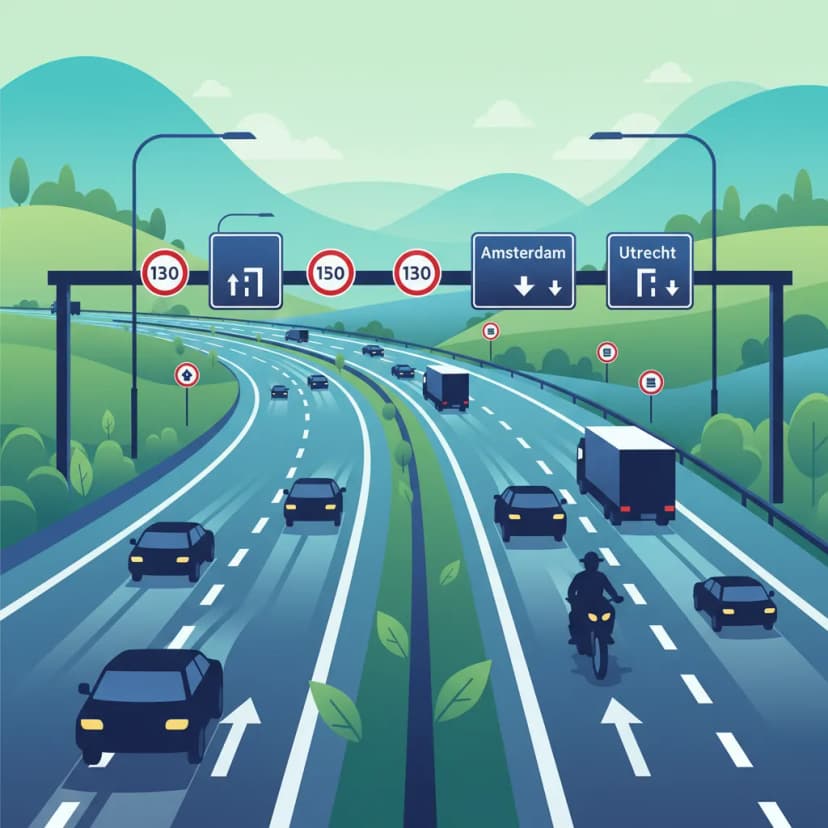
This lesson details the specific regulations for driving on Dutch motorways, identifiable by the G1 sign. You will learn the correct procedure for joining the flow of traffic using the acceleration lane and for leaving via the deceleration lane. The curriculum reinforces the 'keep right unless overtaking' rule for lane discipline. It also explains that stopping is strictly forbidden, and the hard shoulder (vluchtstrook) may only be used for genuine emergencies.
Explore how factors like weather, visibility, road design, and vehicle load influence safe riding speeds in the Netherlands. Learn to adjust speed below limits for enhanced safety and compliance with Dutch motorcycle theory.
The posted speed limit is a maximum, not a target. This lesson teaches the crucial skill of adapting your speed to prevailing conditions. You will learn how to assess factors like traffic density, poor weather (rain, fog), limited visibility (at night), and slippery road surfaces. Adjusting your speed downwards in these situations provides you with more time to react to hazards and significantly reduces the risk of losing control or being involved in a collision.
This lesson explains how to respond to variable speed limits shown on overhead electronic signs, which are used to manage traffic flow in real-time. You will learn why these limits are adjusted for factors like congestion, accidents, or bad weather, and the legal requirement to obey them. The content focuses on the importance of anticipatory riding, scanning far ahead for these signs to allow for smooth and safe speed adjustments.
This lesson focuses on the unique demands of riding at sustained high speeds on motorways ('snelwegen'). It covers essential topics such as strict lane discipline, safe overtaking procedures, and maintaining a greater following distance to compensate for higher reaction and braking times. The content also addresses the physical and mental challenges, including managing wind blast, increased noise levels, and maintaining heightened situational awareness over long distances to combat fatigue.

This lesson reinforces the critical relationship between adverse conditions, reduced traction, and massively increased stopping distances. It provides a clear framework for how much riders need to increase their following distance and reduce their overall speed to maintain a safe margin for error. The curriculum teaches riders to constantly reassess their speed based on visual feedback from the road surface and the level of visibility, ensuring they can always stop within the distance they can clearly see.
This lesson emphasizes the critical importance of adapting your speed to prevailing conditions, which may require driving slower than the legal limit. You will learn how factors like rain, fog, snow, and darkness significantly increase braking distances and reduce visibility. The curriculum explains the dangers of aquaplaning on wet roads and black ice in winter. The core principle taught is that a safe driver always adjusts their speed to ensure they can stop within the distance they can see to be clear.

This lesson explains why the standard two-second rule is insufficient in adverse conditions and requires extension. It details how factors like rain, fog, and darkness reduce both visibility and tire grip, thereby significantly increasing total stopping distance. The content provides practical guidelines, such as extending the following gap to four seconds or more in the wet, to ensure the rider always has enough time and space to stop safely, regardless of the conditions.
This lesson provides a definitive guide to the legal speed limits on different types of Dutch roads. It covers the rules for built-up areas (typically 50 km/h), rural roads (80 km/h), expressways ('autowegen'), and motorways ('snelwegen'), including time-dependent variations. Understanding these official limits is the first step in managing speed legally and appropriately for the road environment, a core topic on the CBR theory test.

This lesson revisits the concept of following distance, emphasizing its heightened importance in the high-speed motorway environment. It explains how increased speeds dramatically lengthen both reaction and braking distances, making a minimum two-to-three-second gap absolutely critical for safety. The content also stresses the importance of maintaining a space cushion to the sides, creating potential escape routes in case of sudden incidents in adjacent lanes.
This lesson details the default speed limits that apply in the absence of specific signs. You will learn to recognize the signs (H1 and H2) that mark the beginning and end of a built-up area, where the default speed limit is 50 km/h. Outside these areas, on non-highway roads, the standard limit is 80 km/h. The content explains the rationale behind these limits, which are based on factors like pedestrian density, road design, and potential hazards, ensuring you can apply the correct speed in any location.
This lesson focuses on identifying different types of speed zones and understanding the rationale behind their limits. It explains how to recognize the start and end of a 'built-up area' ('binnen de bebouwde kom') via place-name signs and discusses special zones like 30 km/h zones and 'woonerven' (residential yards). The curriculum emphasizes adapting riding style to the specific hazards present in each type of zone, from high pedestrian activity in urban areas to unexpected curves on rural roads.
Find clear answers to common questions learners have about Fixed Speed Limits and Sign Interpretation. Learn how the lesson is structured, which driving theory objectives it supports, and how it fits into the overall learning path of units and curriculum progression in the Netherlands. These explanations help you understand key concepts, lesson flow, and exam focused study goals.
BORD 50 is the standard Dutch traffic sign indicating a maximum speed limit. For motorcycles, this sign means you must not exceed the indicated speed. It's crucial to always adhere to this limit to ensure safety and comply with traffic laws.
In the Netherlands, there are default speed limits: 50 km/h within built-up areas (binnen de bebouwde kom), 80 km/h outside built-up areas (buiten de bebouwde kom), and 130 km/h on motorways (autosnelweg), although some sections have lower limits like 100 km/h or 120 km/h. Always look for specific signs.
Yes, the fixed speed limits and default limits discussed apply to all motor vehicles, including Category A2 motorcycles, unless specific signs indicate otherwise for certain vehicle types. Always check for motorcycle-specific regulations if they exist.
Higher speeds require greater following distances. Understanding and respecting speed limits helps you maintain adequate space from other vehicles, allowing more time to react and brake safely, which is especially critical on a motorcycle.
During the CBR theory exam, questions about speed limits are common. Incorrectly identifying or interpreting speed limit signs or default limits will result in a failed question. Passing requires demonstrating a thorough understanding of these rules.