
Welcome to this lesson on regulatory traffic signs, a crucial topic for your Dutch Category AM theory exam. Regulatory signs, like the essential Stop and No Entry signs, dictate legal obligations and prohibitions. Mastering these is key to navigating Dutch roads safely and passing your CBR test.

Welcome to a crucial lesson in your Dutch Driving License Theory Course for Category AM. This chapter delves into regulatory traffic signs, the fundamental pillars of road safety and law on Dutch roads. These signs are not mere suggestions; they are legally binding directives that every moped and scooter driver must understand and obey without exception.
For Category AM drivers (mopeds and scooters), a thorough grasp of regulatory signs is paramount. Your vehicle’s smaller size and reduced visibility compared to cars mean you are more vulnerable in traffic. Misinterpreting or failing to observe a regulatory sign can lead to severe consequences, including fines, legal penalties, and, most importantly, dangerous collisions. This lesson will equip you with the knowledge to correctly identify, interpret, and react to essential signs such as the B6 Stop sign and the C2 No Entry sign, ensuring you navigate Dutch roads safely and confidently.
Regulatory signs stand apart from other traffic signs because they impose a direct legal obligation or prohibition on all road users. They are the visible manifestation of traffic laws, designed to standardize behavior and prevent conflicts, particularly at high-risk locations like intersections, road entries, and specific lanes.
The core principle behind these signs is safety and predictability. By clearly indicating required or forbidden actions, they allow all road users, especially vulnerable ones like moped riders, to anticipate others' movements. This predictability is vital for creating a safe and efficient traffic flow. Failure to comply with a regulatory sign is a direct violation of the Dutch traffic regulations (Reglement Verkeersregels en Verkeerstekens, or RVV 1990) and carries immediate legal consequences.
To fully understand and correctly react to regulatory signs, several core principles must be internalized:
Every regulatory sign creates a legal duty or prohibition for drivers. This means you must treat the sign's instruction as a binding rule of the road. Disobeying these signs is a traffic offense, potentially leading to fines and points on your record.
Dutch regulatory signs use a systematic combination of shapes and colours to convey their meaning rapidly. This shape-colour coding allows for quick, pre-attentive visual processing, helping you recognize the type of instruction (e.g., prohibition, command, stop) even before reading any text or symbols. This rapid recognition is crucial for reducing reaction time and ensuring prompt, correct responses, especially important for Category AM drivers in dynamic traffic situations.
In traffic, rules sometimes overlap or appear to contradict. The hierarchy of rules dictates that regulations of a higher legal rank supersede those of a lower rank. For example, a traffic sign generally takes precedence over road markings. A police officer's instruction, however, always overrides any sign or marking. When multiple rules apply, you must always obey the most restrictive one.
Many regulatory signs are accompanied by supplementary plates (onderborden). These rectangular panels, placed beneath the main sign, add specific conditions to the regulation. They can specify times, vehicle classes, or distances. The main sign's meaning is only modified and applicable when the condition stated on the supplementary plate is met. Ignoring a supplementary plate can lead to misunderstandings and violations.
Traffic restrictions are rarely permanent for an entire road. End-of-restriction signs indicate where a previously imposed regulation terminates. Once you pass such a sign, the default rules of the road resume, and you are no longer bound by the previous restriction. Understanding these signs prevents unnecessary compliance and ensures efficient traffic flow.
Regulatory signs are broadly categorized into groups, each with a distinct visual identity and function. Understanding these categories helps in immediate identification and action.
These signs indicate actions that are forbidden. They typically feature a red circular shape with a diagonal bar or a specific symbol on a red background. The most well-known prohibitory sign is the octagonal B6 Stop sign.
When you encounter a prohibitory sign, you must not perform the action indicated. For example, a "no overtaking" sign means you are legally forbidden from passing other vehicles.
Restrictive signs impose a limit or restriction on certain actions. Like prohibitory signs, they are predominantly red circular signs, often with a symbol indicating the nature of the restriction.
These signs dictate what you cannot exceed or where you cannot go. A speed limit sign, for instance, means your speed must not surpass the indicated maximum. The C2 No Entry sign means you absolutely cannot enter the road ahead.
Mandatory signs indicate an action that must be performed. These signs are typically blue circular signs with white symbols. They direct traffic flow or designate specific paths.
When you see a mandatory sign, you must follow the instruction. For example, a "turn left only" sign means you are legally obliged to turn left. A blue circle with a bicycle symbol mandates the use of that path for bicycles and specific mopeds.
While all regulatory signs are important, some demand particular attention from Category AM drivers due to their direct impact on safety and common occurrences in urban and rural environments.
The B6 Stop sign is arguably one of the most critical regulatory signs. Its unique octagonal shape and bright red colour with white "STOP" lettering make it instantly recognizable.
Upon encountering a B6 Stop sign, you are legally obliged to bring your moped or scooter to a complete and absolute halt. This means your wheels must stop turning. You must stop before the white stop line (stopstreep) painted on the road, or, if no line is present, before the crosswalk (zebrapad) or the point where the road you are on intersects with the main road.
After stopping, you must yield to all cross-traffic on the intersecting road, as well as to pedestrians and cyclists on any crossing paths. You may only proceed when it is absolutely safe to do so, ensuring you do not impede or endanger other road users.
A frequent violation is the "rolling stop," where a driver slows down significantly but does not come to a full halt. This is illegal and dangerous, as it compromises your ability to properly observe cross-traffic and react safely. Stopping beyond the stop line is another common error that can obstruct cross-traffic or pedestrians and is also a violation.
The C2 No Entry sign is a clear directive to prevent vehicles from entering a road or area from the direction of the sign. It is a red circular sign with a horizontal white bar.
When you see a C2 No Entry sign, it means that entry into the road or lane ahead is prohibited for all vehicles, including mopeds and scooters, unless explicitly exempted by a supplementary plate. You must not proceed past this sign. This is commonly used at the exit of one-way streets, private access roads, or areas temporarily closed to traffic.
A common mistake for moped riders is assuming that a "no entry" sign applies only to cars or larger motor vehicles. Unless a supplementary plate specifically exempts mopeds or two-wheelers, the prohibition applies to you. Entering a no-entry zone is a serious violation and carries a high risk of head-on collisions, especially on one-way streets.
While B6 and C2 are paramount, Category AM drivers will frequently encounter other regulatory signs that demand strict adherence:
Supplementary plates (onderborden) are crucial for interpreting the full meaning of a regulatory sign. These rectangular plates are always placed below the main sign and provide additional conditions or exemptions. Ignoring them can lead to incorrect actions or violations.
Imagine a C3 Speed Limit sign indicating "30 km/h" with a supplementary plate showing "07:00 – 19:00." This means the 30 km/h limit is only in effect during these hours. Outside this period, the general speed limit for the area applies, which could be 50 km/h.
End-of-restriction signs are vital for knowing when a specific traffic rule no longer applies. These signs are typically circular with a grey or white background and a single diagonal black slash (or multiple slashes for "end of all local restrictions").
When you pass an end-of-restriction sign, you should revert to the default traffic rules or any other overriding signs for that area. For example, after an "End of 30 km/h speed limit" sign, you would typically resume the general 50 km/h urban speed limit, unless another speed limit sign is immediately visible.
A common error is continuing to obey a restriction even after an end-of-restriction sign has been passed. This can unnecessarily slow traffic, disrupt flow, and lead to other drivers attempting to pass you in an unexpected manner, creating potential risks.
Every regulatory sign is underpinned by specific articles within the RVV 1990 (Reglement Verkeersregels en Verkeerstekens), the comprehensive Dutch traffic regulations. Adhering to these articles is a legal obligation.
Always remember that specific articles within the RVV 1990 may be amended. While the core principles remain, staying informed about recent traffic law updates is important for all drivers.
Ignoring or misinterpreting regulatory signs can have serious repercussions. Here are some frequent violations relevant to Category AM drivers:
The interpretation and required action for regulatory signs can be influenced by various contextual factors. Safe driving means adjusting your behavior to these conditions.
Understanding regulatory signs is about knowing the direct outcome of your actions.
| Scenario | Correct Follow-through | Result (Safety/Legal) | Violation Outcome |
|---|---|---|---|
| Driver stops fully at B6 | Vehicle halted before crosswalk; pedestrians cross safely | No collision, legal compliance, no penalty | Rolling stop → possible collision, fine, points |
| Driver respects C2 No Entry | Moped turns away; avoids entering one-way traffic | Safe traffic flow, no violation | Enters prohibited lane → head-on collision risk, fine, points |
| Driver obeys time-limited C3 | Adjusts speed only during specified hours | Optimized traffic flow, legal compliance | Disregards time limit → unnecessary slowdown or illegal excess speed |
| Driver follows D3 Turn Left | Moped follows left-turn arrow, merges safely | Predictable movement, safe lane use, no violation | Ignores D3 → wrong-way travel, collision risk |
| Driver uses mandatory cycle path | Moped uses designated path, stays off main road | Enhanced safety for moped and other road users | Rides on main road → increased collision risk, fine |
Regulatory signs are not arbitrarily placed. Their design, placement, and legal backing are deeply rooted in traffic safety research and psychological principles.
This comprehensive understanding of Dutch regulatory signs is a cornerstone of safe driving and crucial for passing your Category AM theory exam. By internalizing these rules, principles, and common pitfalls, you will be well-prepared to navigate Dutch roads responsibly and confidently on your moped or scooter.
Lesson content overview
Explore all units and lessons included in this driving theory course.
Explore search topics learners often look for when studying Regulatory Signs (e.g., B6 Stop, C2 No entry). These topics reflect common questions about road rules, driving situations, safety guidance, and lesson level theory preparation for learners in the Netherlands.
Browse additional driving theory lessons that cover connected traffic rules, road signs, and common driving situations related to this topic. Improve your understanding of how different rules interact across everyday traffic scenarios.
Explore how Dutch regulatory signs, such as Stop and No Entry, apply in various real-world contexts. Learn about adaptations needed for different weather, road types, and interactions with vulnerable users.
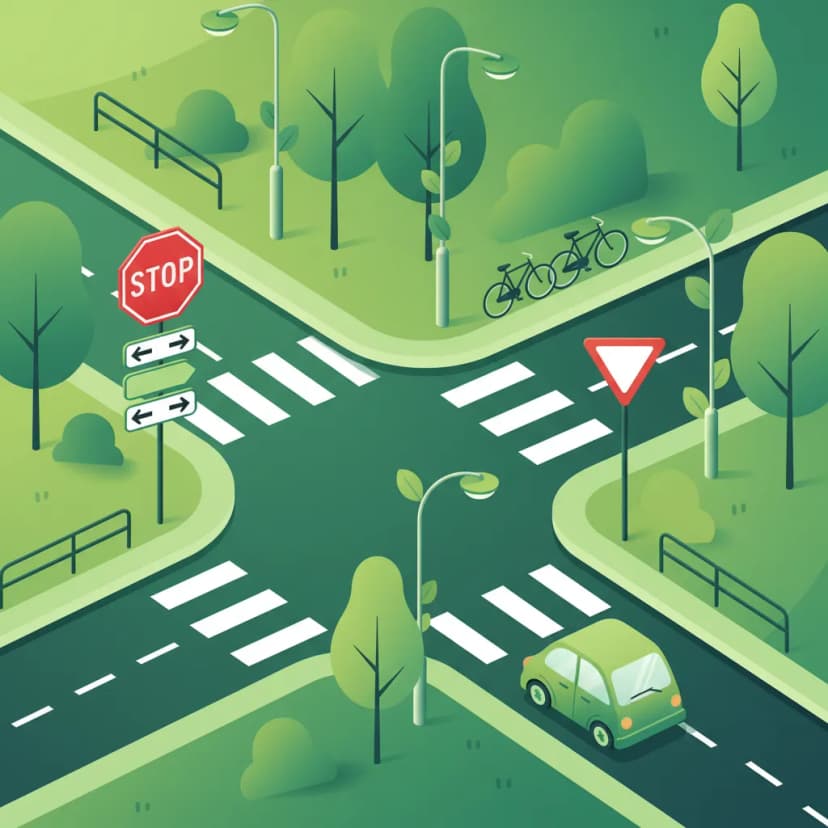
This lesson focuses on regulatory signs, which impose legal obligations on drivers and are essential for maintaining traffic order. You will learn to identify and act upon fundamental signs such as the octagonal B6 Stop sign, the diamond-shaped B1 Priority Road sign, and various compulsory direction arrows. The content explains the legal implications of these signs, detailing when a driver must stop completely, when they have priority, or the required path they must follow. Understanding these commands is crucial for safe and lawful driving at intersections and on designated routes.
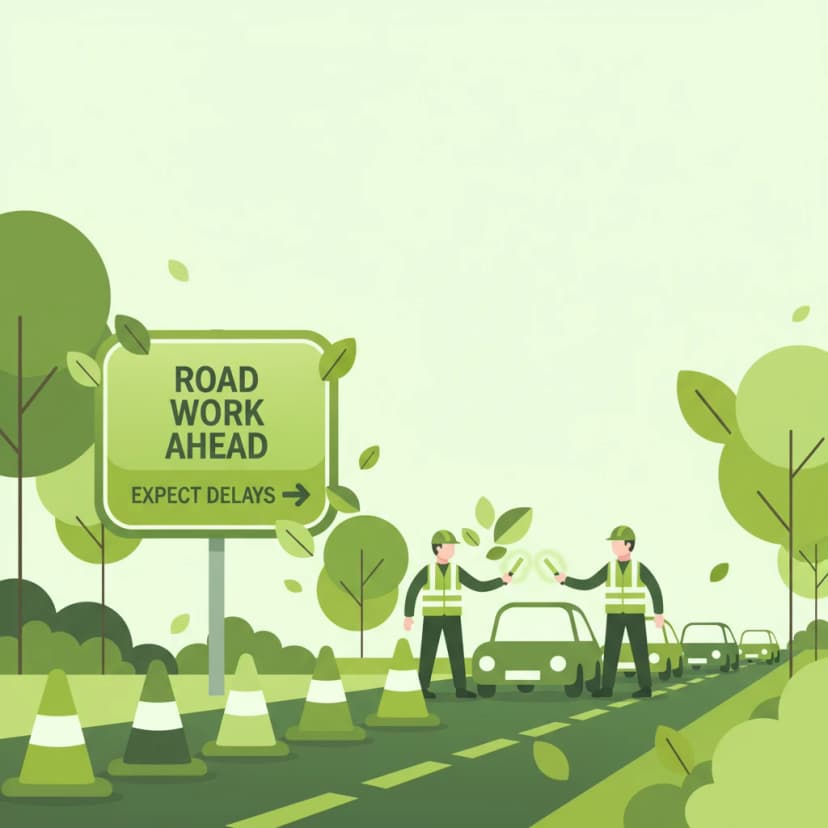
This lesson prepares you for encountering road works, a common feature on any road network. You will learn that signs and markings related to road works are often yellow and that they temporarily override permanent white markings and signs. The curriculum stresses the importance of adhering to temporary speed limits, being alert for workers and machinery, and navigating narrowed lanes. It also covers how to follow diversion routes ('omleiding') and obey instructions given by traffic controllers.

This lesson introduces warning signs, which are designed to alert drivers to potential dangers or changes in road layout ahead. You will learn to interpret the triangular-shaped signs that indicate hazards such as sharp curves, slippery road surfaces (J27), or upcoming road works (J8). The curriculum explains how these signs help in anticipating risks and adjusting driving behavior accordingly, such as reducing speed or increasing alertness. A thorough understanding of warning signs is vital for proactive and defensive driving in various environments.
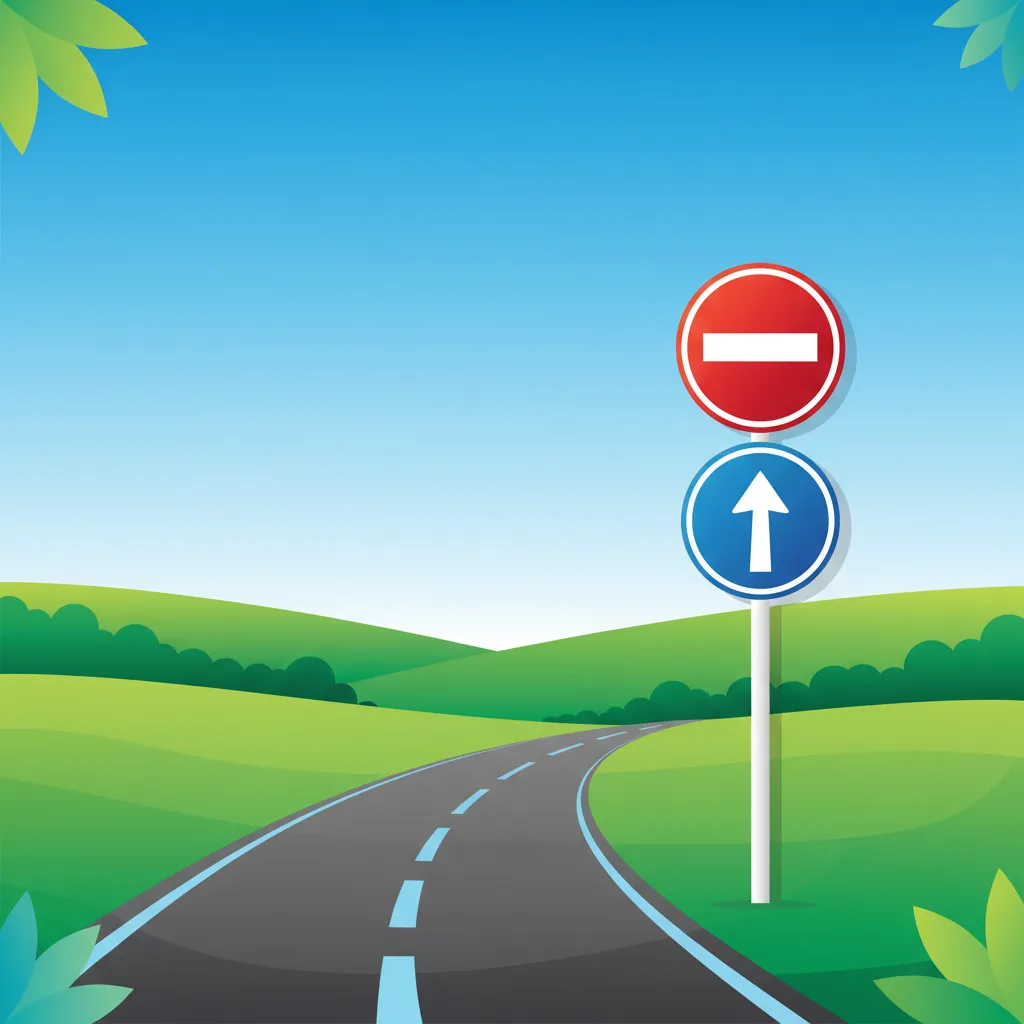
This lesson offers an in-depth study of Dutch regulatory signs, which impose mandatory actions or prohibitions on road users, with a specific focus on their impact on motorcyclists. It explains the visual language of prohibition symbols ('verbodsborden') and obligation symbols ('verplichtingsborden'), the contexts in which they appear, and the strict statutory consequences of non-compliance. Real-world examples are used to illustrate how these signs directly influence route planning, overtaking decisions, and speed management.
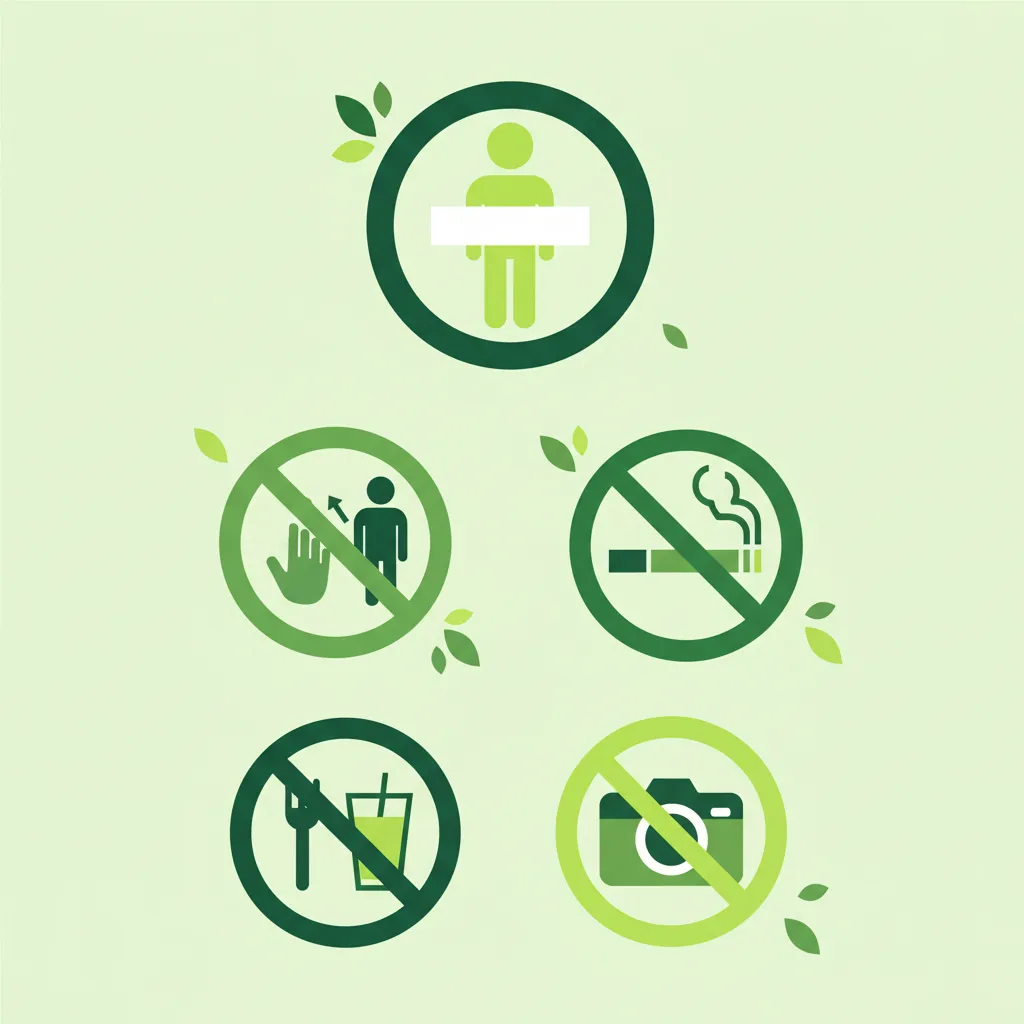
This lesson covers prohibition signs, which are used to forbid specific maneuvers or restrict access for certain vehicles. You will study the characteristics of these signs, typically circular with a red border, such as the C2 'No Entry for any vehicle' or the F1 'No Parking' sign. The content details the legal consequences of ignoring these prohibitions and explains how they contribute to traffic flow and safety in congested or sensitive areas. Recognizing these signs is fundamental to avoiding fines and dangerous situations on the road.
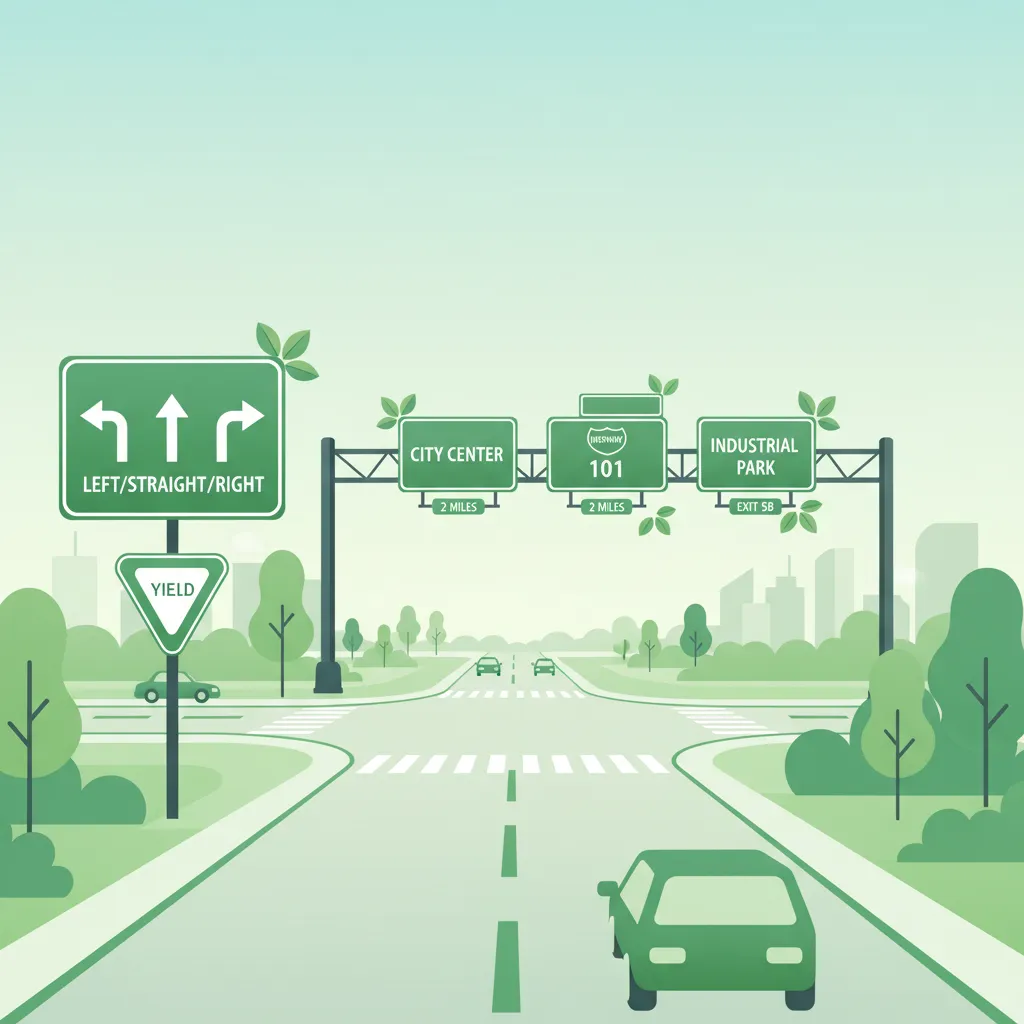
This lesson focuses on the array of signs used to manage traffic at intersections and along multi-lane roads. You will learn to interpret overhead gantry signs, lane designation signs, and markings that guide drivers into the correct lane for their intended direction. The curriculum covers signs indicating priority at upcoming junctions, such as the B3 and B4 signs, which clarify right-of-way rules in complex scenarios. Proper interpretation of these signs is essential for smooth lane changes, efficient navigation, and preventing conflicts at junctions.
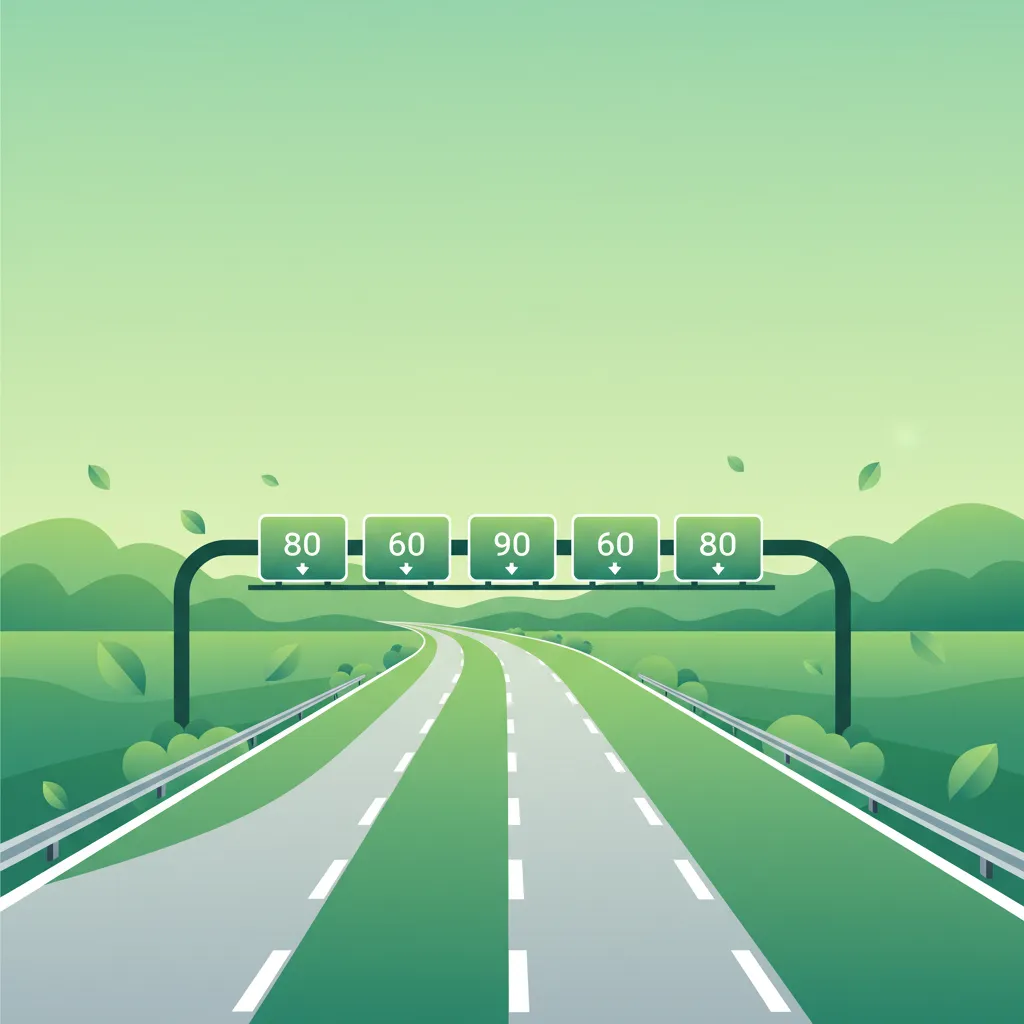
This lesson explains how to respond to variable speed limits shown on overhead electronic signs, which are used to manage traffic flow in real-time. You will learn why these limits are adjusted for factors like congestion, accidents, or bad weather, and the legal requirement to obey them. The content focuses on the importance of anticipatory riding, scanning far ahead for these signs to allow for smooth and safe speed adjustments.
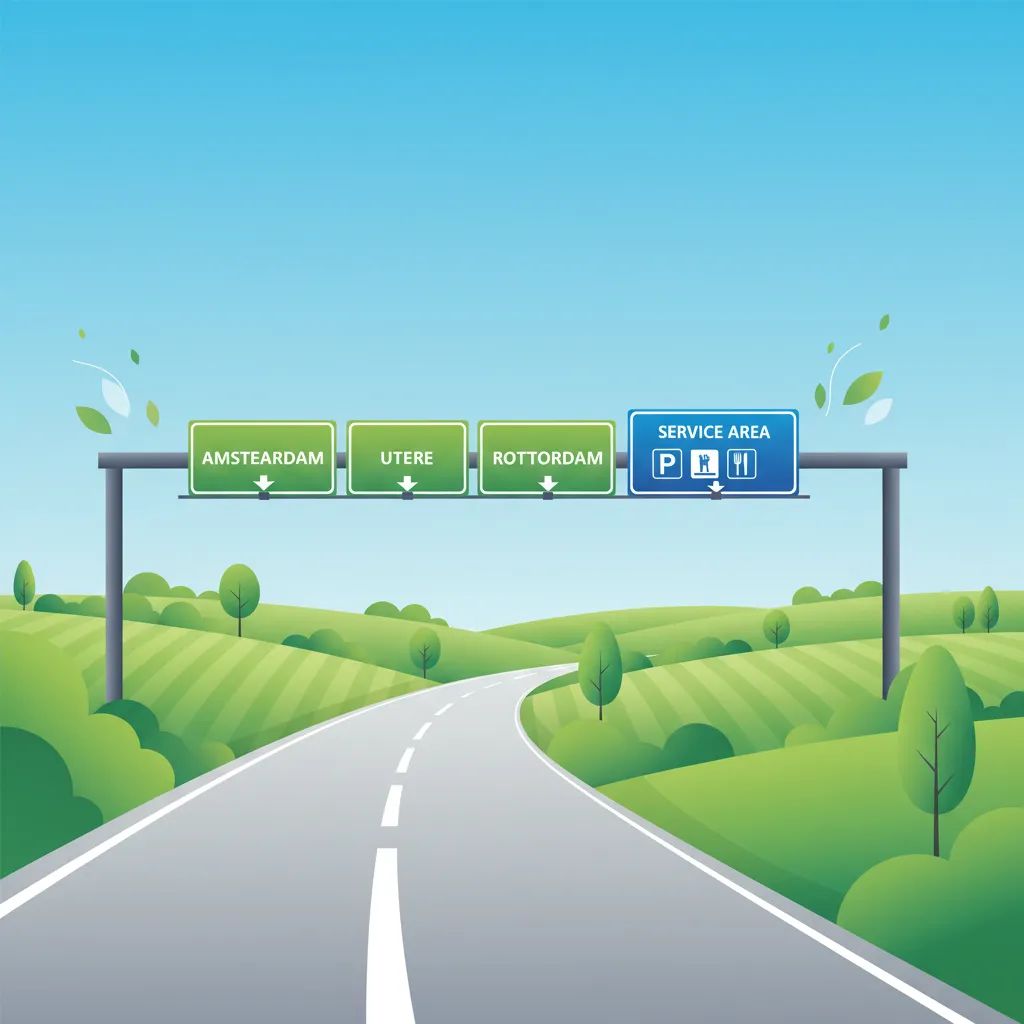
This lesson explains how to interpret informational signs that provide guidance and navigational aid. You will learn to read directional signs indicating cities and locations, understand route numbering on major roads, and recognize signs for services like fuel stations or parking areas. It also covers the signs that mark the beginning and end of a built-up area ('bebouwde kom'), which have important implications for speed limits and traffic rules.

This lesson covers the full range of lights and signals required on a vehicle for visibility and communication. You will learn about the mandatory requirements for headlights, taillights, brake lights, indicators, and reflectors. The curriculum emphasizes the driver's legal responsibility to ensure all lights are clean and functional before every journey. The correct use and function of the horn as an audible warning device in case of imminent danger are also explained.

This lesson focuses on Dutch regulatory signs that enforce mandatory rules and restrictions, particularly those impacting A2 motorcyclists. You will learn to recognize and obey prohibition signs, such as those indicating a motorcycle ban (BORD 40), speed limits, and overtaking restrictions (BORD 21). The content explains the legal consequences of non-compliance and how to apply these rules in practical riding scenarios to ensure full adherence to Dutch traffic law.
Understand the full legal force of Dutch regulatory signs like Stop (B6) and No Entry (C2). Learn what actions are prohibited and mandatory as per RVV 1990, with details on supplementary plates and end-of-restriction signals.
This lesson offers an in-depth study of Dutch regulatory signs, which impose mandatory actions or prohibitions on road users, with a specific focus on their impact on motorcyclists. It explains the visual language of prohibition symbols ('verbodsborden') and obligation symbols ('verplichtingsborden'), the contexts in which they appear, and the strict statutory consequences of non-compliance. Real-world examples are used to illustrate how these signs directly influence route planning, overtaking decisions, and speed management.
This lesson covers prohibition signs, which are used to forbid specific maneuvers or restrict access for certain vehicles. You will study the characteristics of these signs, typically circular with a red border, such as the C2 'No Entry for any vehicle' or the F1 'No Parking' sign. The content details the legal consequences of ignoring these prohibitions and explains how they contribute to traffic flow and safety in congested or sensitive areas. Recognizing these signs is fundamental to avoiding fines and dangerous situations on the road.
This lesson focuses on regulatory signs, which impose legal obligations on drivers and are essential for maintaining traffic order. You will learn to identify and act upon fundamental signs such as the octagonal B6 Stop sign, the diamond-shaped B1 Priority Road sign, and various compulsory direction arrows. The content explains the legal implications of these signs, detailing when a driver must stop completely, when they have priority, or the required path they must follow. Understanding these commands is crucial for safe and lawful driving at intersections and on designated routes.
This lesson focuses on Dutch regulatory signs that enforce mandatory rules and restrictions, particularly those impacting A2 motorcyclists. You will learn to recognize and obey prohibition signs, such as those indicating a motorcycle ban (BORD 40), speed limits, and overtaking restrictions (BORD 21). The content explains the legal consequences of non-compliance and how to apply these rules in practical riding scenarios to ensure full adherence to Dutch traffic law.
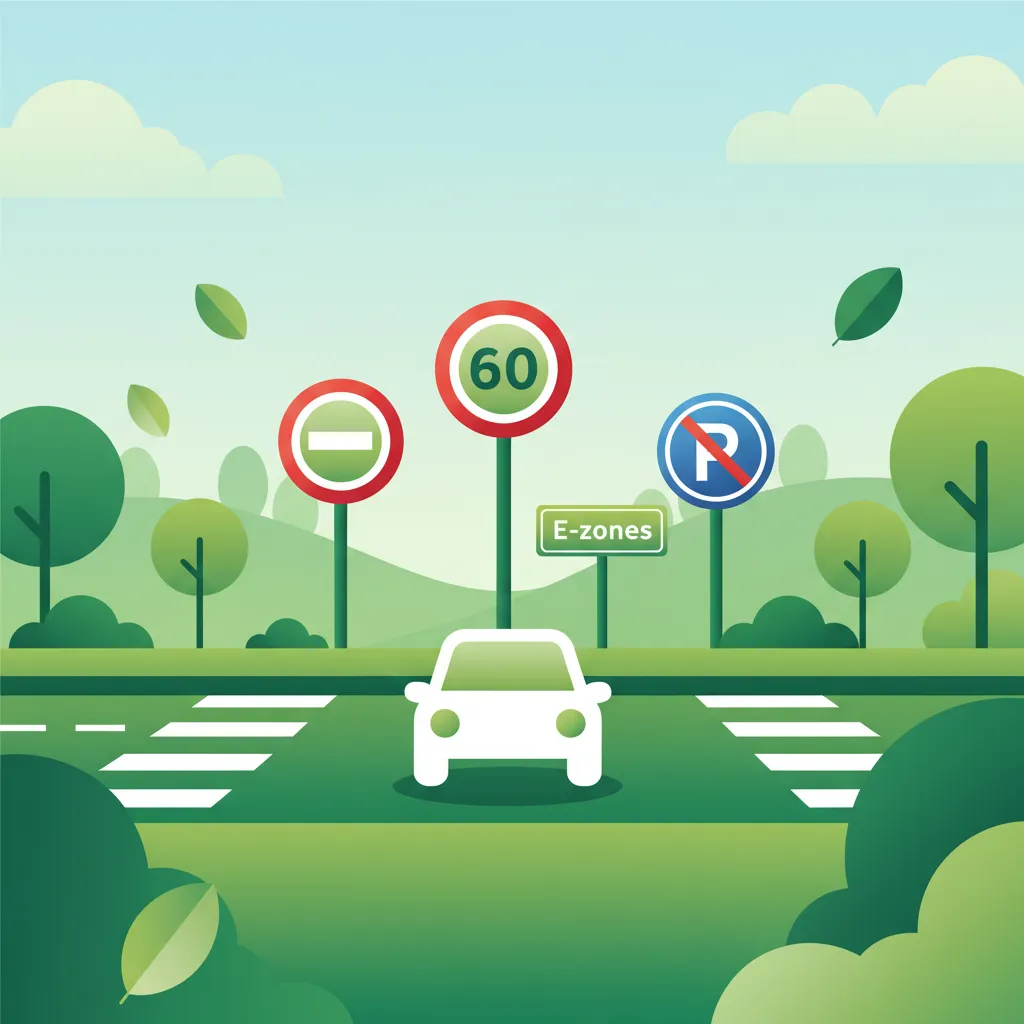
This lesson focuses on C-code regulatory signs, which impose legal obligations and prohibitions on road users. Learners will study signs that establish speed limits, forbid entry, mandate specific directions, and restrict overtaking or parking. Understanding these signs is non-negotiable for legal compliance and safety, as they form the basis of traffic regulation and are a major component of the CBR theory exam for motorcyclists.
This lesson introduces warning signs, which are designed to alert drivers to potential dangers or changes in road layout ahead. You will learn to interpret the triangular-shaped signs that indicate hazards such as sharp curves, slippery road surfaces (J27), or upcoming road works (J8). The curriculum explains how these signs help in anticipating risks and adjusting driving behavior accordingly, such as reducing speed or increasing alertness. A thorough understanding of warning signs is vital for proactive and defensive driving in various environments.
This lesson covers the full range of lights and signals required on a vehicle for visibility and communication. You will learn about the mandatory requirements for headlights, taillights, brake lights, indicators, and reflectors. The curriculum emphasizes the driver's legal responsibility to ensure all lights are clean and functional before every journey. The correct use and function of the horn as an audible warning device in case of imminent danger are also explained.
This lesson explains how to interpret informational signs that provide guidance and navigational aid. You will learn to read directional signs indicating cities and locations, understand route numbering on major roads, and recognize signs for services like fuel stations or parking areas. It also covers the signs that mark the beginning and end of a built-up area ('bebouwde kom'), which have important implications for speed limits and traffic rules.
This lesson details the purpose and visual design of Dutch warning signs ('gevarendriehoeken') that alert riders to potential hazards ahead. It covers a wide range of scenarios, from road narrowing and dangerous curves to construction zones and the risk of falling rocks, emphasizing the need for early anticipation and speed adaptation. The content also explains how these warning signs integrate with other traffic information to help a rider form an accurate risk assessment and make safer decisions.

This lesson focuses on informational signs that guide motorcyclists in navigation, route planning, and locating essential services while on the road. It examines the standardized symbols and color-coding for directions ('richtingsborden'), destinations, distances, and amenities, explaining how these signs support efficient and safe travel. Learners will understand how to use this information for strategic route selection, especially on long journeys or in unfamiliar areas, ensuring a smooth and predictable trip.
Find clear answers to common questions learners have about Regulatory Signs (e.g., B6 Stop, C2 No entry). Learn how the lesson is structured, which driving theory objectives it supports, and how it fits into the overall learning path of units and curriculum progression in the Netherlands. These explanations help you understand key concepts, lesson flow, and exam focused study goals.
The B6 'Stop' sign (usually octagonal and red) legally requires you to come to a complete stop, regardless of traffic. You must always stop behind the stop line or at the edge of the intersection. The A1 'Yield' sign (usually an inverted triangle) requires you to give way to other traffic but does not mandate a full stop unless necessary to do so safely.
The C2 'No Entry' sign, typically a red circle with a white horizontal bar, means you are forbidden to enter the road or area. This applies to all vehicles, including mopeds and scooters (bromfietsen and snorfietsen), unless specific supplementary signs indicate otherwise (e.g., allowing cyclists or mopeds). Always respect this sign to avoid contravening traffic laws.
Yes, the 'Stop' sign (B6) legally requires a complete stop. Even if the road appears clear, you must bring your vehicle to a standstill before proceeding. This is a common question in the CBR theory exam, testing your understanding of strict adherence to mandatory signs.
Generally, the 'No Entry' sign (C2) is absolute. However, sometimes supplementary signs are placed below it. These might exempt specific vehicles like bicycles or mopeds, or indicate a specific time period. Always check for any additional signs that modify the C2 sign's instruction.
Regulatory signs (like Stop and No Entry) impose a legal requirement or prohibition. They command you to do something or not do something. Warning signs, typically triangular, alert you to potential hazards ahead, requiring caution and anticipation but not always a specific, immediate action like stopping.